Brand Guidelines Deliverables Startups Should Request
Match what you buy to your stage: credibility, then sales tools, then governance.

The brand guidelines deliverables a startup should request depend on its stage. Before demand is proven, buy credibility. When sales start, buy tools that help the team sell. At Series A, buy a governed system that keeps execution consistent. Buying too soon wastes runway, but buying too little leaves each new hire to invent the brand again.
Why the stage of a startup determines which brand deliverables are worth buying
A founder buys a 60-page brand book before product-market fit, then changes how the company is positioned. The book now describes a business that no longer exists. Its polish does not make it useful. The failure was buying something built to preserve decisions while those decisions were still changing.
The reverse failure starts with a logo-only handoff. It looks good enough until a second person starts making decks, posts, or sales documents without any shared rules. Each person fills the gaps differently. Guidelines are the transfer mechanism between the founder and the first marketing hire, agency, or AI tool. The scope should match what those people need to reproduce, rather than the founder’s hope of solving branding permanently.
The three-phase brand maturation ladder and what moves a startup between stages
The three phases follow changes in the company’s work. Phase 1 is about looking credible while demand remains unproven. Phase 2 begins when the startup is selling and needs a growing team to explain its offer consistently. Phase 3 addresses consistency across a larger organization, multiple products, and investor and enterprise scrutiny. Each phase answers a different operating risk.
Funding labels help locate the company, but they are not the only test. A repeatable offer is an important transition point. The startup can explain it in one sentence, and buyers repeat it back. When the company makes its first marketing or design hire, it needs shared rules, while raising a Series A calls for a system that holds up as more people use it.
Skipping ahead still leaves the earlier work to do. It embeds unsettled decisions in more assets, which then need rebuilding when those decisions change. Staying behind creates the opposite problem, as more people work without enough direction. Identify your phase before reading further.
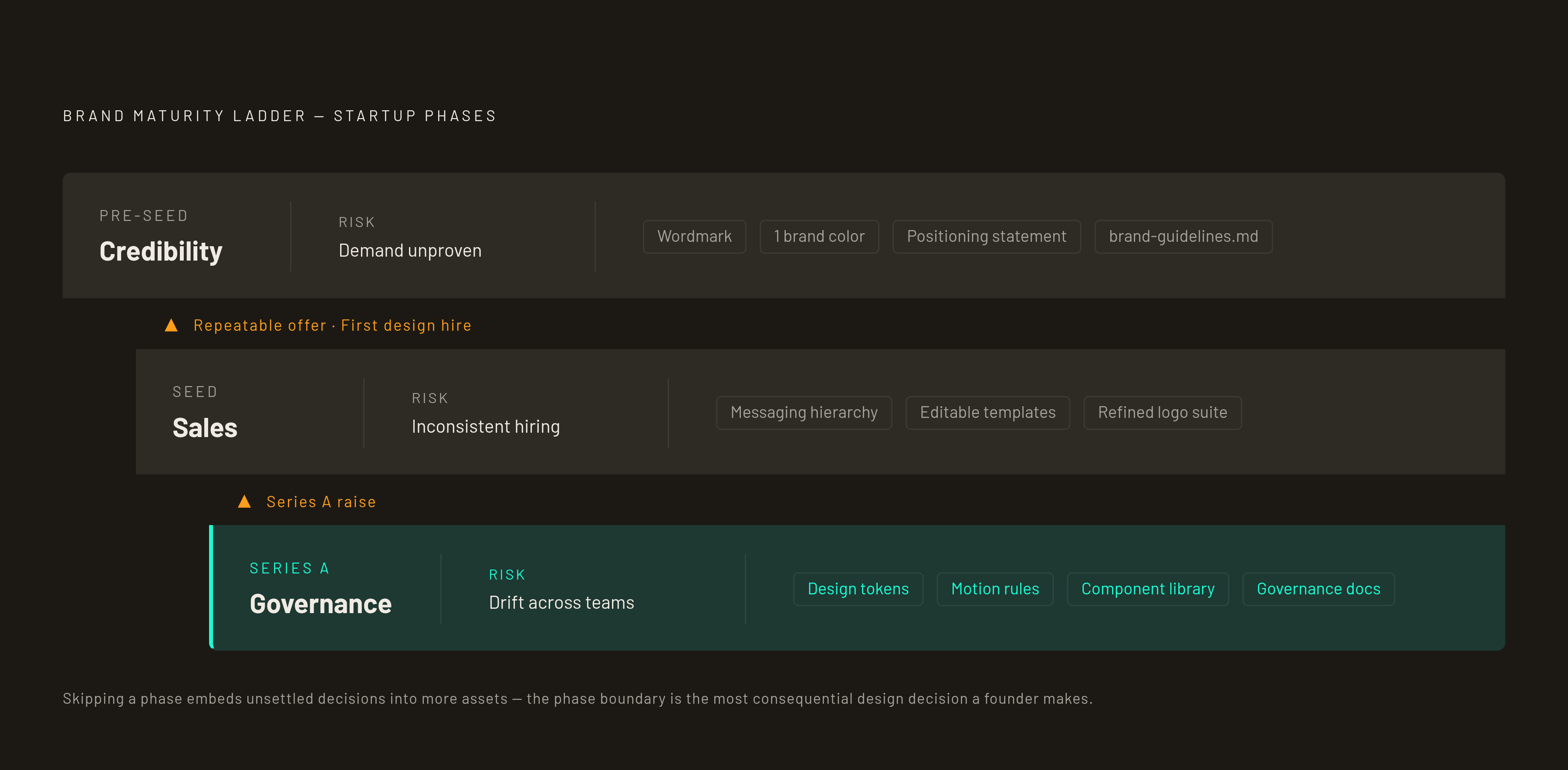
Phase 1 deliverables: what a pre-seed startup actually needs to look like a real business
Before demand is validated, the brand’s job is limited. It needs to make the business look credible enough that potential customers do not walk away. Request a wordmark typeset in a classic typeface, one brand color, and a favicon or social avatar. A solid-color square is sufficient for the avatar. One free typeface, such as Geist or Inter, and a stock-template landing page with a contact form and email capture complete the basic presence.
The words need just as much discipline. Request a one-sentence positioning statement, a short elevator pitch, and three proof points. Add a one-paragraph ideal customer profile so hires, agencies, and AI prompts all speak to the same person. A brand archetype and three tonal attributes, each with do/don’t pairs, show contractors and AI tools what to do. Five sample headlines and the elevator pitch show what that direction sounds like in practice.
Keep the handoff small enough to maintain. Use one well-organized folder with a README, font files, and usage notes in place of a 47-page PDF. A brand-guidelines.md file gives the team readable guidance that AI tools can parse and version control can track. Source file ownership also needs explicit attention. Request AI, EPS, and SVG source files as well as JPEGs, because the ability and right to modify the identity are operational and legal dependencies.
Skip a logo symbol, comprehensive brand book, design tokens, motion guidelines, component libraries, and anything that needs a system to enforce it. These solve later-stage problems, and buying them now ties budget to decisions that may not survive product-market fit.
Phase 2 deliverables: the 80/20 brand system a seed-stage startup needs to close deals and hire well
Once the startup is selling, its messaging helps the sales team do its work. A prospect needs to understand the offer, believe its claims, and get answers to objections. Request a structured positioning statement covering category, ideal customer profile, outcome, timeframe, and differentiation. A brand promise, proof points, and an objection-handling framework turn that statement into material the sales team can use. This is more useful than visual polish that leaves the offer unclear.
Request 3–5 named attributes, do/don’t pairs, and rules for how tone changes across contexts. Legal copy can be formal while social copy is casual and alerts are urgent. A behaviorally specific core values statement helps prospective hires understand the company beyond its aspirations. Examples of on-brand writing make those choices usable by people who did not help create them.
Request editable masters for a pitch deck and one-pager, plus social templates pre-sized for each platform. Flat images are not substitutes for editable files. For SaaS companies, guidance on a 60-second product story also connects the identity to an actual sales conversation. These deliverables let the team explain the same offer across content, video, and sales collateral without starting over.
The visual work should be a refinement. Request a refined wordmark and, if useful, a simple symbol. The logo suite should include a primary logo, vertical and horizontal secondary versions, and a favicon or submark. Handoff formats should include AI, EPS, and SVG vector originals, transparent PNGs in multiple sizes, JPGs for non-transparent uses, and a print-ready PDF.
A concise guide should connect those assets to rules. It needs a short brand overview, logo spacing and misuse examples, color roles and specifications, type specifications, basic layout and imagery rules, and voice guidance. A well-organized Notion doc, Google Slides deck, or Figma file is enough. An asset kit should also show how to style icons, choose photos, and follow basic motion rules. The aim is a small system people actually follow.
Phase 3 deliverables: the governed brand system a Series A startup needs to scale without breaking
At Series A, clarity alone is no longer enough. The identity has to remain coherent across more people, products, and surfaces. Request a wordmark and symbol with a clear usage hierarchy, an extended palette with assigned color roles, and type scales for web, product, and print. Motion deliverables should include logo animation for intros and loaders, easing curves, and duration ranges. These rules define repeatable behavior rather than leaving each execution open to interpretation.
The technical handoff needs equal care. Request design tokens exported in a standard format, a Figma library with published components and variables, a documented naming convention, and a live handoff with engineers. For product companies, a small core UI library should cover buttons, cards, inputs, and tables. Sample product screens should show typography, color, and spacing in use, with microcopy guidance for labels, errors, and empty states. Brand architecture should set out products, tiers, sub-brands, and naming on their own.
Governance is what makes this a working system. The deliverables should name who approves what, set service-level agreements for brand reviews, and define an intake process for new requests. Without those decisions, even a larger asset library leaves people unsure who has the final say. A digital asset management library or template hub makes approved materials findable. A press kit, media pack, and partnerships and co-marketing toolkit extend that control to work outside the company.
These are operating deliverables. A tokenized system with documented component mappings signals that the team can ship quickly without breaking its identity. Unversioned Figma pages offer no equivalent assurance.
Motion and design tokens: the two deliverables most commonly missing from agency proposals
Motion and design tokens are common gaps in proposals that otherwise look complete. Motion defines how the brand behaves over time. Without shared rules, animators and developers make independent choices, even when they use the same logo and colors. At Phase 2, a paragraph stating how the brand moves can be enough. A mature system needs logo animation for intros and loaders, easing curves, and duration ranges.
In plain terms, they give shared design values documented names that design and engineering can use. The handoff is not just a page of swatches. It includes a standard-format token set, a naming convention, published variables, and the engineer handoff needed to put them to work.
Neither deliverable should hide behind the word “comprehensive.” Their absence means the scope is closer to Phase 1 or Phase 2, regardless of the package name. That may be appropriate for the company’s stage. The audit should check whether motion rules and design tokens each have their own line item.
What inconsistent brand deliverables signal to investors and enterprise buyers
A pitch deck has different color values from the website, and the marketing materials use a different font. The inconsistency is visible before anyone examines the business closely. An over-hedged tagline adds uncertainty about the offer itself. At pre-revenue stage, a growing collection of logo variants can send another unwelcome signal, that spending runway on identity options left the company’s needed work underfunded.
Enterprise buyers look at these gaps with a longer relationship in mind. When a vendor’s own materials vary, buyers may doubt that it can keep its product and support up to the same standards over time. Cohesion across the deck, website, demo, and one-pager gives the buyer fewer reasons to question how the company operates. Phase 3 governance is therefore part of both the commercial handoff and the design handoff.
Candidates also need a readable point of view. Top engineers and PMs can use brand clarity as a proxy for organizational coherence when comparing offers. That clarity has to exist somewhere they can read it. A specific voice and behavior-based values give candidates something firmer to assess than a polished identity with no clear position behind it.
How to audit a brand agency proposal before signing
Start with what the final handoff contains. Source file ownership is the first gate. Check that the scope includes AI, EPS, and SVG vector files as well as exported images. Then ask where the guidelines will live and how the team will use them. A machine-readable markdown file, Notion doc, or working Figma library is more useful than a PDF left to drift in Google Drive.
For Phase 1, ask whether the proposal has positioning, a voice definition, and source files that are in order. Tokens, motion systems, and component libraries are work for a later stage. For Phase 2, ask whether it includes a messaging hierarchy, editable template masters, assigned color roles rather than swatches alone, and a concise guide. Confirm that social templates are pre-sized for their platforms.
For Phase 3, ask whether the scope names standard-format tokens, motion rules, governance documentation, an asset library or template hub, and a live engineer handoff. Brand architecture needs an explicit place, too. Product and sub-brand naming should not remain an unresolved task after delivery. For SaaS companies, Phase 2 and Phase 3 proposals should also name the pitch deck template, one-pager, and guidance for a 60-second product story.
Building everything once may sound cheaper than revisiting it. Before product-market fit, however, a full system preserves positioning that may change and creates more documentation to update. The goal is the right phase, the right deliverables, and a handoff the company can use, enforce, and build on.