Brand Messaging Frameworks Agencies Use for SaaS
Match each messaging framework to the gap it actually fixes.

SaaS brand messaging frameworks put positioning decisions into words buyers recognize from their own lives. The right framework depends on what is missing, whether that is a clear market category, a reason to act, or a homepage people understand. The job is to resolve the gap and take that decision through every buyer-facing asset.
Why SaaS messaging fails before a sales rep enters the room
SaaS companies often write in language that satisfies their own teams and leaves buyers struggling to understand the product. The founder talks about the vision, sales talks about the deal, and customer success talks about how people use the product day to day. All three may sound reasonable in isolation. But without a shared positioning decision, the homepage and sales decks inherit different answers to the same basic question about what the product is for.
Visitors may reach the homepage yet leave unable to explain the product back. A message that cannot establish relevance costs more than a click, because it can close off a deal before a conversation starts. Copywriting alone cannot fix that upstream failure.
AI makes the problem harder to contain. Given incomplete positioning, a content system can fill the gaps with polished language that changes the target buyer or turns a feature into an unsupported promise. Buyers also find brands more often through AI search tools before they visit a website, and messages about specific outcomes give those systems something more concrete to retrieve than broad descriptions of features. Clarity now has to survive beyond the page.
What a messaging framework actually does — and what it does not do
A messaging framework documents what a company says, to whom, and why the buyer should care. It sits above individual assets. Positioning sets out where the product fits in the market, what buyers compare it with, and why it wins. Messaging puts that choice into words buyers understand, while brand messaging carries the company’s voice, point of view, and story to the different groups it speaks to.
These layers are connected, but they are not interchangeable. A market category is not a homepage headline, and a company story does not settle which customers value the product most. Confusing those jobs makes framework-collecting look productive. A Notion workspace full of methods produces little if none of them changes what buyers see.
A method passes the test when it makes a team choose, gives them a story someone can retell, and keeps that story clear across assets and AI tools. The sales motion also shapes that test. Product-led SaaS needs to make the use case and first value obvious, while sales-led SaaS needs to make a conversation feel worthwhile. Enterprise messaging must establish risk reduction and strategic fit, and vertical SaaS must express what buyers in its market struggle with better than horizontal alternatives.
April Dunford's positioning method — resolving the wrong reference frame
April Dunford’s method starts with the comparison buyers actually make. That is often where the expensive mistake lives. A team may argue against another software vendor when the buyer is deciding whether to keep a spreadsheet or change anything at all. Until that reference frame is right, a sharper headline can sharpen the wrong argument.
The method links five parts, starting with competitive alternatives and the unique attributes those alternatives do not have. It then connects those attributes to value, identifies the best-fit customers who care most about that value, and establishes the market category that makes it obvious.
Redgate Software shows what that change can accomplish. Customers said they were too busy with DevOps transformations to buy, so Redgate used Dunford’s method to develop the concept of “database DevOps.” Its tools became part of the transformation, easing the competing demand on buyers’ time. The repositioning produced a large uptick in inbound leads.
The consequences can extend well beyond marketing. Dunford’s repositioning of a database product from a spreadsheet alternative to an embeddable database reshaped pricing, the sales motion, and the product roadmap. But the method stops short of writing the story. It establishes where the product stands, leaving the narrative work to follow.
Andy Raskin's Strategic Narrative — giving the positioning a "why now"
Andy Raskin’s Strategic Narrative gives an established position a reason to move now. It begins with a shift in the buyer’s world. The story shows who wins and loses as that shift unfolds, makes a better future tangible, and presents the product as a path toward it. Features enter as “magic gifts,” with evidence presented last.
This is a story a champion can retell. That makes it useful for a CEO keynote or an enterprise sale, where the people deciding may never speak directly with the vendor. Once positioning is settled, the narrative connects the product’s role to a change that has strategic weight for the buyer.
Its strength is also its boundary. A board-level story is not a homepage system, and a persuasive deck does not automatically produce clear emails or useful product pages. The next task is to make that story work at the level of a buyer’s visit.
Donald Miller's StoryBrand — reorienting the homepage around the buyer
The StoryBrand framework makes the buyer the hero and the company the guide. Its SB7 structure follows a character with a problem who meets a guide, receives a plan and a call to action, avoids failure, and reaches success. That structure interrupts a familiar homepage habit of talking about the company before explaining the buyer’s problem.
A fictional CPQ tool called QuoteSphere AI makes the application concrete. The hero is a VP of Sales losing deals to slow, inaccurate quoting, while the tool takes the guide’s role as an expert in sales automation. “Start Your Free Trial” or “Book a Demo” supplies the next step. Failure means missed quotas, team burnout, and lost revenue, while success means shorter sales cycles and higher close rates.
StoryBrand is especially useful for early-stage SaaS whose visitors cannot explain the product back because it directs attention toward the buyer’s outcome. But its single-hero structure is harder to use with an enterprise buying committee whose members have different ideas of success. It also does not force a positioning decision, so a team can end up with a more readable version of the same confusion.
Jobs-to-be-Done — surfacing why buyers actually switch
Jobs-to-be-Done gives the narrative methods the research they need, while leaving the work of arranging a message to them. It asks why a buyer fires one solution and hires another, or decides to stay with the current approach. A persona describes who the buyer is. JTBD seeks the causal explanation for the purchase, including the struggle that makes change worth considering.
That distinction is especially useful when the alternative is doing nothing. A product team may be proud of its features, but those features are not necessarily the reason someone changes tools. Interviews can reveal that the real alternative is a spreadsheet, even when the sales deck names a competitor. That finding changes the reference frame Dunford’s method works from and the outcome the narrative needs to express.
The research can reveal the buyer’s desired progress, but it does not turn that insight into a homepage or a sales story by itself. Teams still have to connect the findings to a messaging structure.
How the strongest SaaS brands combine these moves in practice
Clear SaaS messaging often brings category, conflict, and outcome together. The pieces reinforce each other. A category tells buyers what they are looking at, a named enemy gives them something to leave behind, and a promised outcome gives the change a purpose.
Salesforce made “software” inside a red circle with a slash through it a marketing emblem, arguing for a better CRM and against on-premise software. Slack founder Stewart Butterfield’s internal memo described the offer as a calmer, more organized working life, an outcome reflected in “be less busy” and later “where work happens.” Gong chose “Revenue Intelligence” rather than presenting itself as a call-recording tool, defining the category through which buyers would assess it.
These examples show how the decisions connect, though they do not prove that each company followed every named method. Their messages gave buyers something repeatable beyond a feature comparison. That helps a brand stand out as AI makes it easier to produce large amounts of content and more of it sounds polished. Volume alone is a weak distinction. A specific point of view about a specific enemy still requires a positioning choice that an AI system cannot supply from a blank page.
How the choice of framework changes by company stage and go-to-market motion
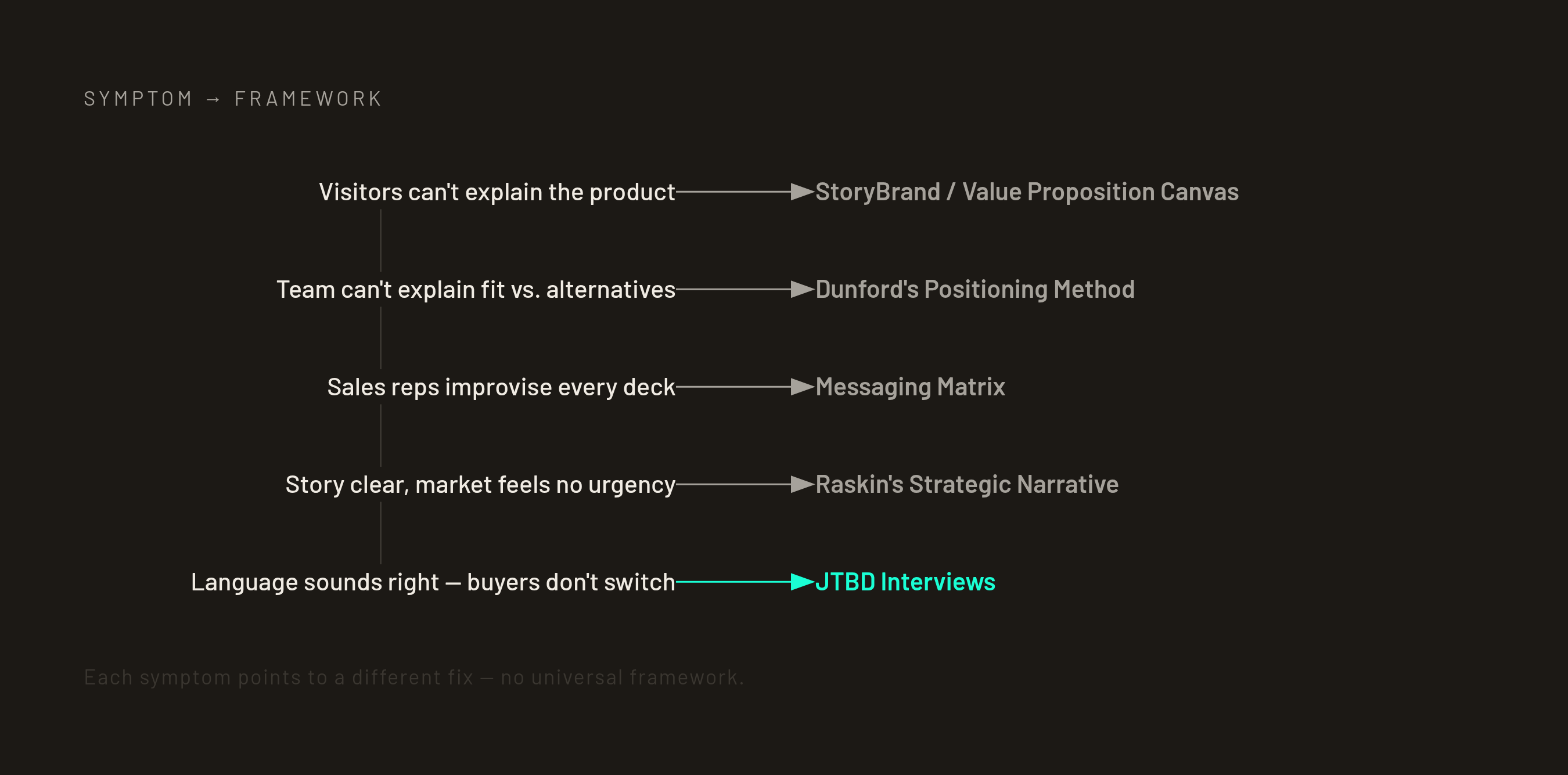
For a team choosing a method, the starting point is the missing decision or failing asset. If visitors cannot explain the product after reading the homepage, StoryBrand or a Value Proposition Canvas can help make it clear. When the team needs to explain where the product fits against real alternatives, Dunford’s method comes first, with different work needed for what can look like the same copy problem.
When sales reps improvise every deck, a Messaging Matrix creates a shared spine across decks, emails, and discovery calls. When the founding story is clear internally but the market feels no urgency, Raskin’s method supplies the “why now.” When the language sounds right but buyers still do not switch, JTBD interviews can uncover the reason and feed it back into the narrative. The symptom determines the next move.
Stage helps narrow the choice, but the route to market is just as important. Product-led teams can use StoryBrand and category design to make their use cases, categories, and first value clear. Sales-led teams have more need for Strategic Narrative and a Messaging Matrix to establish relevance for a conversation. Enterprise teams get more from positioning work when it draws on research into what each stakeholder needs to buy, while vertical SaaS needs research and a clear case against the horizontal alternative.
Execution can outweigh the theoretical fit of a method. A team that completes a positioning exercise and applies it consistently can get further than one that chooses the ideal framework and stalls. Measurement then tests whether the work helped. Messaging should be treated as a hypothesis that must prove itself in conversion and win rates.
What to look for when an agency brings these frameworks to your SaaS product
Knowing the names is not enough. For a team evaluating a partner, the useful questions are whether the work forces a positioning choice and whether the resulting message survives the move from homepage to deck, sales email, and AI tool. The agency also needs a way to validate buyer language and connect the work to conversion, win rates, or deal size.
SaaS knowledge makes that evaluation more specific. Recurring revenue, product-led growth, buying committees with multiple stakeholders, and the differences between technical and business buyers all shape what the messaging needs to do. Those fundamentals need to be established before the story is written. A partner that understands them can address the product’s actual gap.
Letterspade, a tiny B2B video boutique that makes videos for devtool and security startups, is one option for teams that have done the positioning work and need a 60-second sales tool made with a deep knowledge of the product as well as care for how the video looks and sounds. It treats a single positioning decision as the spine of the piece, keeping the video consistent with the homepage and sales deck.
The practical filter is what the agency resolves before production starts. Teams should avoid partners that start with visual identity before positioning, cannot show how messaging leads to pipeline outcomes, or use the same framework no matter what is missing. A familiar method is not evidence of a good diagnosis.