Why Product Knowledge Matters More Than Production Budget in SaaS Video
Understanding your buyer's problem matters far more than your production budget.

SaaS video performance depends more on product knowledge than production budget. A creator who understands the product can name the buyer’s problem, show the right proof, and make a clear case for change. A bigger budget can make that argument look and sound better. It cannot supply an argument that was missing from the script.
Why SaaS videos fail before production begins
A founder or marketer hands a brief to a studio. It has features, product language, and ideas for what the video should show. The studio turns that into a script, a style of animation is chosen, and a voiceover is approved. Everything looks like progress from that point. But unless the handoff transfers why buyers need the product, the production starts with a gap that better craft cannot close.
That gap is a failure of comprehension. Teams often rush through the script so they can start what they see as the real production. Someone close to the product writes down its capabilities, and the result becomes a tour of everything the platform lets a customer do. Features lead to workflows, which lead to edge cases. The viewer gets more information without a clearer reason to act.
Proximity to the product is not enough, either. A scriptwriter needs to distinguish what the team finds impressive from what the buyer needs to understand. Otherwise, internal knowledge becomes a catalogue. Production can faithfully execute the brief and still deliver a video that explains too much while persuading too little.
What buyers actually need from a SaaS video in the first ten seconds
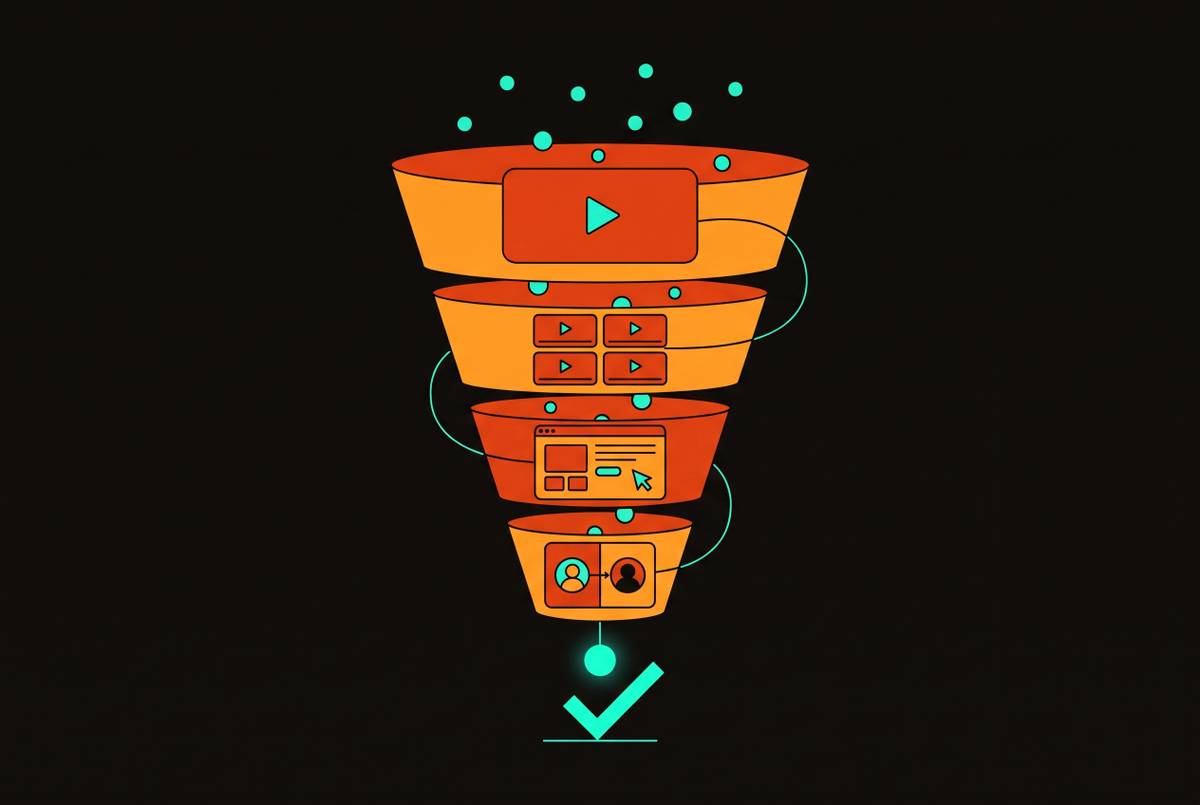
The buyer needs to recognize a problem before being asked to care about a product. That recognition has to use the buyer’s language. A strong opening names the problem immediately, then shows real UI within the first few seconds. The interface gives the claim something concrete to stand on.
The next step is to show the transformation before the pitch begins. That means making the change in the buyer’s situation clear, rather than assuming a feature demonstration explains its own value. A capability’s relevance as a reason to buy depends on the problem it solves and the person watching. Product knowledge connects those pieces without making the viewer do the work.
This sequence is a useful standard for judging a video, but it is not a template that fixes weak understanding. A feature list cannot tell a studio which problem deserves the opening or which screen provides the strongest proof. Those choices rest on what the product team knows. The creator has to learn that from the team before choosing what goes into the first ten seconds.
Why production polish cannot rescue a message that misses the mark
An unnamed B2B SaaS company spent a large sum and twelve weeks on a custom-animated 90-second explainer with professional voiceover. Over six months, the video got views but brought in zero attributable pipeline. The head of product then recorded an unedited Loom screen capture walking through a new feature. It generated fifteen inbound demo requests in a week. In that case, the spending and the outcome moved in opposite directions.
The early-stage startup used a minimal video budget to help validate product-market fit, concentrating on its core software UI and a clean voiceover. The video became its top-performing asset and drove a high volume of new leads through its landing page. The product itself supplied the visual evidence. Elaborate treatment was not required to make that evidence useful.
Intercom’s sales team took the same approach when reaching out to prospects. Loom’s official Intercom case study describes videos made for each prospect that used screen capture and webcam recording to show how the product could help them. The differentiator was knowing which Intercom capability to demonstrate on that prospect’s website. Relevance determined what appeared on screen. If that can work without a large budget for production, when does production quality become a must?
When production quality is load-bearing and when it is not
Production quality establishes a minimum level of credibility, and 89% of consumers say video quality affects their trust in a brand. Poor execution can weaken a sound message, especially when viewers judge the product through the craft of the video itself. Some audiences evaluate that craft professionally.
Framer is a website builder, so visual judgment is closely connected to what its buyers are evaluating. A video presenting that kind of product cannot treat design as incidental. Its presentation needs to support the promise of a well-designed result. This is not decoration added after the argument. The visual treatment helps make the argument credible because the audience is assessing a product used to build websites.
ElevenLabs presents a related case through sound. It is a broad AI voice platform, so voice quality is directly relevant to the capabilities buyers are considering. In that context, audio is not merely packaging for the message. Yet copying effects without a clear message to guide them still makes noise. Craft earns its place when it helps demonstrate the product.
The practical distinction is between lean production and cheap production. Lean means a tight team, a focused script, and rigorous pre-production. Cheap means skipping strategy, voice direction, real motion design, and color without thinking about what the audience needs. Design tools need to look designed, developer tools need to earn trust on technical grounds, and enterprise tools need to show that buyers can stay in control and rely on them.
How the Blockdaemon production shows product knowledge operating in practice
Blockdaemon has blockchain infrastructure for institutional and technical buyers. For viewers who already understood blockchain infrastructure, the production needed to establish reliability and security without falling back on generic claims. That distinction changed where the script needed to begin. Explaining a problem the audience already understood would have delayed the proof it still needed.
The production moved quickly into positioning, the value proposition, capability proof, and risk mitigation. That choice depended on understanding the buyers’ existing knowledge. It also clarifies why “problem first” is not a demand for a lengthy introduction in every video. The opening must meet the buyer where they are. For a knowledgeable audience, the unresolved issue may be confidence in the provider.
The three-video series made another distinction visible. Institutional and technical buyers needed different entry points into the same product, rather than one video that tried to cover every capability for everyone. Separating those needs kept the structure from becoming a feature tour. Product knowledge shaped the format as well as the words. It also explains how knowledgeable production teams can shorten revisions, because the client does not first have to correct technical errors or reexplain the architecture before useful scripting can begin.
Why AI-commoditized production raises the stakes for message specificity
By 2026, cheaper and faster AI production has changed the competitive setting for SaaS video. More teams can publish more content, while polished output is harder to distinguish on appearance alone. A video that could have stood out in 2023 through production quality now competes with dozens of technically comparable outputs. The production barrier has become much lower. A generic message has less protection from attractive execution.
That shift puts more pressure on specificity. When many videos can look competent, the useful distinction is whether one names a buyer’s actual problem in language that buyer recognizes. More output spreads a weak argument across more assets. The script needs to reveal an understanding of the product and the buyer that cannot be obtained by copying a visual style.
For AI and deep-tech SaaS, technically fluent production is a direct response to this problem. A creative director who understands ARR, CAC, activation, payback period, tokens, context windows, and API-first products can work from the product’s substance with less need for repeated corrections of misunderstandings. The ElevenLabs example also shows the limit of imitation, because copying effects without message discipline leaves the underlying problem untouched.
Why SaaS's continuous release cycle makes product knowledge a velocity problem
SaaS video also has to keep up with the product it represents. Major releases each quarter, minor releases each month, and product drops each week make it hard for a team that works around traditional campaigns to keep up. By the time a campaign video ships, several releases may have made parts of it outdated. The initial production is only one cost. Keeping the content up to date is a job that keeps coming back.
Over-produced, monolithic videos make that job harder because they cannot be updated incrementally. Content for the brand and its executives can be worth the cost of full production, while product-tier content can use a product manager talking to camera, clean screen capture, and the same brand template each time. Those videos can ship in days. The condition is that the team understands what changed and why the buyer should care.
Intercom’s personalized sales videos show how little production infrastructure this kind of content can require. Each took approximately two minutes to create and was current to a particular prospect’s context. That speed depended on knowing what to show. The recording tools did not have to supply the product judgment.
This broadens the question a team should ask about a production partner. Can the partner make a strong launch video, and can it also understand the next product change without starting discovery from scratch? A showreel answers only part of that question. The evaluation needs to include how the team learns the product, handles technical detail, and chooses the right production level for the job.
What to look for in a video partner when product knowledge is the priority
A team choosing a partner should begin with the questions that partner asks before scripting. Questions about the ideal customer profile, the buyer’s existing mental model, and what the product does differently indicate the right starting point. Portfolio aesthetics and animation styles are useful later. They do not establish that the studio understands the buying decision. Discovery should precede scripting, with storyboard and creative direction following the script.
The clearest test is plain-language explanation. A prospective partner should be able to describe how the product creates value without the client repeatedly correcting the account. Its scripts should name the buyer’s problem before introducing the product and distinguish a genuine difference from a capability competitors already offer. Technical SaaS raises the bar further. AI products, developer tools, and infrastructure need enough domain fluency that the founding team is not spending revision rounds repairing basic technical errors.
A partner willing to challenge over-production before the message is validated offers more than one that simply agrees to the brief. The practical test is to commission a lean version first, using a screen recording and a tight voiceover, then measure demo-request lift. Polish can follow once the message converts. Before scaling the production, ship the script first.