Animated vs. Live-Action Explainer Videos for SaaS Products
Match your format to what your product actually does, not what other SaaS companies choose.

Picking animated or live-action for a SaaS explainer comes down to what your product actually does and how much of that "doing" happens somewhere a camera can't reach. Get that match wrong, and you end up with a video that's technically well-made and still fails to explain anything.
Here's the backdrop: video is now the default marketing tool for the vast majority of businesses, up from where it stood just a couple years ago. Google's 2025 research puts B2B video viewership among buyers at 70% during the purchase journey. Video itself isn't much of a competitive advantage anymore, since everyone has one. What separates a video that converts from one that gets skipped is whether the format matches what you're trying to show. For SaaS specifically, that question hits different than it does for physical products, because software often has no shape, no face, and no shelf. I've watched teams default to animation because "that's what SaaS companies do," and I've watched others insist on live-action because it "feels more premium." Neither reason holds up. What follows is the actual logic.
What makes SaaS products unusually hard to explain on video
Software has an image problem, literally. The product runs in the background, moves data around, automates some workflow nobody sees happen, and there's nothing to point a camera at. A CRM doesn't have a chassis. An API doesn't have a face.
Then there's the UI problem. Interfaces change constantly, sometimes every quarter, sometimes with every sprint. Film your dashboard today, and there's a real chance that footage looks outdated in six months. Add to that the privacy constraints most SaaS companies operate under: you usually can't show real customer data on a public-facing video, which rules out a lot of straightforward screen recording.
So the job of a SaaS explainer is genuinely harder than most video briefs. It needs to show how the thing works, why that matters, and what makes it different from the five other tools doing something similar, and it needs to do this in roughly 60 to 90 seconds. That's a tight compression ratio for something this abstract.
This isn't a nice-to-have detail either. SaaS websites running a product video convert at somewhere around 4.8%, compared to roughly 1.9% for sites without one. That gap is too large to treat the format decision as an afterthought. Invisibility, mutability, privacy, and time compression: those four constraints are what any format has to answer for, and they're the lens for everything that follows.
What animation actually does well when software is the subject
Animation's whole advantage is that it can show what a camera physically cannot. Data moving between systems, an API handshake, a background job triggering three downstream actions: none of that has a physical form, but a motion graphic can represent it clearly in a few seconds.
There's real research behind this too. A 2024 study published in the Journal of Educational Psychology found that animated explanations of abstract concepts improved comprehension by 42% compared to plain text, and by 28% compared to live-action demonstrations. That's not a small gap, and it lines up exactly with what SaaS explainers need to do: take something with no physical form and make it click fast.
Animation also solves the UI-drift problem I mentioned earlier, since an animated screen is an illustration, not a recording. When your product updates its navigation or rebrands its dashboard, you re-render the relevant frames instead of re-shooting an entire scene. Wistia's 2025 benchmark data puts the update cost for animation at 60 to 80% less than live-action for content that needs quarterly refreshes. Over a two-year product cycle, that's the difference between a video that stays usable and one you quietly stop linking to.
Privacy gets solved too, since an animated dashboard was never real customer data to begin with. And scaling across markets is simpler: no re-booking talent, no new shoot location, just a new voiceover track and updated on-screen text.
Where animation falls short: it can read as cold, since a motion graphic doesn't have a face, and faces are how humans signal trust to each other. If your buyer needs to feel something about your team before they'll feel confident about your product, animation alone won't get you there.
The categories where animation is the clear right call: fintech, AI and ML platforms, logistics software, healthcare tech. These are products where the value exists entirely inside a system nobody can see with their eyes, so the only way to make it visible at all is to draw it.
Where live-action earns its place in the SaaS funnel
Human faces do something animation structurally can't: they build trust fast, and they do it efficiently. Nielsen research found that ads featuring real people generated 40% more engagement than graphics-only or text-only equivalents. That's not a minor edge; it's the entire mechanism live-action is built on.
Where this actually shows up in a SaaS funnel is late-stage, not early-stage. Testimonials, founder stories, sales-assist videos: these are moments where the buyer already gets what the product does and is now deciding whether to trust the company behind it. That's a different job than explaining a workflow, and animation tends to handle it poorly.
The numbers back this up directionally. Zebracat's 2026 dataset found free-to-paid SaaS conversion lifts to 46% when video testimonials are part of the flow, versus 27% for demo-only flows. That's the kind of lift you only see when trust, not comprehension, is the bottleneck.
Live-action also fits naturally when your SaaS product touches a real human workflow: field service tools, HR platforms, anything customer-facing. Show a real technician using the app on a real job site, and the abstract value of "streamlined dispatch" (sorry, had to use it once to make the point) suddenly has a face and a place attached to it.
The tradeoffs are real, though. Reshoots cost money and take time. UI footage still goes stale the same way it does for animation, except now fixing it means booking a crew again, not opening a project file. Locations and talent don't scale the way illustrations do, and the data privacy issue doesn't disappear just because there's a human in frame.
Practically speaking, live-action in SaaS works best as a tool for building confidence in the company rather than explaining the product itself. That's a distinct job, and worth budgeting for separately rather than expecting one video to do both.
How production costs and timelines actually differ between the two formats
Numbers first, because this is where a lot of teams get surprised. A professional 60 to 90 second custom animation, including voiceover and sound design, runs $5,000 to $15,000 in 2026. Break that down further: 2D sits between $3,000 and $15,000, while 3D starts around $10,000 and can exceed $50,000 per minute if you're going for broadcast-level polish.
Live-action starts around $5,000 at the low end, but a comparable two-minute production realistically ranges from $17,000 to over $100,000, depending on crew size, number of locations, and whether you're hiring professional talent or using employees.
Timelines follow a similar pattern. A freelancer can turn around a custom animated video in two to four weeks, while agencies typically need four to eight weeks. Live-action adds location scouting, scheduling around people's calendars, and a heavier post-production lift on top of whatever the animation timeline would've been.
Worth noting: roughly 40% of companies spent under $5,000 on video production overall in 2025, per Wistia. For that segment, the format decision is already half-made by budget before anyone even discusses creative direction. On the other end, AI-generated animation tools have pushed entry costs as low as $99 to $500, which is fine for an internal onboarding video, less fine for a homepage video that needs to close six-figure deals.
Here's the line item most teams miss entirely: maintenance costs often outweigh production costs over time. Live-action requires a reshoot every time your product changes meaningfully, while animation doesn't, and over a two-year product cycle, that difference can flip which format was actually cheaper, even if live-action looked competitive on day one. The more useful question isn't which format costs less to make, but which one costs less to keep accurate for as long as you need it.
When combining both formats produces better results than either alone
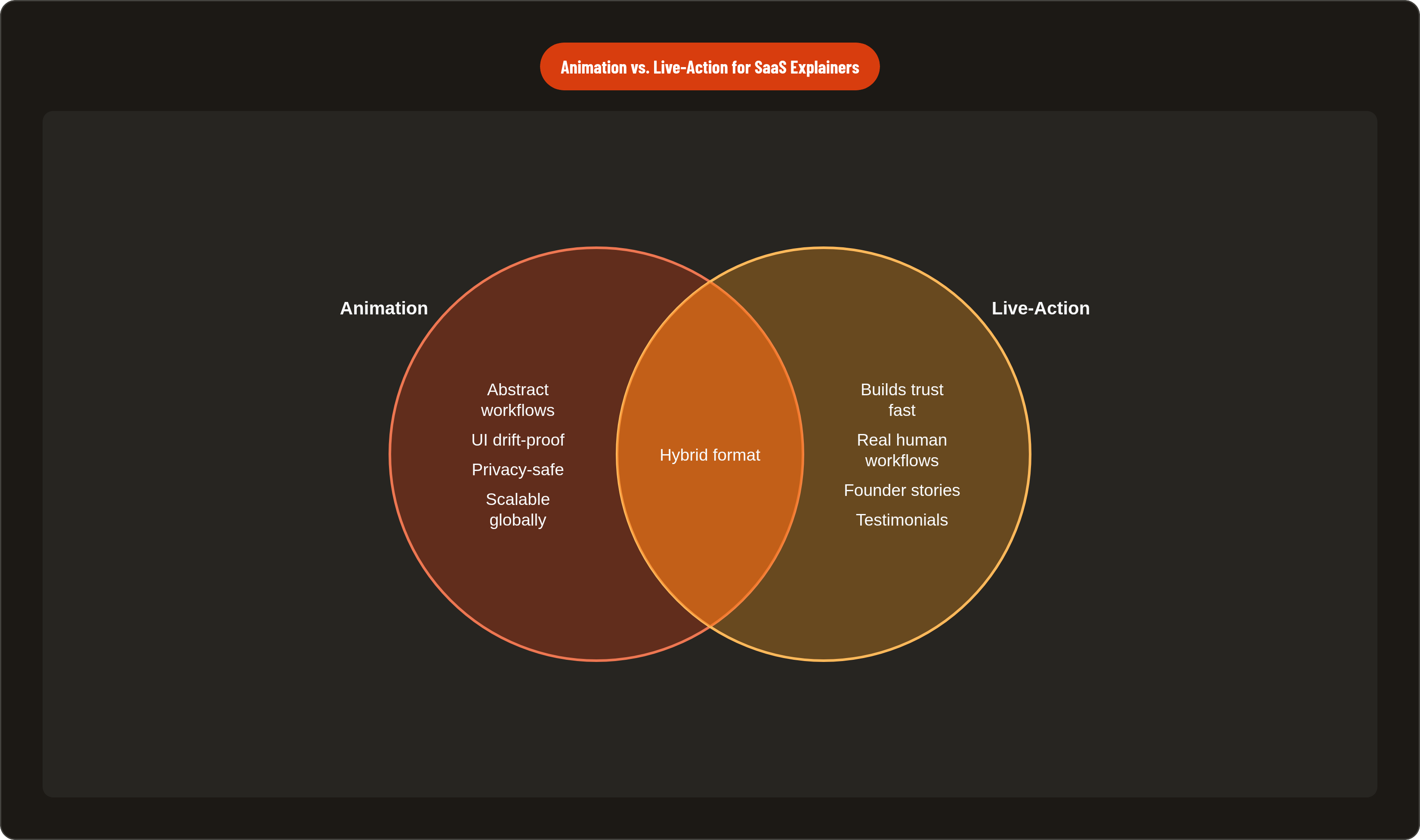
Hybrid is a legitimate strategy with its own track record. A 2025 Wyzowl survey found 37% of businesses now use hybrid videos, combining real footage with animated elements in the same piece. And hybrid videos post 23% higher completion rates than single-format videos, which matters because completion rate is the clearest signal of whether your message actually landed.
Two patterns show up consistently in SaaS work. The first: film a founder or a customer talking to camera, then layer animated callouts, workflow diagrams, or UI illustrations over that footage. The human face carries the emotional weight; the animation carries the explanation. Neither element is doing the other's job.
The second pattern: open on live footage of a real-world problem, an office, a support queue, a factory floor, then cut into animation that shows how the software resolves it. This grounds an abstract product in something the viewer recognizes immediately, before asking them to follow a more conceptual sequence.
Hybrid earns its complexity in complex B2B SaaS specifically, where the buyer needs to both trust the vendor and understand what the product does. Those aren't competing needs you have to choose between; they happen sequentially, trust first or comprehension first depending on the video's placement, and hybrid lets you address both without diluting either.
The catch: hybrid is genuinely harder to produce well. You're coordinating two production tracks, sometimes two vendors, and you need a single creative brief tight enough to keep the whole thing coherent. Done sloppily, hybrid feels like two videos stapled together, but done right, it's the strongest format available for SaaS.
A format-to-product-type matching framework SaaS teams can actually use
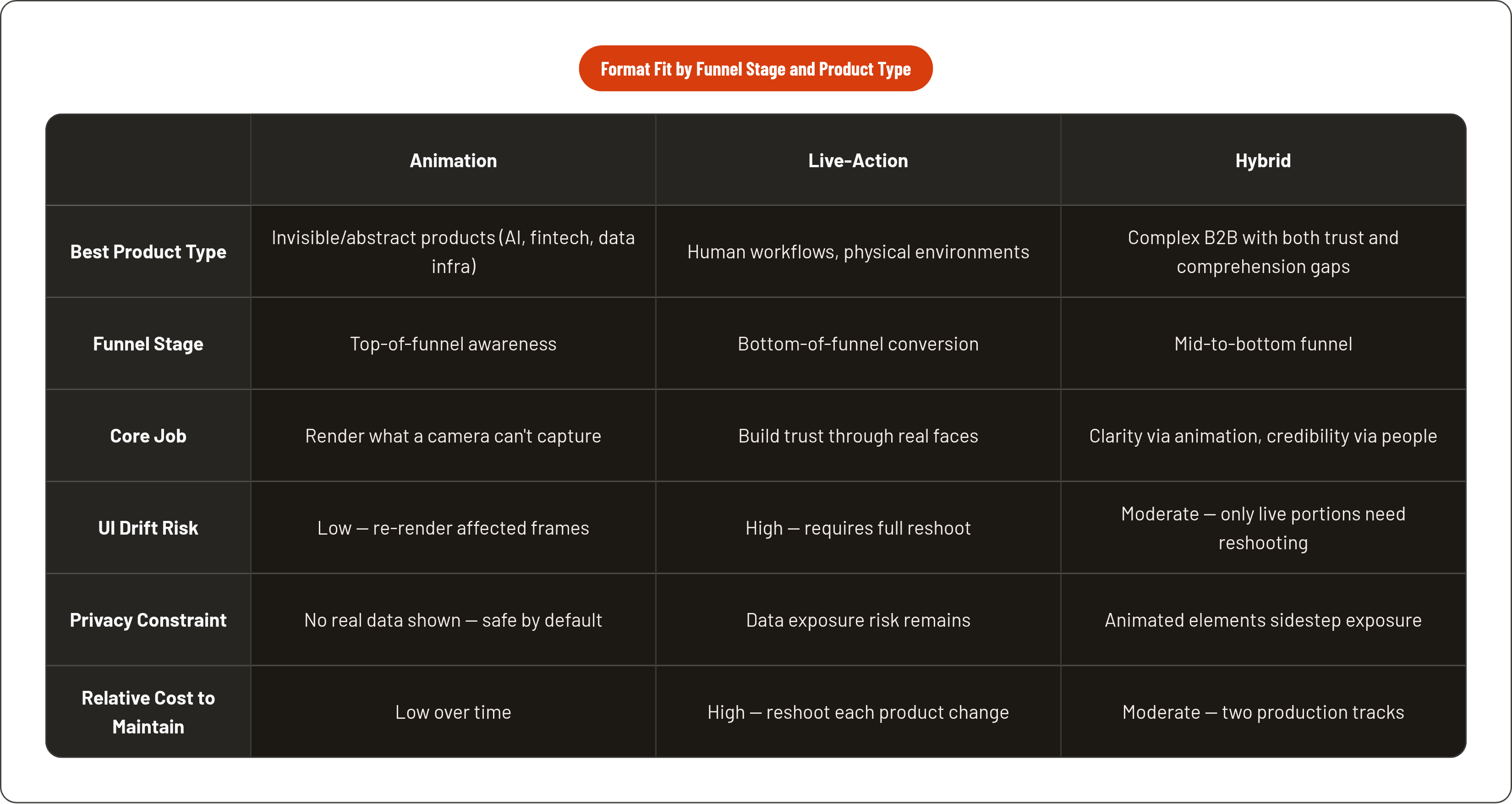
Strip away budget and trend, and the real decision variable is complexity and visibility. If your product's value is invisible or abstract (AI, fintech, data infrastructure, anything running quietly in the background), animation is your default, since it's the only format that can render what a lens simply cannot capture.
If your product involves real human workflows or physical environments, field service, HR, retail operations, live-action earns a place somewhere in your video mix, even if it's just one testimonial. And if your product is both complex and facing a trust bottleneck at conversion, hybrid is the answer: animation handles clarity, live-action handles credibility.
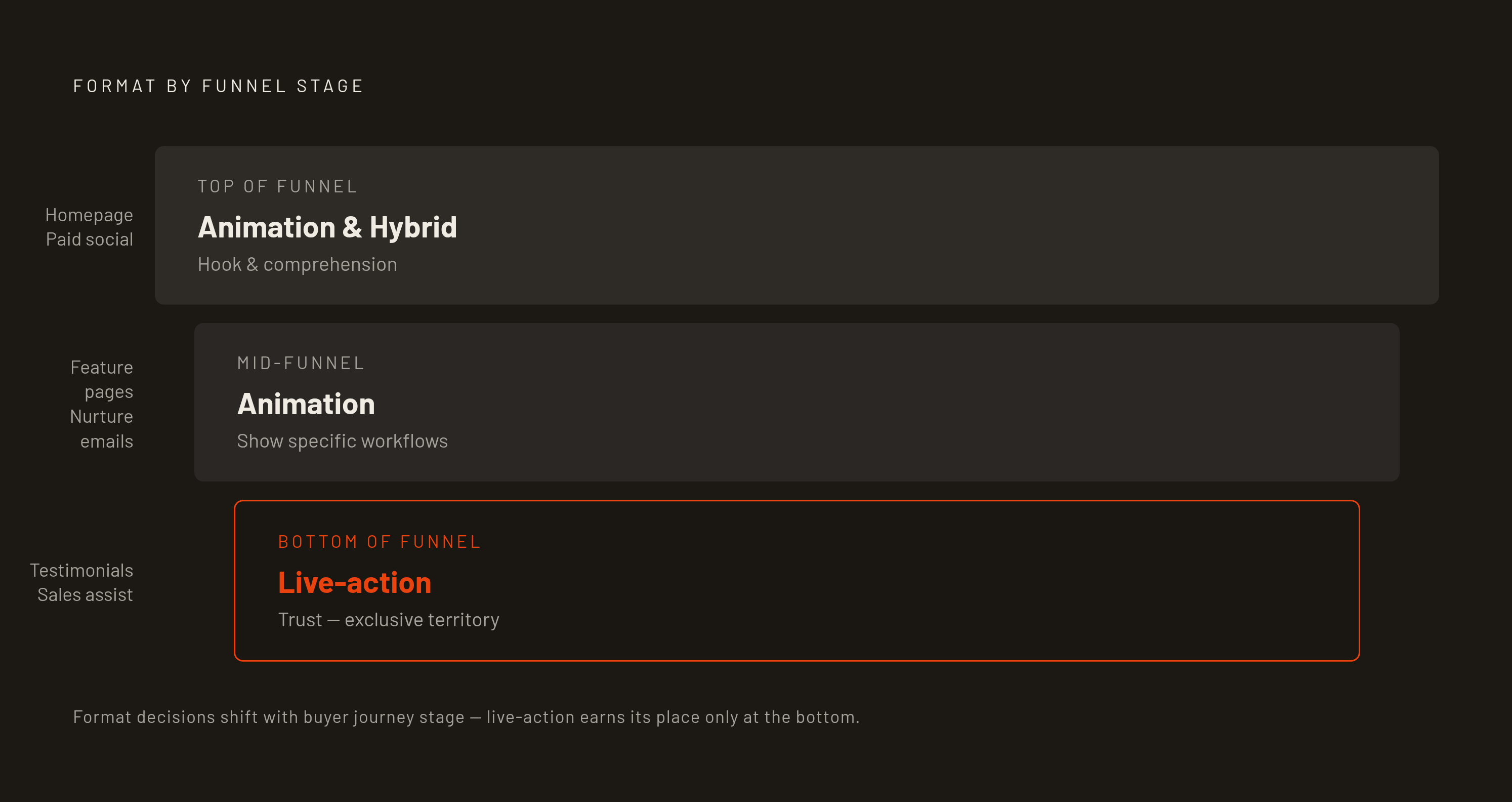
Funnel stage matters just as much as product type. Top-of-funnel awareness content, your homepage hero video, paid social, should lean animation or hybrid, since the job there is comprehension and a hook, not trust. Mid-funnel content, feature pages, nurture emails, works well as animation showing specific workflows, or a clean screen recording with voiceover. Bottom-of-funnel content, testimonials and sales-assist material, is where live-action does its heaviest lifting, because by that point the buyer already understands the category and just needs to trust you specifically.
Two quick diagnostic checks before you commit. First, how often does your UI change? If it's more than once a year, live-action UI footage is a liability from day one, so factor that into the format decision, not after the invoice arrives. Second, are you restricted from showing real dashboards for privacy reasons? If so, animation is the only viable option for that content, full stop.
And regardless of format, hold the line at 60 seconds for a homepage explainer, since the format doesn't change that compression requirement; it only changes how you hit it.
What this all means in practice: format should be the last question you answer, not the first. It's the output of a clear brief about your product and your audience, never the starting point of one. The order is to understand what the product actually does and what sets it apart, then figure out whether animation, live-action, or a hybrid of the two gets that story told in 60 seconds flat. The format serves the story, and follows from it rather than leading it.