Explainer Video Length and Completion Rates in B2B
Shorter B2B videos complete better, but length depends on where buyers stand in their decision.

In B2B video, length isn't a creative preference. It's a lever that directly controls how much of your message actually reaches the buyer, and the data on this is now specific enough to act on. Once you see the completion curves by runtime, you stop picking video length by gut feel and start picking it by math.
Video itself isn't optional anymore either. Per Wyzowl's 2026 State of Video report, 91% of businesses now use video in their marketing, and B2B decision-makers consistently report that explainer videos and peer recommendations shape their purchase decisions. Explainers were widely produced in 2025, with 73% of video marketers creating them, and Vidyard puts product demos at 47% of all business video with explainers close behind at 35%. So when everyone's got a video, the video itself stops being the differentiator. What finishes playing is.
How average video length has compressed and what that signals about buyer behavior
Average B2B video runtime has compressed significantly in recent years, and it didn't happen because teams got lazier or budgets got tighter.
It happened because they were watching what viewers actually finished, and adjusting.
Vidyard's analysis of more than 940,000 business videos found that 60% of videos made in 2024 ran two minutes or under, and 35% came in under a minute. Meanwhile Vidyard puts the median business video length at around four minutes. That second number matters more than the first. It's not what got published; it's what got watched.
There's still a gap between the two, published length versus consumed length, but it's shrinking. And that gap is exactly where completion-rate data earns its keep. If you know where viewers drop off, you can stop publishing past that point.
The steep, non-linear relationship between runtime and how much of a video buyers actually watch
Here's the part that surprises people: the relationship between length and completion isn't a gentle slope. It's a cliff with a few ledges.
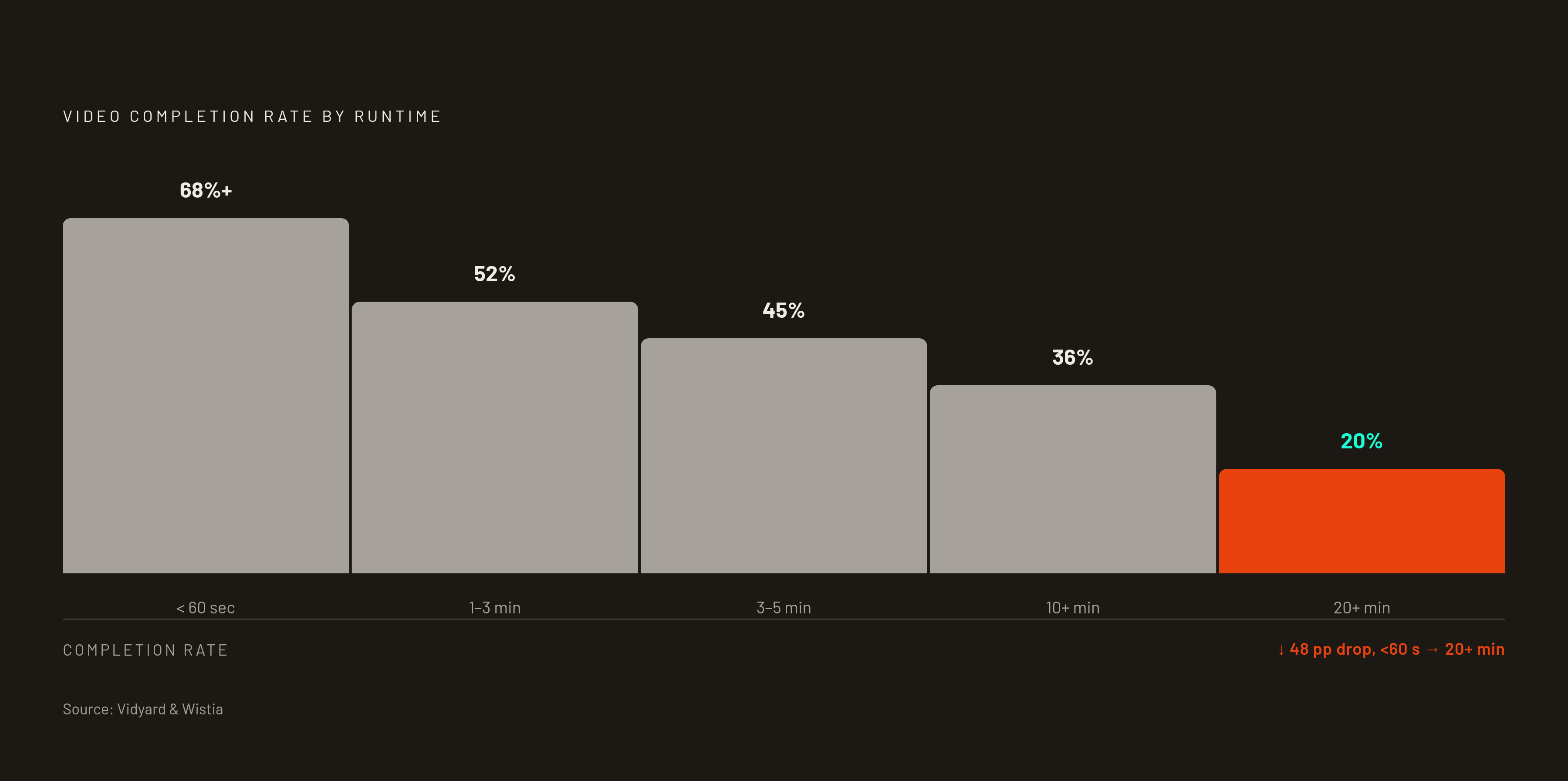
Vidyard's numbers show videos under a minute finishing at a 65% completion rate. Push past 20 minutes and that number falls to 20%. In between, the decline isn't steady, it happens in jumps:
- Under 60 seconds: completion rates above 68%
- Two to four minutes: roughly 52% completion
- Over ten minutes: around 36% completion
Wistia's dataset, built from more than 14 million videos, tells a similar story through engagement rather than strict completion: 50% average engagement under a minute, 46% from one to three minutes, 45% from three to five minutes. Their engagement curve holds fairly flat through the first two minutes, then starts sliding, and the slide gets steeper after six minutes.
Put those together and you get an uncomfortable fact: the median B2B video runs about four minutes, but the median viewer only watches 54% of it. Half your audience is gone before the video ends. Anything you put in the back half of a four-minute video, any proof point, any pricing detail, any closing argument, is landing on an empty room.
There's a real tension buried in here though. Longer videos, even with lower completion rates, rack up more total watch time. A 30-to-60 minute video gets roughly half the engagement rate of a one-to-three minute video, but delivers more than ten times the total minutes watched. So the right metric isn't universal; it depends on whether you're optimizing for reach or for depth.
Why short videos are also getting harder to hold — and what that demands of the opening seconds
You'd expect short videos to be safe from the attention crunch. They're not. Overall video engagement dropped 7% in 2024, per Wistia's 2025 report, the steepest single-year drop in four years. And the videos that took the hit hardest weren't the long ones.
Three-to-five minute videos lost 10% of their engagement year over year. Videos over 30 minutes only dipped 3%.
That's backwards from what most people would guess, and it tells you something about where viewer attention is being trained. People are marinating in short-form content on social platforms all day, every day, and that's resetting their patience threshold for everything else. A viewer who's used to swiping past a clip in two seconds isn't going to sit through five seconds of your logo animation before you get to the point.
So brevity alone doesn't save you anymore. The first few seconds of a short video now have to do real work, naming the problem, showing the product, giving a reason to stay, because the alternative is a thumb moving toward the next tab.
How the right length shifts depending on where a buyer is in the purchase journey
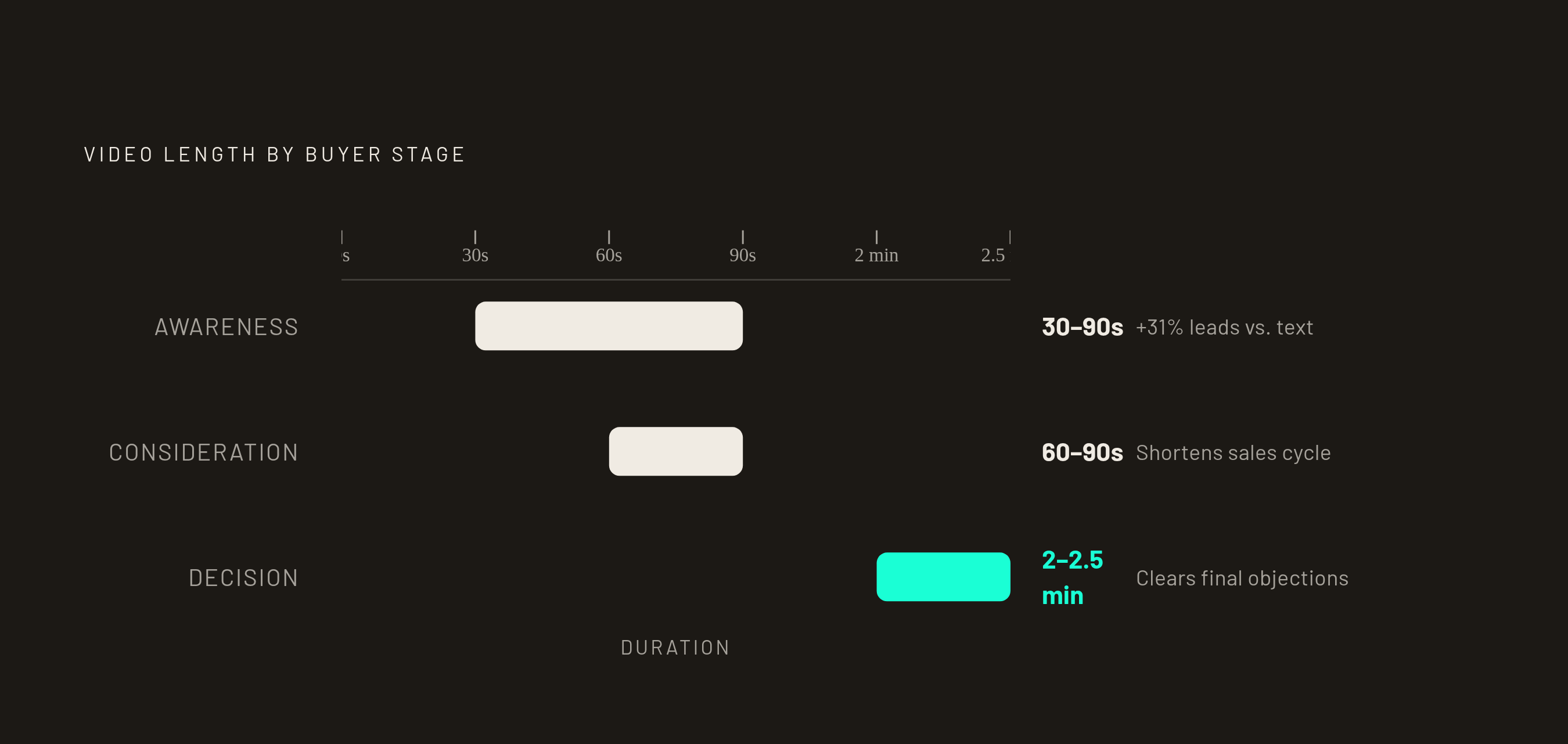
Length isn't one number. It moves depending on where the viewer is standing.
Awareness stage. The viewer doesn't know you yet, and they're scanning, not studying. Thirty to 90 seconds is the workable range here. HubSpot's 2025 data shows awareness-stage video generating 31% more leads than text-based blog content alone. A short cut that names the problem and hints at the fix will beat a polished three-minute video the viewer never finishes, every time.
Consideration stage. Now the buyer's comparing options, and they'll give you more rope, 60 to 90 seconds, sometimes a bit more. This is where a little extra length actually pays for itself, especially for SaaS and technical products where the features are the argument. Consideration-stage video can meaningfully shorten B2B sales cycles, mostly by answering questions upfront that would otherwise get asked across three calls and a dozen emails.
Decision stage. The buyer is close, and they're hunting for either a reason to say yes or a last objection to raise. A tight two-to-two-and-a-half-minute walkthrough clearing those final doubts is worth every second of runtime here. It tracks with the demo data too: product demos tend to hold attention notably longer than explainers, reflecting how much more patience buyers extend when the format justifies the depth. Buyers this far along extend more patience when the format justifies the depth.
Then there's a paradox worth sitting with. Wistia's numbers show videos in the 30-to-60 minute range converting at 17%, compared to just 2% for videos under three minutes. That's not a contradiction of everything above it. It's self-selection: nobody sits through a 45-minute demo by accident. Anyone watching that long has already decided you're worth their time. Completion rate is the wrong yardstick for a webinar or a deep product walkthrough; conversion rate is what actually tells you if it worked.
What video type does to the length-engagement relationship
Format changes the math more than almost anything else. Instructional and how-to videos blow past the generic benchmarks at every single length. Under a minute, they hit 82% engagement. Between five and 30 minutes, they're still holding 58%, which crushes the all-format average at that runtime. In the three-to-five minute band, the all-format average sits at 43% engagement; instructional content in that same window hits 74%.
Why the gap? Because a how-to video comes with a built-in reason to finish. The viewer showed up looking for a specific answer, and they stick around until they get it. Compare that to explainer videos, which average three minutes and 45 seconds of attention, and product demos, which average five minutes and 20 seconds; the format itself sets the patience level before a single frame plays.
So a two-minute how-to video for a SaaS onboarding flow can hold a viewer's attention that a two-minute brand story never could. Same runtime, completely different completion odds. The real question for any team planning a video isn't just how long it should run. It's whether the format gives the viewer an actual reason to stay until the end.
What the data converges on for B2B explainer videos specifically
Everything above points to the same window, and marketers seem to know it even without seeing all the completion data. In Wyzowl's survey, 39% of marketers say the ideal explainer video runs 30 to 60 seconds, another 33% prefer one to two minutes, and only 11% go longer than two minutes on purpose. Overall, 71% say the 30-second-to-two-minute range performs best.
On landing pages specifically, videos under 60 seconds complete at over 70%, and Wistia's engagement data shows completion falling meaningfully as runtime pushes past two minutes. Wistia's engagement curve backs this up almost exactly, showing the real drop-off starting right around the two-minute mark. That makes two minutes less of a guideline and more of a practical ceiling for most explainer contexts.
If I had to name one range as the safest bet for a mid-funnel explainer, it's 60 to 90 seconds. Short enough to protect your completion rate, long enough to actually make a product argument instead of just teasing one.
Here's the uncomfortable part for anyone writing scripts: if your message can't fit in two minutes, the problem usually isn't the runtime. It's the script. Adding more time doesn't add more persuasion; it just lowers the odds that anyone's still there to hear the argument land. For SaaS products with real differentiation to explain, that constraint is actually a gift. It forces the question every script should start with: what's the one thing this video has to make someone understand, and is every single second earning its place toward that?