Explainer Video Conversion Rates by Video Type
Animated explainers win on workflows, live-action on trust—choose based on your funnel stage.

Most SaaS marketers ask "should we make a video?" when the real question, the one with actual money behind it, is which kind. Format changes conversion outcomes by wide margins, and that gap is where the leverage sits. According to Wyzowl's 2026 survey of 266 respondents, explainer videos are now the second most-produced content format at 68%, trailing only social media videos at 69%. Nearly everyone's making them, but almost nobody is choosing the right one for the job.
That's the gap this piece covers: what each major explainer format actually does to your conversion numbers, and which one belongs at which stage of your funnel. I'm using "explainer video" the way the market actually uses it, loosely, as any short-form video whose job is to move a prospect closer to a decision. Animated, live-action, demo, testimonial, interactive: they're all doing that job, just at different points and with wildly different results.
How much video on a landing page actually moves the needle
Landing pages with embedded video convert at 86% higher rates than text-only versions. That's the headline number, and it's worth sitting with for a second because of what it's being multiplied against: the average landing page conversion rate across industries sits at 5.89%, ranging from 3.6% in real estate up to 9.8% in catering. Video's lift lands on top of these already-thin baselines, which is exactly why even a modest bump compounds fast once you're talking about thousands of visitors a month.
Only 30% of top landing pages currently use video at all, though, which means most SaaS pages are simply leaving this on the table.
Placement matters nearly as much as presence. Video sitting near the top of the page, above the fold, outperforms video buried further down, after the visitor has already scrolled past three sections of text explaining what your product does.
One thing to flag early, because it shapes everything that follows: "video on a landing page" isn't one thing. That 86% figure is an average across every format, animated, live-action, demo, testimonial, all lumped together. The sections below show just how wide that spread actually is.
Animated explainer videos: where SaaS defaults land, and what the data says
Animation is the instinctive pick for software companies trying to explain something abstract, a workflow, a data pipeline, an integration that has no physical form. Turns out that instinct isn't just comfort, it has evidence behind it.
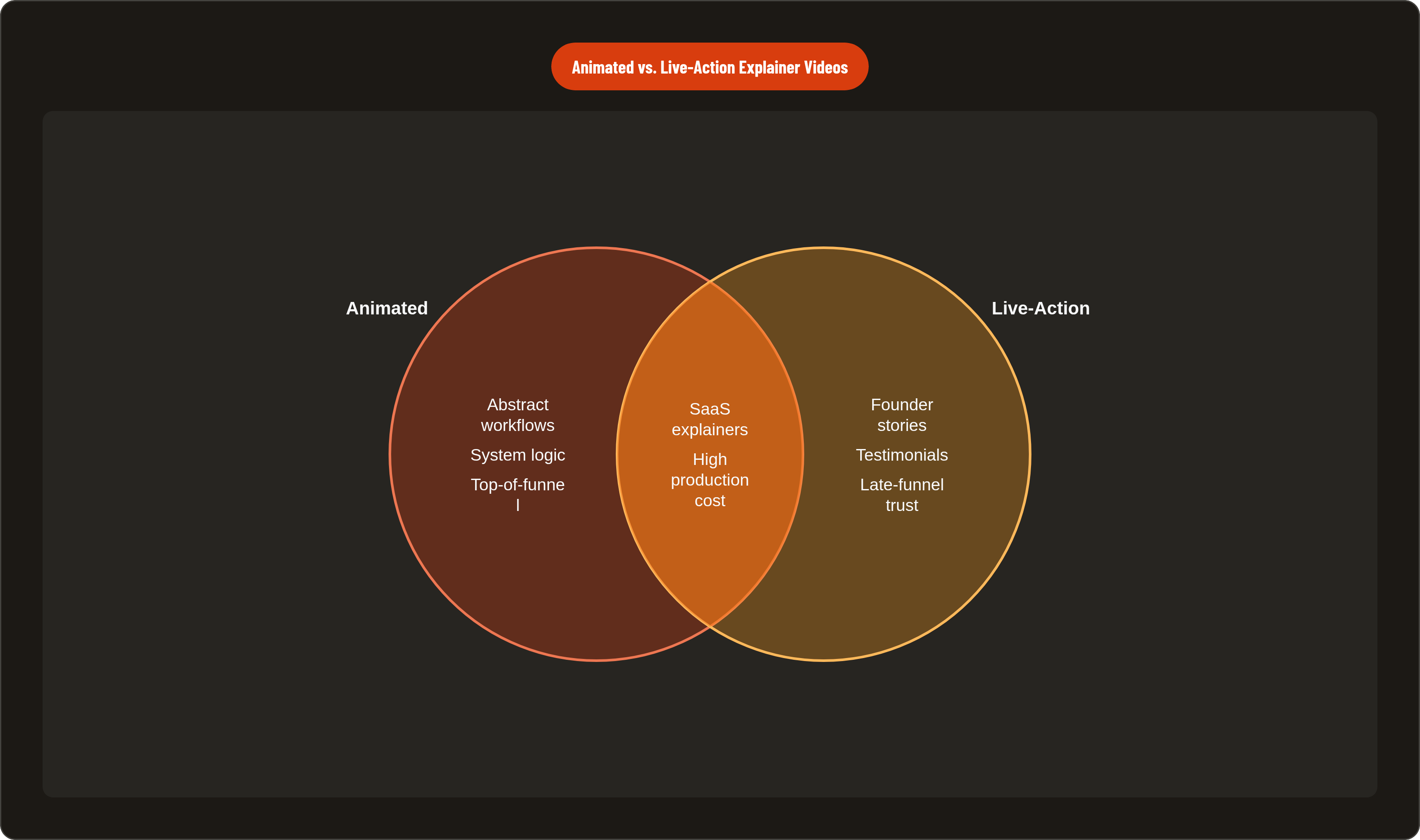
JotForm ran an A/B test pitting animated video against live-action on YouTube. The animated version won with a 20% higher click rate, one of the few controlled head-to-head data points anyone in this space actually has. Animation's structural edge for SaaS is straightforward: it can show a workflow, a data flow, a piece of system logic that a camera simply cannot capture, because there's nothing physical there to film.
Dropbox is the case everyone cites, and for good reason: adding a simple animated explainer to its landing page drove a 10% jump in conversions. It's become a benchmark precisely because it's concrete and repeatable.
None of this comes cheap, though. A quality 90-second to 2-minute animated explainer typically runs $15,000 to $35,000. That's a real line item, not a rounding error, and it raises a fair question: does animation earn that cost every time? Not always, since animation loses ground in trust-driven, late-stage moments, the parts of the funnel where a buyer needs to believe in a company, not just understand a diagram. Abstraction works against you there instead of for you.
Live-action explainer videos: when a human face outperforms a moving illustration
Live-action's advantage is credibility, plain and simple. A real person talking to camera signals accountability in a way a moving illustration structurally cannot; there's no character on screen standing in for a founder, an engineer, or a customer who actually exists.
Nielsen found that ads featuring people generated 40% more engagement than ads using only graphics or text. That's a real signal that human presence changes how people watch and respond, not just a nice-to-have.
Cost is all over the map here. Live-action production ranges from around $17,000 on the low end to well over $100,000 for a complex, multi-location shoot with talent and lighting crews. That spread reflects how variable quality actually is in this format, and where you land on it should shape which format you pick in the first place.
Live-action wins clearly in testimonials, founder stories, sales calls recorded for async distribution, and any moment where the buyer needs to trust a person before they'll trust the product. It loses just as clearly when you're trying to explain system architecture or a multi-step workflow, or show something that doesn't physically exist yet, and animation handles those jobs better, full stop.
The practical takeaway for SaaS teams: live-action isn't a replacement for animation. It's a complement, deployed at a different point in the buyer's journey.
Hybrid video: what combining formats costs and what it buys
Hybrid video, animation layered over live-action footage or cut together with it, tries to grab both things at once: the explanatory clarity of animation and the trust signal of a real person on screen.
According to Vidyard's 2025 data, hybrid videos hit a 23% higher completion rate than single-format videos of the same length. Mixing formats seems to hold attention longer, likely because the visual variety keeps a viewer's eye from checking out halfway through.
That said, hybrid isn't free. Production typically runs 20% to 30% more than a single-format piece, and adds one to two weeks on top of whichever individual format would've taken longer on its own. The premium is worth paying in the middle of the funnel, when a prospect needs to both understand the product and feel good about the company behind it, since neither pure animation nor pure live-action covers both jobs by itself.
At the top of the funnel, though, it's not worth paying. Early-stage awareness content lives or dies on attention span, and a clean, simple animated explainer will do that job for less money and less time.
Product demo videos: the format with the clearest B2B conversion evidence
Here's the clearest number in this entire piece: landing pages with embedded demo videos convert at 4.8%, compared to 2.9% without one. That's a 65% lift from a single decision.
Demo videos aren't explainer videos wearing a different hat. They work differently, because the job is reducing purchase uncertainty rather than teaching a concept, showing rather than telling.
The Optifai Sales Ops Benchmark, covering 939 companies from Q2 2025 through Q1 2026, put the average B2B demo-to-close rate at around one in four. SaaS specifically hits 30%, and SMB buyers close at notably higher rates than enterprise buyers, which tracks: shorter sales cycles, fewer stakeholders, less internal red tape to clear.
Interactive demos in that same dataset convert at a notably higher rate, a meaningful jump over the traditional walkthrough format. Letting a prospect click through the product themselves, instead of watching someone else click through it, appears to raise their commitment level in a way passive viewing just doesn't.
That's the real implication for SaaS teams: a recorded walkthrough isn't the ceiling anymore. Interactive or branching demo formats push the floor higher. One caveat worth planting here: demo conversion depends heavily on where in the funnel it shows up. A demo sitting on a cold landing page behaves nothing like a demo sent to a warm lead after a discovery call.
Video testimonials: the format buyers trust most at the moment they're deciding
Testimonials are among the highest-completion commercial video types, which tracks with how they're consumed. That makes sense once you think about who's actually watching: people who've already half-decided to buy and want reassurance, not people idly scrolling.
Placement precision matters more here than for any other format on this list. Testimonials placed immediately below a pricing section consistently outperform testimonials tucked at the bottom of the page, after a visitor has already made up their mind one way or the other.
For SaaS specifically, video testimonials raise free-to-paid conversion meaningfully above what demo-only funnels achieve, even without pinning an exact figure to it. Yet only 57% of video marketers actually made testimonial videos in 2026, a lower adoption rate than animated explainers get. Part of that gap is pure friction: a good testimonial video takes real calendar time to produce, between finding the right customer, scheduling the shoot, and getting sign-off on the final cut.
That friction is exactly why testimonials carry so much leverage. They're rarer than they should be, and late-stage buyers trust them more than almost anything else on a page. A well-placed testimonial is one of the highest-return format decisions a SaaS team can make, even if it's the slowest one to produce.
What separates a testimonial that actually converts from one that just sits there decorating a page? Specificity matters most: named outcomes, real numbers, not vague praise about how "the team loves it." Proximity to a decision point matters too, and the customer on screen needs to resemble the person watching, same size company, same role, same problem.
Interactive and clickable video: the format gap between engagement claims and funnel reality
Interactive video makes the boldest conversion claims of anything covered here, and it's worth saying plainly: a lot of those numbers come from platform vendors like Brightcove and Walnut, companies with an obvious interest in the figures looking good.
The underlying logic still holds up, though. A viewer making choices inside a video, clicking to see a specific feature, branching down a path relevant to their use case, is demonstrating intent, not just paying attention. That's a fundamentally different signal than someone passively watching a video play to the end.
Platform data from interactive demo tools points to a meaningful jump in conversions when interactive demos replace or sit alongside traditional demo videos. The broader directional evidence points the same way: interactive content in B2B buying journeys consistently outperforms passive content in conversion. Take platform-sourced figures as directional, given who's publishing them, but the direction is consistent.
The catch is production overhead. Interactive video needs authoring tools, branching logic, and usually a dedicated platform to run on, a much heavier lift than filming a testimonial or animating an explainer. It earns that complexity in the middle to late funnel for SaaS products with multiple use cases, where one linear demo can't serve every buyer persona and letting someone self-select their path actually helps. At the top of the funnel, though, it doesn't earn it, where a simpler, lower-friction format will carry more of your audience all the way through to the end.
Video length as a conversion variable that cuts across all formats
Here's the paradox: short-form video gets more engagement, but long-form converts at meaningfully higher rates. These aren't contradictory claims once you separate what each one is actually measuring, awareness versus conversion.
Short-form's job is reach: it grabs attention and gets shared. Long-form's job is conviction, closing the gap between "interesting" and "convinced." The same SaaS product often needs both, deployed in different formats at different points in the funnel.
Short-form video consistently ranks among the top ROI-driving content formats in marketer surveys. That's likely a volume story, a large audience producing a large raw number of conversions, rather than evidence that short-form outconverts long-form on a per-viewer basis.
Practically, this maps cleanly onto everything above: a 60-second animated explainer for top-of-funnel awareness, a longer product demo or walkthrough once a prospect is actively evaluating, and a testimonial that can run short but has to stay complete enough to land the specific outcome it's citing. And the 78% of consumers who say they prefer short videos, per Wyzowl's 2025 data, are telling you about their discovery habits, not what convinces them to buy.
Matching format to funnel stage: a practical decision framework for SaaS teams
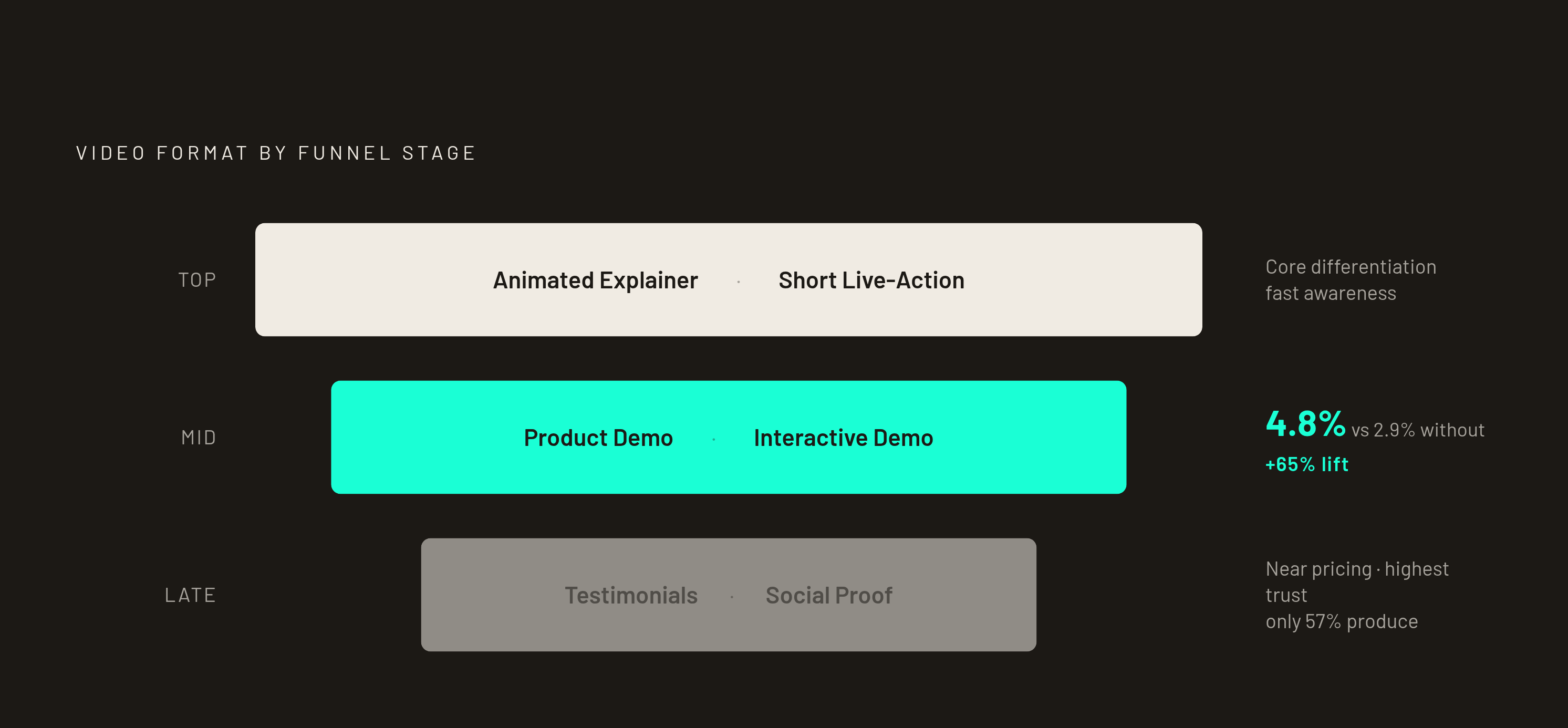
Top of funnel is about awareness, so an animated explainer or a short live-action piece does the job: communicate the core differentiation fast. This is where most SaaS teams already spend their budget, and it's also where generic videos fail hardest, because a template explainer doesn't say anything specific about what actually makes the product different.
Mid funnel is evaluation. A product demo or interactive demo belongs here, reducing uncertainty by showing the product in realistic use. The 4.8% versus 2.9% conversion gap between pages with and without demo video is directly relevant to this stage; it's not a top-of-funnel number.
Late funnel is decision. Video testimonials and live-action social proof do the final work of removing whatever trust barrier is left standing. Placement near pricing or checkout matters here as much as the format choice itself.
On budget: animation runs $15,000 to $35,000 for a solid top-of-funnel asset, live-action testimonial spend is justified by how much leverage it carries late in the funnel, and interactive demo platforms require real investment but pay it back for SaaS products serving multiple buyer personas.
The most common mistake is using an awareness-stage video, short, conceptual, animated, at a decision-stage moment: wrong format, wrong job, wrong point in the buyer's head. Production polish, meanwhile, matters less than people assume. A technically precise 60-second animated explainer, built from a script that reflects exactly how the product solves the buyer's actual problem, will outperform a gorgeous video built on generic messaging every time. That's the whole game: video production built around specific product differentiation, not a template with your logo swapped in, is what closes deals instead of just filling a content calendar.