Video Agency Vetting Criteria for Seed and Series A Startups
Early-stage startups need different video criteria than standard vetting advice assumes.

91% of businesses now use video as a marketing tool, and most B2B buyers would rather watch a product demo than read a whitepaper. Nobody's arguing that point anymore. What almost nobody talks about honestly is how a seed-stage or Series A startup should pick who actually makes that video, because the standard vetting advice assumes a company with a validated product, a defined category, and buyers who already know what they're shopping for.
I spent a while trying to figure out why that standard advice kept failing founders I talked to, and it came down to this: early-stage companies don't have any of that validated-product, defined-category setup. Their buyers are forming an opinion about a whole category in real time, not comparing you against three known competitors. That changes what "good" looks like. It also means the criteria most founders lean on, portfolio polish, team size, client logos, filter for exactly the wrong thing.
How seed and Series A differ in what they need video to accomplish
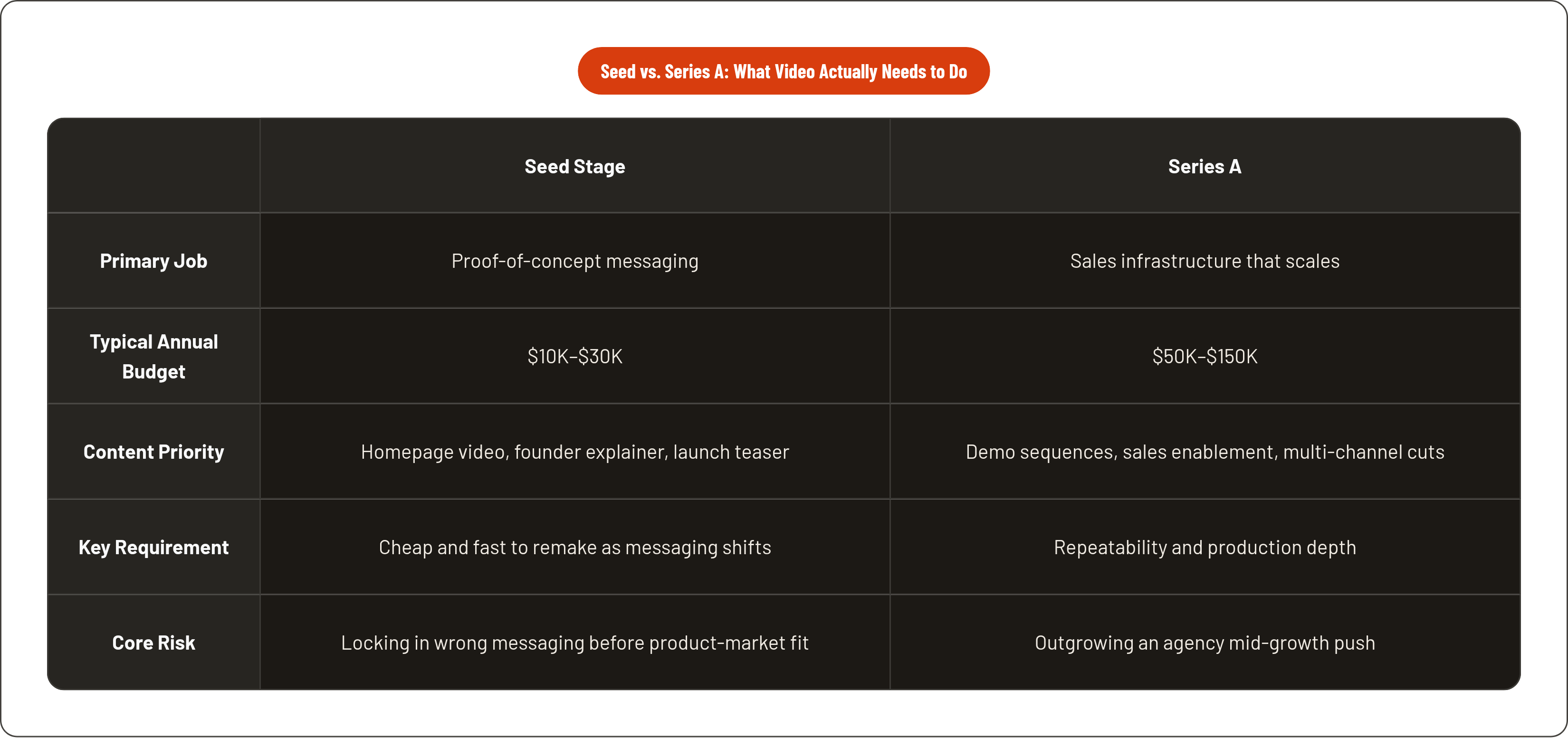
At seed, the job is proving the model can work. Video isn't a brand asset yet, it's a testing instrument. I've seen annual spend land somewhere between $10,000 and $30,000: enough for a homepage video, a founder explainer, maybe a teaser for a launch. The content has to be cheap and fast to remake, because your messaging is going to shift, and you don't want $20K of sunk cost sitting on your homepage contradicting what you said in your last three customer calls.
The existential risk lives right here. Sign a 12-month retainer before you've confirmed product-market fit, and there's a real chance the video and the messaging under it are both wrong by month three. You've locked in the wrong thing at the exact moment you could least afford to.
Series A flips the job entirely. The model works now, so the goal becomes scaling what's already working. Budgets move to the $50,000 to $150,000 range annually, flagship pieces running $15K to $50K, the rest going toward retainer or subscription arrangements for ongoing content. Priorities shift toward repeatability: demo sequences, sales enablement clips, cuts for different channels. The risk changes shape too. An agency scrappy enough to move fast for you at seed may not have the bench to produce at Series A volume without falling apart at the seams.
The underlying job stays the same in both cases: video has to move a buyer. But seed needs proof-of-concept messaging, and Series A needs sales infrastructure that scales. Run one vetting process for both problems, and you'll hire the wrong agency at least once.
I'll name the counterpoint directly, because it's a real one, and it took me a couple of conversations with skeptical operators to take it seriously. Some experienced operators argue seed-stage founders should skip agencies entirely. A 40-second founder explainer shot on a phone can build more trust with early buyers than a polished brand film, since the polished film signals "we spent money" when what an early buyer wants to hear is "we understand your problem." Fair point. Think hard about it before you commit a dollar of seed budget to video.
Why most agencies are optimized for the wrong outcome at early stage
The default agency pitch leads with reel quality, because production value sells in a pitch meeting. Nothing wrong with that as a business strategy, except it's built for a client that isn't you.
Take a large agency built around enterprise retail clients. Its whole operation is structured around big budgets, long timelines, and brand awareness goals. When a startup engagement lands on their desk, it usually goes to whoever's newest on the team, since the senior people stay staffed on the accounts that pay for the office. What gets optimized in that setup is visual polish and award-worthiness. What gets underweighted is speed, flexibility, and the actual hard skill of explaining a complex product to a skeptical buyer who's never heard of your category before.
That's the evaluation trap, and it took me a while to see it clearly myself. A beautiful reel built from consumer brand work tells you nothing about whether that team can explain what a workflow automation platform does to a VP of Ops who's currently doing the job by hand in a spreadsheet. Stage fit matters more than agency size, awards, or client logos.
Messaging capability: whether the agency can distill what you actually do
The hardest part of early-stage video isn't the production. It's figuring out what to say and who exactly you're saying it to.
On a discovery call, watch what they ask first. Do they want to know who the specific buyer is, what that buyer already believes, and what objection the video needs to knock down? Or do they jump straight to format, length, and visual style? That order tells you almost everything you need to know.
Ask them to explain, in plain language, before a single frame gets shot, what your product does and why a buyer should care. If they can't do it in conversation, they won't do it in a script either. And on scripts: does the agency treat the script as a strategic document worth debating and revising, or as a formality on the way to the part they actually enjoy?
Here's a test that costs nothing: ask the agency to critique the positioning on your current homepage. An agency with real messaging chops will have an opinion, probably a strong one. An agency without it dodges into questions about visual style, because that's the only ground they're comfortable standing on.
There's a domain-knowledge piece easy to miss here too. A studio full of people who make gorgeous consumer commercials may not know how to walk a technical buyer through a complex decision without flattening the parts that actually matter to that buyer. When you review portfolios, ask specifically for B2B SaaS or tech product work, not the general reel. Watch whether those videos teach you something you didn't already know, or whether they only make sense if you already spoke the category's language walking in.
Portfolio evidence of complex product work, not just production quality
Here's the mental shift that matters most in this whole process, and it's one I had to talk myself into after watching too many founders get it backwards. You're not grading the portfolio on how good it looks. You're grading it on whether it taught you anything.
Pick a video for a product you've genuinely never heard of. By the end, do you know what it does and who it's for? Is the actual mechanism, the thing that makes it different, on screen, or does the video just wave at words like "innovative" and "powerful" without ever showing you what backs them up? Does it assume you already speak the category's language, or does it build your understanding from zero?
Red flags, once you're looking for them, show up fast:
- Heavy consumer or lifestyle work with no B2B tech examples anywhere in sight
- Explainers that look expensive but stay so generic they could describe five competitors in the same space
- Case studies leading with view counts or award nominations instead of pipeline, demo requests, or conversion numbers
Green flags run the other direction: examples of genuinely complex or unfamiliar products explained without dumbing them down, evidence the agency reshaped a fuzzy brief instead of just executing it as handed to them, and work made for companies at a stage like yours, not just logos from companies that were already at Series C by the time the video shipped.
Format range counts for something too. An agency that handles demos, testimonials, onboarding clips, and social cuts under one roof saves you real coordination headaches. But that only matters once the messaging instinct checks out. Range without judgment just means more ways to produce the wrong thing quickly.
Speed and operational fit for a team that ships every two weeks
Startups run on sprint cycles. A video that lands six weeks after the feature it explains has already shipped is dead weight, not an asset.
Speed isn't a preference here, it's the constraint that makes everything else moot if it isn't met. Ask any founder who's actually shipped on a two-week cycle and they'll tell you the same thing: price and style stop mattering the moment a deadline slips twice.
Turnaround expectations should track the type of work. Operational content, launch clips, demo updates, quick social cuts, should move in 72 hours to two weeks. Flagship pieces, a homepage hero video, a Series A launch film, can reasonably take four to six weeks, but with real milestones along the way, not an open-ended "we'll get to it."
Ask these questions straight out. What's your average turnaround from brief to first draft? What happens if we need something in 48 hours, is there an actual process for that, or does it break how your team works? Are revision cycles time-boxed, or can they drag on indefinitely?
A newer tier of AI-assisted video shops, usually priced between $500 and $8,000, competes almost entirely on speed. For fast social content and quick-turn demo clips, that tier is worth a look on its own merits, though messaging depth varies a lot across it and needs its own scrutiny. Reliability counts as part of speed too: an agency with a track record of missed deadlines does more damage to a startup than to an enterprise client, because a missed launch window doesn't have the recovery room a six-month campaign calendar gives you.
Contract structure and what it signals about how an agency thinks about your stage
An agency asking for a 12-month retainer before you've proven video drives any outcome at all is asking you to fund their predictability with your runway. Say it plainly, because that's exactly what it is.
Contract structures that actually fit a startup's reality look like this: project pricing with a clearly defined scope, so you know cost and deliverable before you start; month-to-month arrangements that let you scale up or pause as priorities shift, without penalty; no cancellation fees tied to unused months down the road.
There's a hidden cost problem worth flagging too, one that only becomes obvious after you've watched a few budgets blow past their line items. Creative projects run over budget constantly, so the contract needs to spell out what happens when scope grows, not just what the starting number is. Push for an itemized estimate instead of one lump total, and ask directly what's not included in the price: extra revision rounds, expanded usage rights, access to raw footage, before you sign anything.
Subscription-based production can bring per-asset cost down meaningfully compared to paying project by project, which becomes a real factor at Series A once content volume climbs. But that only makes sense once you've confirmed the agency's output actually performs. A good discipline at seed: don't put more than 30% of your annual video budget into any single asset until you've got evidence that spending at that level moves anything.
IP ownership and usage rights — the terms most founders skip and later regret
Three situations catch founders off guard almost every time. A revision request gets flagged as out of scope and turns into a surprise invoice. The finished video can't run on paid media because the usage rights never covered that. Or the raw footage stays with the agency, so re-editing it later means paying again just to get access to it.
Usage rights determine where you can run a video, how, and for how long, and broader rights cost more. This is one of the most important clauses in any production contract, and it's the one founders skim past fastest. The most common setup: IP transfers to you once final payment clears, but "IP" often gets defined narrowly to mean the finished edit only, not the raw footage or the underlying project files.
Before signing, get clear answers. Do you own the final cut outright, or are there platform or time limits baked in somewhere? Do you get the raw footage, or only the finished export? If you plan to run this in paid media, is that already covered, or does it need a separate license on top?
If you already know your distribution plan, paid social, outbound sales decks, conference screens, product onboarding, say so before the project starts. Negotiating usage terms upfront takes five minutes. Renegotiating them after delivery is a negotiation you've already lost the leverage in. For an early-stage company especially, full and clean IP ownership matters more than it seems to in the moment: your messaging is going to change, you're going to want to re-cut footage six months from now, and paying twice for something you already commissioned is money that should've gone to payroll.
Scalability across funding rounds: avoiding the cost of re-vetting every year
Here's a pattern that costs founders more than they realize, and it took seeing it happen a few times before the shape of it became obvious. You hire an agency at seed, it works, you raise a Series A, and the agency simply can't operate at your new budget or volume. So you start the whole vetting process over, right in the middle of a growth push, exactly when your time is worth the most it's ever going to be.
Switching agencies every funding round costs more in time than in dollars. Re-briefing a new team on your product, your buyers, and your positioning from scratch eats months you don't get back, months where your competitors are shipping content while you're onboarding a vendor.
Ask this directly during vetting: what's the largest engagement you've run for a company at Series A or later, and what did that look like in terms of volume, format range, and delivery cadence? And if we outgrow you, what does that transition actually look like? Do you hand off to a partner agency, or does the relationship just end with a shrug?
Keep the Series A pricing tier in your head while you ask. Flagship work at that stage legitimately runs $15K to $50K per asset. An agency that topped out at $5K projects when you hired them at seed may not have the team depth or production infrastructure to operate in that range later, and that's fine, as long as they're honest about it. An agency that admits its ceiling upfront is worth more than one that oversells its upper-tier capability during the seed pitch and quietly underdelivers the moment you actually need it.
How to run the actual vetting process: a sequence that surfaces fit quickly
Start with the portfolio test before anything else. Find a B2B or tech product video from the agency for a company you don't know, and see if you understand what that company does by the end. That single exercise filters out more bad fits than a reference call ever will.
Move next to a live discovery conversation, and watch the order of the questions. Buyer, belief, objection first; format and style second. Reversed order is your answer right there.
From there, run the tests in sequence: ask them to critique your homepage positioning, ask for their average turnaround from brief to first draft, ask what happens on a 48-hour request. Get contract terms on the table early, project versus retainer, usage rights, raw footage access, rather than waiting until you're deep into the relationship and out of leverage. Close by asking about their ceiling: the biggest, most complex engagement they've run, and what a transition looks like if you outgrow them.
None of this takes more than two or three conversations to surface. Founders who skip it aren't saving time. They're just deferring the cost to a moment when it's a lot more expensive to fix.