In-House Video vs. Agency for B2B SaaS Teams
SaaS teams need constant video but can't always afford the in-house crew to produce it.
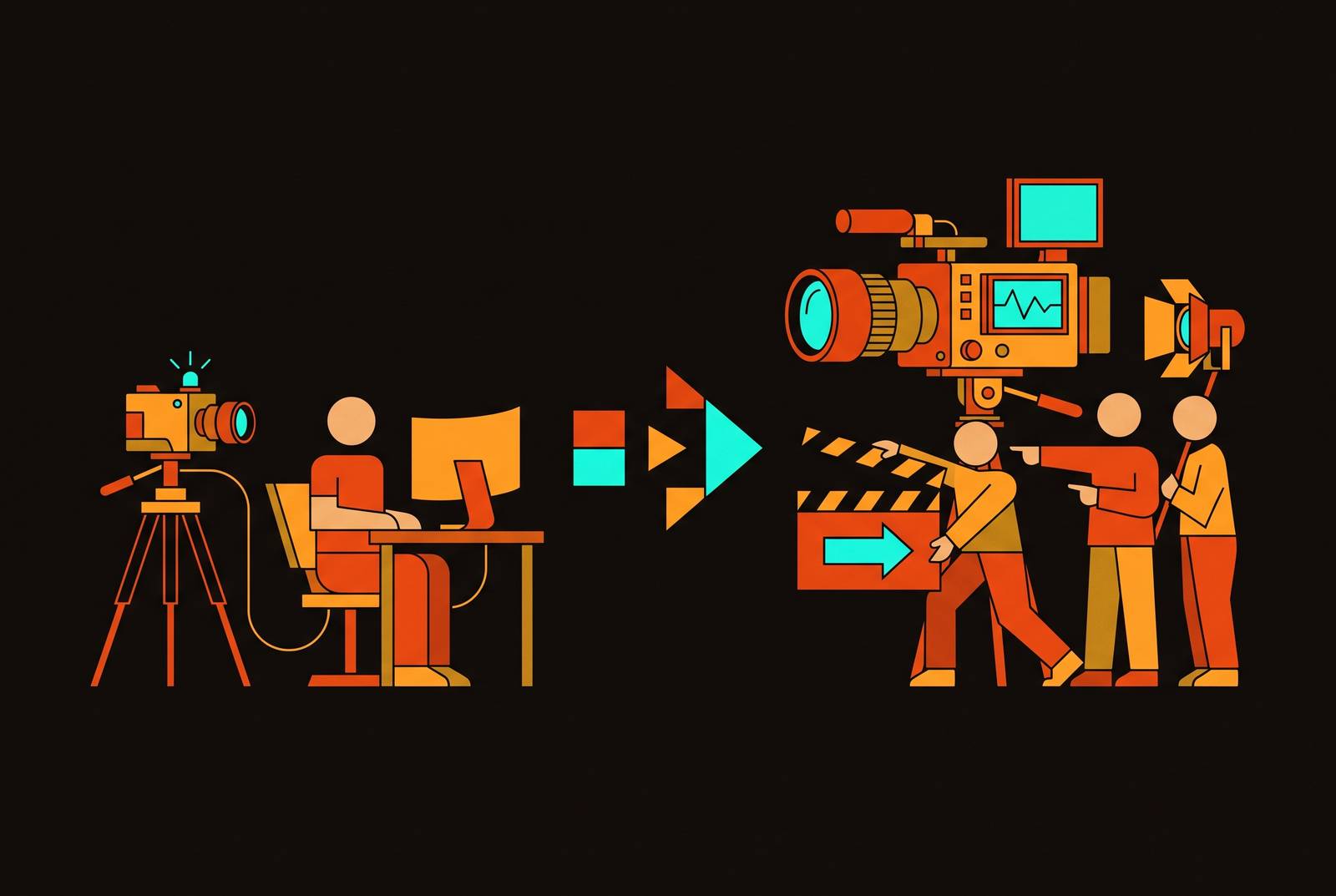
B2B software buyers now finish most of their evaluation before they ever talk to a rep, and video carries that self-serve journey. People would rather watch a product move on screen than read a whitepaper or wait a week for a demo slot. That means SaaS teams need video on a constant drip: short clips up top to earn a scroll-stop, product tours and webinars in the middle for people actively comparing options, demos and customer stories at the bottom for buying committees closing in on a decision. Most teams don't have the budget or the bodies to hit that pace, so the choice between building a crew in-house and hiring an agency carries more weight than it used to.
What makes B2B SaaS video different from other video production work
Most video advice out there comes from brand campaigns, consumer launches, or broadcast work. None of it maps onto SaaS cleanly, and the gap between generic video thinking and what SaaS actually requires is wider than most teams expect going in.
In a SaaS video, the product has to be the star. Talking heads and lifestyle b-roll don't close software deals; a clear look at the interface doing something useful does. Your audience is often technical, so vague claims about "powerful" features read as filler. Specificity is what actually earns trust here, not adjectives. You're also rarely talking to one decision-maker. A buying committee sits on the other side of the screen, so one video has to answer different objections for a CFO, an IT lead, and an end user, all at the same time. And because the product changes release over release, the videos describing it go stale faster than almost anything else you'll produce.
Watch time on B2B video has dropped hard the past few years. That shrinks your creative window and kills patience for a slow build. You get a few seconds to prove the video's worth finishing, sometimes less.
Social proof carries more weight here than almost anywhere else in marketing. Buying committees are risk-averse by nature, and a testimonial from a customer the buyer actually recognizes will beat a beautifully lit brand film when it matters most, right before the deal closes. So the real skill isn't production polish. It's turning deep product knowledge into something specific enough, timed to the right stage of the funnel, to move a buyer forward with no salesperson in the room.
What building an in-house video function actually costs and requires
Teams budget for a salary and assume that covers the whole cost of an in-house video capability. It doesn't, not even close.
One capable hire, someone who can shoot, edit, and handle basic motion graphics, costs somewhere between $70,000 and $95,000 a year before benefits, and benefits add another 20 to 30 percent on top. Want more than one format? Motion graphics or full animation layered on live action means hiring more specialists, not squeezing more hours out of the same person. A lean team that covers the whole SaaS video stack, scripting through animation, usually lands between $250,000 and $400,000 a year once benefits are folded in.
Then there's the part that never shows up on the headcount line. A decent camera body, lighting kit, and audio setup runs $8,000 to $15,000 before anyone shoots a single frame. Software licenses (Adobe Creative Cloud, cloud storage, stock asset libraries) bill every month whether you used them or not. Recruiting fees eat 15 to 20 percent of that first-year salary. And if your one production hire leaves, you're not just down a person, you're down a functioning pipeline while a replacement gets recruited, onboarded, and ramped. In the U.S. that's usually two to three months just to get someone seated, several more before they're running at full speed. Real output can lag close to a year behind where you need it.
Run the break-even math and the picture clears up fast. Say a team needs 20 to 30 videos a year. Spread a $300,000 fully-loaded in-house cost across that output and you're paying $10,000 to $15,000 per video, before you've even accounted for the ramp time. That's often more than an agency would charge for the same deliverable.
There's a ceiling built into hiring just one person, too. A single generalist can't be a director of photography, an editor, a motion designer, a scriptwriter, and a content strategist all at once. Something gives, usually quality, sometimes the person.
Where in-house production genuinely wins
In-house earns its keep when speed on small assets, brand depth, and staying close to the product day to day matter more than scale.
Need a quick social clip, a Loom-style walkthrough, or an email embed by end of day? An internal person turns that around in hours. No brief, no approval chain, no queue to wait in. Low-polish content also carries its own advantage: founder commentary, a raw screen recording, a candid walkthrough can outperform a slick corporate explainer, especially early on when buyers are trusting a person more than a brand. Tools like Loom, Descript, and Canva have lowered the floor for what counts as effective video. A small team with no studio can still put out something genuinely useful.
Institutional knowledge compounds, too. Someone on your team knows the product's quirks, the internal shorthand, where the competition is weak, what actually lands with your buyer. An outside agency needs weeks just to approach that depth. That gap matters even more for technical products, regulated industries, or a company built around a founder with a distinct point of view.
In-house wins clearly for high-volume, low-stakes output: internal enablement videos, quick product-update clips, fast social responses. Anywhere speed and familiarity beat production value.
The ceiling shows up the moment content turns high-stakes, faces outward, and needs to convert. That's exactly where the gap between a generalist hire and a specialist team starts to show up on screen.
What agencies offer and where they fall short for SaaS teams
A full agency brings a bench no single in-house hire can match: scriptwriters, directors, motion designers, editors, all working together, often able to start delivering pipeline-ready video in weeks rather than the months it takes to hire and ramp someone internally from scratch. Some studios narrow further by audience, like Letterspade, a B2B video shop focused specifically on devtools and security companies selling to technical buyers.
Pricing spans a wide range depending on scope. Per-video project work for mid-market B2B typically runs $3,000 to $25,000, depending on whether it's live-action, animation, or both. Subscription and retainer models built specifically for SaaS offer a predictable monthly cost and steady output; Content Beta is one example built for exactly this category, usually running a few thousand dollars a month for a set number of deliverables. For a company producing 20 to 30 videos a year, agency work often comes in cheaper than a fully-loaded in-house team for the same output.
Agencies with real SaaS chops understand something generalist shops miss: the product screen is the star of the video, not the set dressing around it. Apollo, for instance, works exclusively across B2B tech verticals, a focused option for teams that want a partner who's only ever worked this category. Studios built specifically around SaaS bring an edge in compressing complex product depth into a 60-second narrative built to convert, not to win an award on a showreel.
The failure mode I see most often: agencies treat SaaS marketing video as a fancier version of generic corporate explainer work. They hand back something polished that reflects their own portfolio style, but it doesn't capture what's actually different about the product. A generic explainer doesn't convert no matter how good the lighting is, and that risk climbs fast with any agency that hasn't done real time in SaaS.
There are trade-offs worth weighing honestly. Handing production to an outside team means less day-to-day control over creative choices. Revision cycles and scheduling can slow down anything time-sensitive. And a new agency partner needs real weeks, sometimes a full quarter, of onboarding before its output reflects actual product understanding instead of a guess at it.
How the hybrid model splits the work in practice
Hybrid has become the most common setup among B2B marketing teams over the past couple of years, passing both the fully in-house model and the fully outsourced one.
The split isn't 50/50. It's tiered by how much is riding on each piece of content. Hero content (brand films, flagship explainers, customer story videos, high-production demos) goes to an outside agency, because the stakes are high, the shelf life is long, and the conversion pressure justifies paying for specialization. Hub content (recurring LinkedIn series, product update recaps, webinar clips, thought-leadership segments) stays with the internal team running templated workflows, where speed and familiarity with the brand voice beat polish. Hygiene content, fast social replies, internal enablement clips, Loom walkthroughs, stays purely internal on cheap tooling. No outside involvement needed there at all.
Accountability usually splits cleanly, too. The internal team owns strategy, editorial direction, and performance reporting. The agency owns execution, production quality, and creative iteration. That keeps strategic control close to home while handing off the specialized labor to people built for it.
Company stage offers a rough guide for when hybrid makes sense. Below roughly $10 million in ARR, pure agency or pure in-house tends to work better; coordination overhead in a hybrid setup can cost more than it saves when the team is small and video volume is low. Between roughly $5 million and $30 million in ARR is the natural entry point for hybrid: enough budget for a small internal marketing team, enough video demand to justify a specialist partner for the high-stakes work. Above $30 million, larger internal teams start absorbing more production themselves, while still leaning on outside partners where specialized expertise keeps paying off.
AI is starting to change how much the in-house half of that split can cover on its own, without adding another hire.
How AI tools are changing the production calculus for both paths
A large and growing share of video marketers now build AI tools into their workflow, and adoption has climbed sharply the past couple of years with no sign of slowing.
In practice, AI is changing a few specific things. Post-production moves faster: AI-assisted editing can turn a full day of cutting into a couple of hours. Scripting and ideation move quicker too, since AI writing tools help a lean team knock out a brief or a first draft without burning a full afternoon on it. Synthetic voiceover has gotten good enough for product demos and onboarding sequences, which cuts the cost of producing variants for different markets or personas. And scene-generation tools are shrinking the time that used to go into planning a shoot before anyone picked up a camera.
Put together, a small internal team can now hold a steady publishing cadence on social and hub content without hiring someone new for every format. That's a real shift for the in-house side of a hybrid setup.
But the counterweight matters just as much. AI-generated content is turning into the floor, not the ceiling, and audiences are getting sharper at spotting it. Human-first content, visible authorship, personal commentary, real hands-on expertise, is becoming the differentiator precisely because feeds are filling up with AI polish that all starts to look the same. High-stakes conversion content, the flagship explainers, the customer stories, the executive thought leadership, still needs human craft and real product knowledge behind it, not a generated first pass.
For agencies, AI is compressing per-video costs and speeding up iteration, which is shifting what they compete on. An agency that used to charge a premium mostly for production labor now has to compete on expertise and product fluency instead, since the execution part alone keeps getting cheaper to replicate.
The decision framework: how to choose based on stage, volume, and what the video actually needs to do
The real question isn't what a team can afford. It's what the video needs to accomplish, and who actually has the product knowledge and craft to make it do that.
Three things decide the answer. Volume: how many videos does the team need a year, and how often. Low volume, say under 15 a year, almost always favors an agency; high volume across mixed stakes favors hybrid. Stakes: is this piece driving pipeline directly, or supporting it from a distance? The higher the conversion pressure, the more production expertise and product specificity matter. Product complexity: the more technical and differentiated the product, the more your partner needs real SaaS fluency, not just general video skill.
Early-stage teams with a tight budget and low volume should start with lightweight in-house tools. Loom and Descript are enough, and authenticity beats polish while the product and message are still taking shape. As volume and stakes climb, the calculation shifts toward bringing in outside specialization for the content actually on the hook for pipeline, while keeping the fast, familiar, low-stakes work close to home. Match the production model to what the video in front of you actually has to do. Don't default to whatever's cheapest this quarter and hope it holds up next year.