Video Agency Retainer vs. Project Models for Startups
Retainers save money at scale, but only if you need enough video to justify the monthly commitment.

Video agency spending is a fit problem, and the fit depends on where a startup sits in its growth curve, how much video it actually needs each month, and what it's trying to optimize for. There's no single math problem with one right answer here, and retainers and project deals both get sold as the smarter choice. Agencies push whichever model fits their own cash flow, not necessarily what fits a founder's stage. This piece breaks down how to make that call on your own terms.
The stakes aren't small. Video ad spend in the U.S. hit $111.55 billion in 2024 and is projected to climb to $130.97 billion in 2025, according to EMARKETER. According to Wyzowl, 91% of businesses now use video as a marketing tool, and 93% of marketers report positive ROI from their video content. Startup marketing budgets rebounded too, landing at 9.4% of company revenue in 2025, up 22% from the year before. Seed companies typically put 10-20% of raised capital toward marketing; Series A companies push that to 25-40%. For early-stage startups doing under $1 million in revenue, video budgets usually land between $3,000 and $10,000, a range small enough that one bad procurement decision can burn through a third of it.
What retainer and project models actually commit you to
A retainer is a fixed monthly fee for an ongoing scope of work, with no end date. The relationship keeps running as long as both sides think it's worth it. Some agencies bill retainers in hours; others use a point system or a defined set of monthly deliverables. That billing mechanism matters a lot when you're negotiating, because it determines whether you're paying for time or for output.
A project is scoped up front, priced to a specific deliverable, and it ends the day the work ships. Think launch videos, one-off explainers, a single asset built for a conference or a campaign push.
The difference goes beyond how you get billed, extending to what each model assumes about your future. A retainer bets that you'll need video on a regular cadence and that consistency across months will pay off. A project bets that your need is bounded, and that the brief you wrote captures it completely. Neither bet is right for everyone. That's the whole reason stage, volume, and what you're optimizing for need to drive the decision, not whichever pitch sounds cleaner.
What video agency work costs at each model in 2025
Project pricing swings wide. Corporate explainer videos run $4,500 to $20,000, while social content comes in lower at $1,500 to $5,000. Premium brand films can clear $50,000 without much trouble. Most video projects listed on Clutch actually price under $10,000, and typical hourly agency rates sit in the $100 to $149 range. That spread exists because project quotes bundle everything together: creative direction, crew, the shoot itself, editing, project management. Hard to compare two agency quotes line-by-line when the packaging differs that much.
Retainers follow their own scale. Basic to mid-tier packages land between $750 and $5,000 a month. Add more shoot days and some strategy work, and you're looking at $2,000 to $5,000 monthly, scaling past $10,000 for higher-volume accounts. Premium agencies charge $5,000 to $10,000-plus a month, and enterprise setups with a dedicated team can run $10,000 to $20,000 or more.
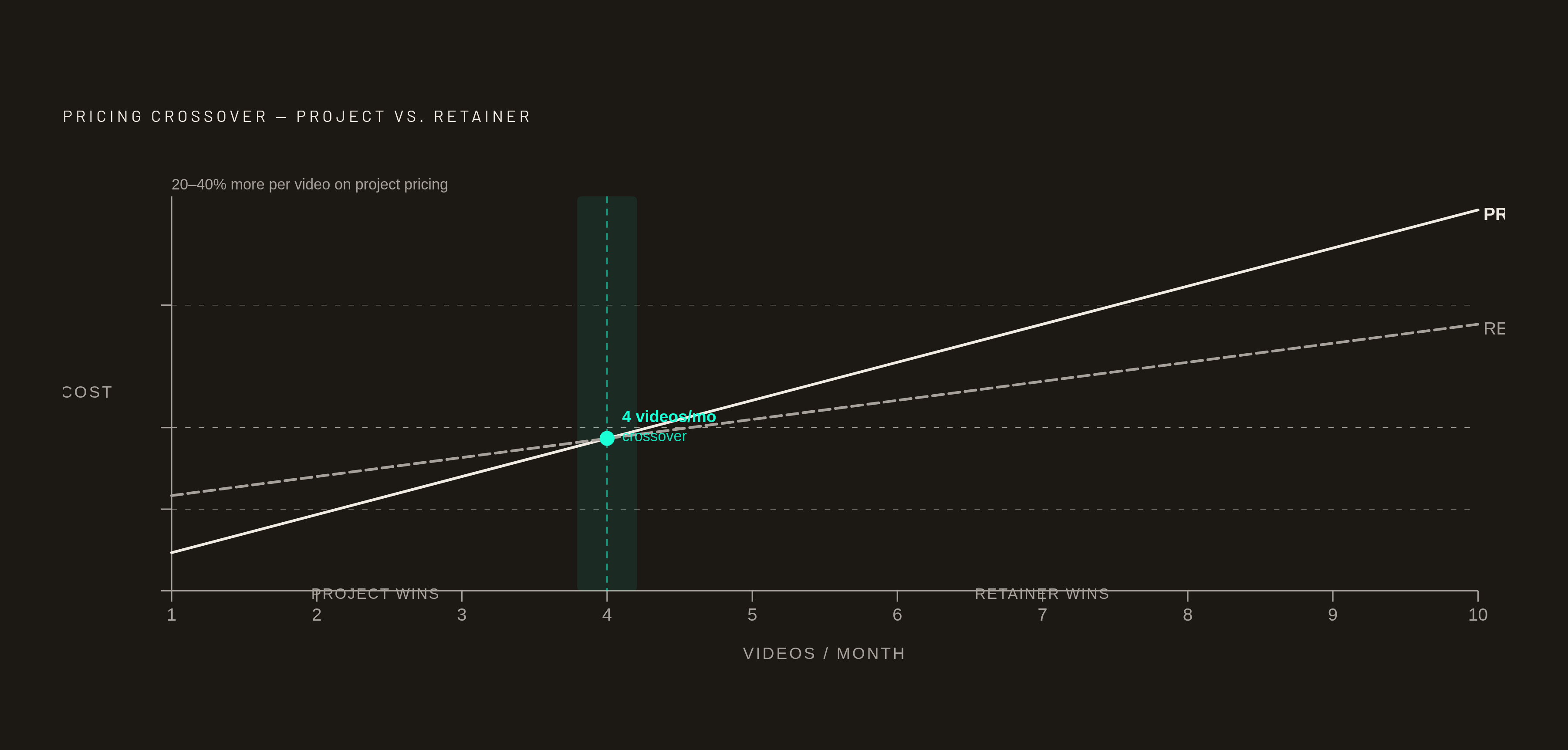
Here's the number that actually matters: retainer clients pay 20-40% less per video than project clients do, measured over a 12-month stretch. Reusing templates and production systems in a subscription setup can cut per-asset cost by another 30-40% versus paying project by project. That's real money, but it only shows up if volume is high enough to earn it back. At low volume, the monthly floor on a retainer wipes out any per-unit savings before they materialize.
The real question worth asking isn't which model is cheaper in the abstract — it's which cost structure matches how much video you're actually going to need.
What a retainer buys beyond the deliverables
Institutional knowledge compounds, and that's the real product a retainer sells. A team that's been working on your account for six months understands your positioning, your audience, your tone, and what's already been tried and failed. Month six output beats month one output, not because the editors got better at their jobs, but because they stopped guessing what you meant. Every time you start a new project engagement instead, that clock resets, and you're left with a new brief, a new brand walkthrough, a new round of explaining what your product actually does.
Retainer clients also get scheduled first. Agencies protect that calendar space before they take on one-off work, because retainer revenue is the business they're built to keep. If a startup needs a sales asset turned around fast for a live deal, that priority access matters more than the per-unit price tag ever will.
There's a sales-enablement angle too. A company using video for demo walkthroughs, objection-handling clips, or customer stories needs steady supply, not sporadic bursts. A retainer makes that supply something you can actually plan around, while a project model leaves you reacting every time.
None of this is charity on the agency's part. Retainer clients carry a lifetime value 3 to 5 times higher than one-off project clients, which is exactly why agencies with healthy retainer books give those accounts better rates and faster turnaround. The incentive lines up on both sides, as long as the volume is real.
Where retainers go wrong for startups specifically
Cash burn without predictability is the first trap. Annual retainers with cancellation penalties were built for marketing departments with a locked budget line, not for a founder deciding month to month whether the runway stretches to the next raise. A retainer that demands a 12-month commitment turns into a liability fast if the product pivots or a fundraise slips by even a quarter.
Scope creep is baked into the model, too. It starts small: one extra cut of a video, one additional format, one more variation "while you're in there," and it feels harmless in the moment. Add those requests up over six months, though, and you've either eaten a pile of unpaid work or you're stuck renegotiating scope you thought was settled. Retainers billed by the hour are especially exposed here, because the agency's incentive runs against yours the whole time.
Then there's the accountability problem. Without a discrete deliverable tied to a clear goal, a retainer can run for months producing plenty of content that never gets measured against anything. Startups optimizing for conversion, not for content volume, need every video to justify its own existence. A retainer's steady drip of output can quietly bury that discipline.
Before signing anything, ask one honest question: can you name four or more videos you need this month? If the answer's no, the per-unit savings a retainer promises won't cover the monthly floor you're paying regardless.
What project-based models protect — and where they fall short
Early on, project work has real advantages. The cost is fixed and the scope is defined before you sign anything, so you know your exposure up front. Commitment stays low while you're still finding out whether video even moves the needle for your product. And nothing locks you to one shop, so you can use a different agency for a brand film than you use for social cutdowns or demo videos. Competitive bidding actually works here too, since a defined deliverable can be shopped across vendors in a way an open-ended retainer relationship never can.
But there's a volume line where this stops making sense. At one to three videos a year, project pricing is the natural fit, since volume is too low to justify a monthly floor. At four or more videos a month, the premium you're paying per project starts adding up fast, and that 20-40% retainer discount turns into a real dollar figure sitting on the table.
Project work carries its own hidden costs too. Anything outside the original scope triggers a change order and a renegotiation, which is a constant headache for a startup whose product, and therefore whose brief, keeps shifting. Every new engagement also means paying the learning curve again, either in time lost or in quality that starts a notch lower than where the last project ended. And there's no compounding: the agency never builds up the product depth that makes month-six work better than month-one work, because there is no month six. Every project starts from close to the same blank page.
This shows up hardest in B2B SaaS. Landing pages with an embedded explainer video convert at 86% higher rates than text-only pages, and for genuinely complex products, that lift can clear 100%. But only if the video actually nails the product's real differentiation, and that kind of precision needs product knowledge that a one-off engagement rarely has time to build.
Matching the model to the startup's growth stage
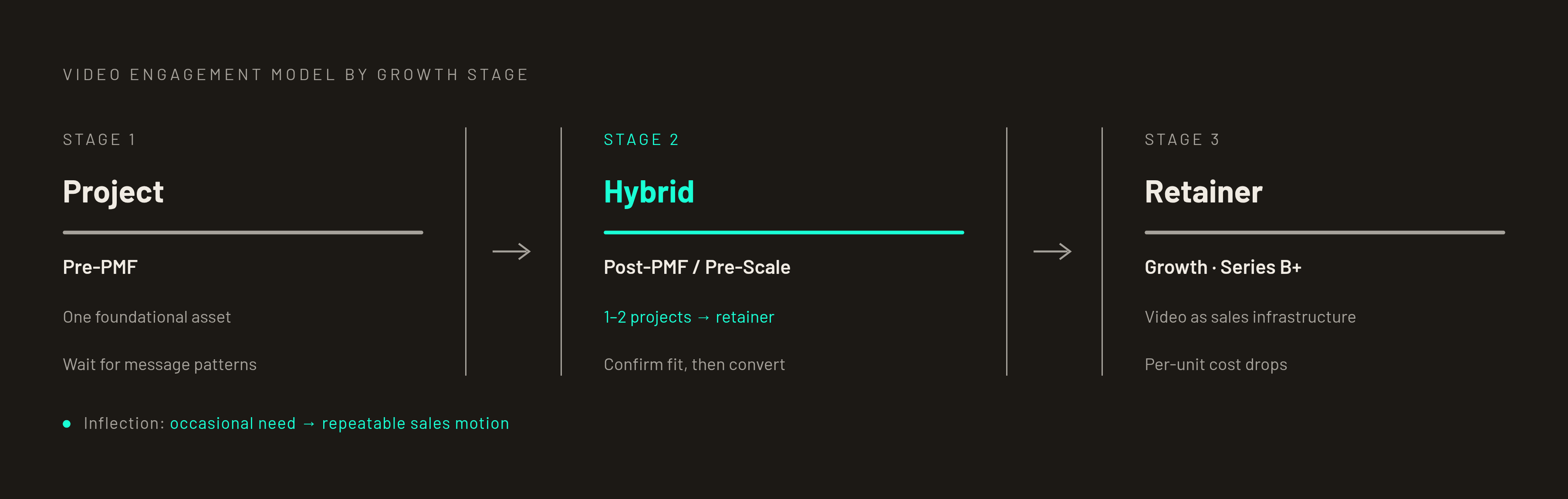
Pre-product-market fit is not the time for a retainer. The product story is still being figured out in real time, and locking in a monthly retainer means codifying messaging that might be wrong in 60 days. Project work is the right default here: lower commitment, easier to change course, and it lets you test whether video actually converts before you scale up spend. The right move is usually one strong foundational asset, a homepage explainer or a core product demo, tested and iterated on before committing to more. Higher production budgets should wait until message patterns prove out across at least two campaign cycles.
Post-PMF but pre-scale is the inflection point. Once there's a validated ICP and a repeatable sales motion, video need stops being occasional. Sales decks need supporting clips, new features need demos, customer wins need to be captured on a schedule. The question shifts from whether video is needed at all to how it gets produced without reinventing the wheel every time. A project-to-retainer sequence fits naturally here: run one or two projects to confirm the agency's a good fit, then convert to a retainer once the volume and the working relationship are both proven.
Growth stage changes the calculation again. At Series B and beyond, with GTM expanding across multiple channels, steady video output becomes a piece of sales infrastructure, not a creative nice-to-have. This is where the retainer's cost advantage actually pays off: institutional knowledge compounds, turnaround speeds up, and per-unit cost drops in real dollars. Agencies that run retainer-heavy books report far more predictable monthly income, and the tradeoff is that they save their best people and their fastest slots for those retainer accounts. That matters a lot once you're the one trying to scale output.
Stage isn't the only lens, either. If speed is what you're optimizing for, retainer wins, since there's no re-onboarding tax and you get priority scheduling. If cost control at low volume is the goal, project wins outright. If you're building toward sustained sales enablement, retainer wins once volume justifies it. And if creative experimentation is the point, project work wins, because it gives you the freedom to run different teams and different styles against each other.
The hybrid path most growth-stage startups land on
The most common pattern involves starting with projects and earning the retainer, rather than picking one model and sticking with it forever. Run one or two project engagements first to check agency fit, see if the messaging actually resonates, and judge production quality before any ongoing spend gets committed. Once that relationship is proven and the volume is real, convert to a retainer, and negotiate the terms from a position of leverage instead of blind trust.
A startup-friendly retainer looks different from a standard agency contract. Commitments run month-to-month or in short 90-day blocks, not a 12-month lock. Scope gets defined by deliverables, not by hours, so everyone knows exactly what ships each month and scope creep has less room to hide. And renewal ties to actual performance benchmarks tied to conversion, not to content volume for its own sake.
For B2B SaaS founders specifically, this argument matters more than the discount does. A complex product needs a production partner who understands it well enough to find what genuinely makes it different, not just a crew that executes whatever brief lands in the inbox. That kind of depth takes real time to build, and a project engagement almost never buys enough of it. The actual case for eventually moving to a retainer rests on the quality of product storytelling that only comes from a team that's spent months actually learning the product, more than on the 20-40% savings on paper.
A few concrete negotiation moves make the transition safer. Ask directly whether an agency offers a project-to-retainer pathway with better rates for long-term commitments. Push for rollover provisions, so a slow month's unused deliverables don't just evaporate. And tie every retainer renewal to an actual performance review instead of letting it auto-renew, so accountability stays live on both sides of the table.