Shooting Startup Demo Videos on Location in New York
The right location sells the product before your sales team ever takes the call.
A demo video shot on location in New York provides a visual vocabulary the buyer already speaks, something a studio backdrop rarely offers. Get the location wrong and the video looks expensive for no reason, but get it right and the video does sales work before a rep ever picks up the phone. Most founders treat location as decoration, chosen after the script is locked, and that order deserves reconsidering. It's part of why so many demo videos look great and convert nothing.
Most B2B buyers now watch a demo before they'll take a sales call, which makes the video a pre-qualification tool worth planning around from the start. The backdrop sits in frame one of that first impression whether anyone planned for it or not. New York offers a dense catalog of visual shorthand that needs no caption: cobblestones in DUMBO, glass towers in Hudson Yards, fire escapes in SoHo. A viewer reads the setting in under a second and starts forming assumptions about the product before the voiceover starts. That's the entire case for shooting on location here, and it's also the entire risk.
What the video needs to accomplish before the location is chosen
Start with the format, because the format rules out most locations before scouting even begins. A demo video running 60 to 90 seconds has no room for scenery that doesn't earn its place. Every second on a skyline or a brick wall is a second not spent on the product, and that tradeoff is the whole design problem.
The structure that works: open on the problem, not the brand, then show the product solving it in a real setting, and close on one clear call to action. Two-thirds of viewers finish a video under 60 seconds, according to Vidyard, and only one in five make it through anything over 20 minutes. Founders have watched a demo push past 90 seconds because they couldn't bear to cut a nice shot, and the drop-off in their own analytics told the story better than any benchmark could. The location is already on screen doing work in the first five seconds, before a single line of script lands, which means it has to be doing the right work.
Before booking anything, nail down the one job-to-be-done the video is going to dramatize. The location's whole purpose is to make that job feel real. A workforce scheduling tool shot on the floor of a busy Manhattan restaurant, real tickets flying, a host actually managing a wait list, reads nothing like the same product demoed in a sterile conference room. A fintech tool shot against the Financial District skyline tells the buyer who this is for without a line of narration.
Decide early whether the location is the world the buyer actually lives in, or the world they wish they lived in. Most B2B founders default to aspiration because it photographs better, and that's usually the wrong call. Unless the product is explicitly selling a lifestyle upgrade, shoot the buyer's real Tuesday morning. Mixing the two by accident, half aspiration and half authenticity, is how a shoot ends up looking expensive and unconvincing at the same time.
One more decision belongs here, not on set. If the product is screen-based, how does the interface actually read on camera? Exterior daylight fights screen legibility: glare, auto-brightness hunting for exposure, reflections nobody notices until playback. That's the fork between shooting fully exterior, mixing interior and exterior setups, or going interview-style with the product cut in as B-roll.
The neighborhoods that appear most often in NYC startup demo shoots and why
Flatiron, NoMad, Union Square. This corridor was the original home of Silicon Alley, and it still reads that way: boutique office buildings, loft interiors, foot traffic that feels professional without feeling corporate. Default choice for B2B SaaS, HR tech, and productivity tools aimed at knowledge workers, because the visual language matches the buyer's actual workday.
SoHo. Big windows, high ceilings, exposed brick, natural light a gaffer would kill for. OpenAI's New York office sits in the Puck Building here, and the neighborhood has picked up that association for AI and creative tech more broadly. Best fit: consumer tech, media platforms, design tools, anything where brand identity is part of the product.
DUMBO and Downtown Brooklyn. Cobblestones, bridge views, converted warehouses stacked close together, a strong tech tenant base backing up the aesthetic without making it read corporate. The Brooklyn Bridge shot works great for B-roll, but it needs a MOME permit and real crowd planning, since half of Instagram is trying to take the same photo at the same time.
Williamsburg. Rooftops with a clean Manhattan skyline sightline are among the most requested setups in startup brand content, and that's exactly the trap: those rooftops are private property, residential or mixed-use, and a location release plus sign-off from building management isn't optional paperwork. Skip it and the shoot doesn't happen, no matter how good the light looks that morning.
Bushwick. The Bushwick Collective murals give a shoot dense, high-contrast walls with real color and texture, at zero permit cost for the exterior wall itself, though crew footprint rules still apply if gear or people block a sidewalk. This is the neighborhood for challenger brands and consumer apps chasing an under-35 buyer tired of seeing the same demo dressed the same way.
Central Park. The most versatile single location on this list: wooded paths, a lake, skyline-framed meadows, all inside one park. That range costs something, since it needs both a MOME permit and a separate Media Production Authorization from NYC Parks, meaning two applications and two clocks running on two different schedules. Fits wellness tech and consumer apps that want to show a person living in the city rather than trapped by it.
How NYC's permitting system actually works for a small production
The Mayor's Office of Media and Entertainment, MOME, is the single point of contact for permits on any public location in the five boroughs. MOME processes more than 50,000 production permits a year, which means the office has seen every version of a two-person crew trying to guess at the rules instead of just asking.
Here's the line that actually matters: handheld camera, no exclusive claim to the space, no permit needed. The second a tripod, dolly, jib, or boom mic shows up, or the crew claims a stretch of sidewalk or a park bench as its own, a permit is required. A two-person run-and-gun crew with a gimbal can often operate under a Letter in Lieu instead of a full permit, a useful shortcut for B-roll days. Actors in costume, stunt work, or production vehicles trigger a full permit no matter what camera is in hand, and no amount of "we'll just be quick" changes that math.
Most MOME permits are free, though the real cost sits in what the permit requires around it. General liability insurance, minimum $1 million, naming the City as additional insured, is standard documentation for any permitted shoot. Closing a street brings a traffic control plan and NYPD coordination to pay for. Flying a drone adds a separate FAA authorization layered on top of the MOME permit, since New York airspace is among the most restricted in the country.
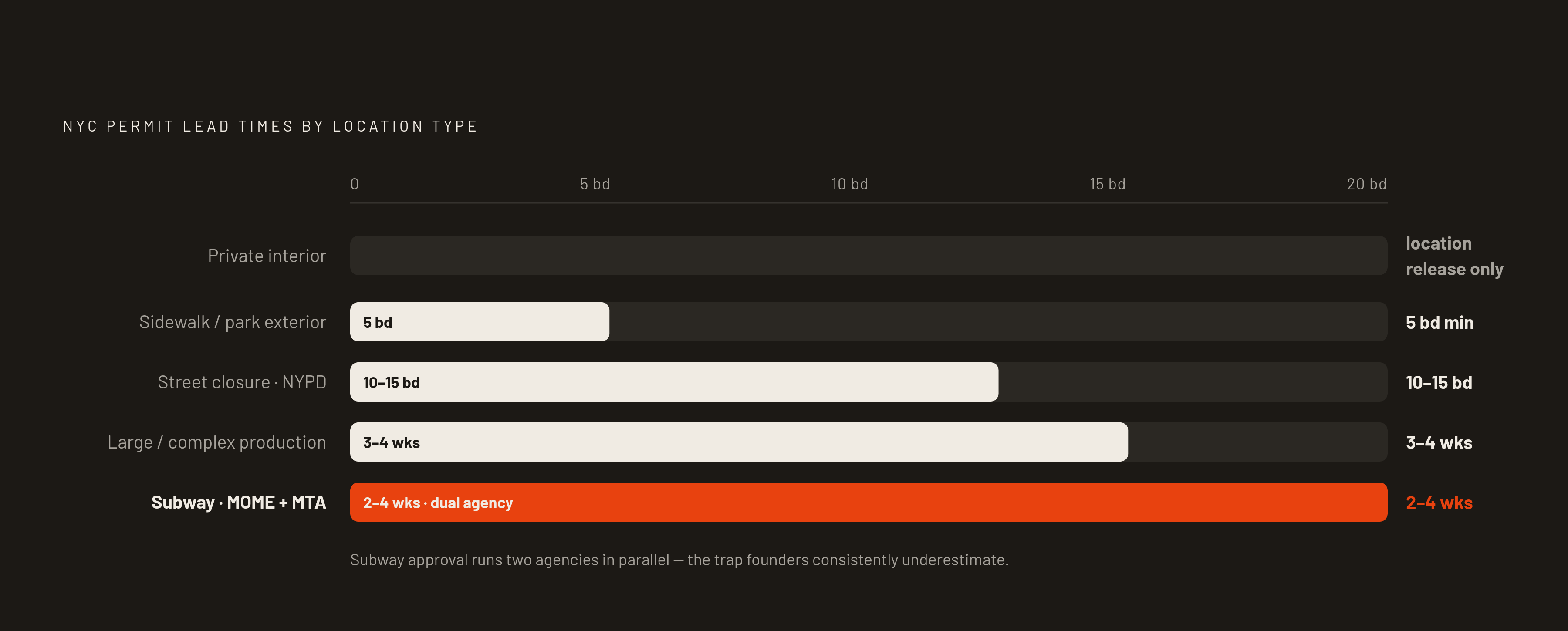
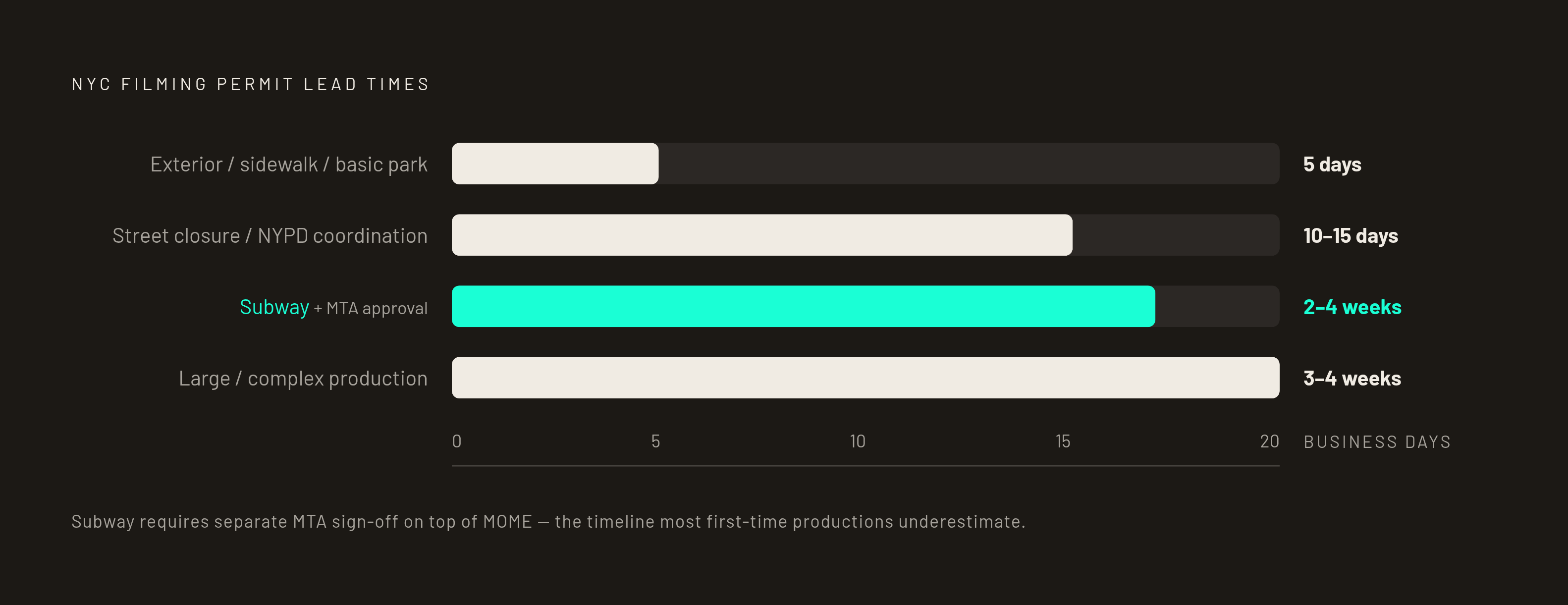
Timelines dictate when scouting has to lock in, and this is where most first-time productions get burned. A standard exterior permit for a sidewalk or basic park use needs 5 business days minimum, and adding a street closure or NYPD coordination stretches that to 10 to 15 business days. Anything involving the subway needs 2 to 4 weeks, with a separate MTA approval on top of MOME's, and large or complex productions should build in 3 to 4 weeks of runway. Founders have lost an entire shoot week to a subway permit assumed to clear in five days like everything else had; the crew instead sat idle, waiting on a second agency's clock.
Parks locations carry their own wrinkle. If a shoot needs a MOME permit and it's also on NYC Parks property, that's a Media Production Authorization running parallel to the MOME application, on its own separate timeline, with two agencies keeping two clocks that never talk to each other.
Private interiors, a SoHo loft, a Williamsburg rooftop, a co-working space, skip the MOME process entirely. A location release from property management and separate insurance documentation are still standard, though, and a slow building management office can eat just as much calendar time as a city permit would. Skipping any of this brings real consequences: fines, equipment seizure, a shutdown mid-shoot. A wasted shoot day in New York costs far more than the permit application ever would have.
What a realistic NYC location shoot costs for a startup demo video
Start with the baseline. The 2025 American Marketing Association survey put the national average corporate video budget at $14,500, up 24% from 2023. New York pushes a comparable brief above that number before a single frame gets shot, because production labor and facility costs here run 20 to 40% above the national average.
Line items break down roughly like this. A single videographer runs $1,000 to $3,000 a day; a full production team runs $5,000 to $15,000 a day. On-camera talent costs $500 to $1,500 a day, voiceover runs $300 to $1,000 a session, and location or studio rental lands between $500 and $3,000 a day depending on the space. Post-production typically eats 25 to 35% of the total project cost, which is the part founders forget to budget for entirely.
Put it together and a realistic 2 to 3 minute demo runs $2,000 to $30,000. That spread is a direct readout of choices. The low end is one person with a camera, a private interior location, the founder on camera, minimal editing, while the high end is a full crew, multiple locations across a day or two, hired talent, a color grade pass, a proper sound mix. Live-action rates run $1,000 to $3,000 per finished minute, so a 90-second demo and a 3-minute demo call for separate budget conversations rather than one scaled up from the other.
Watch for what actually blows past estimates on a New York shoot: overtime, since crew day rates don't flex; a denied permit or a locked building forcing a last-minute location swap; weather contingency on anything exterior; reshoots because a mic picked up a siren or a jackhammer nobody planned for. Every one of these has shown up on real shoots, usually the one item that wasn't in the budget line. Building a 10 to 15% contingency buffer on top of the quoted budget is simply what the city does to a shoot schedule as a matter of course.
What the New York premium actually buys: crews who move between commercial work, corporate video, and long-form production in the same week, rental houses stocking broadcast-grade gear on short notice, colorists and editors with feature-film credits available at a day rate. That bench depth is real, and it shows up in the finished product.
How to make location decisions that serve the product story rather than the production reel
Run every location choice through one test: does this environment make the buyer feel seen, or does it just make the production look expensive? Confusing those two is a common mistake in this whole process, and founders make it constantly, because the expensive-looking shot is the one that feels like progress on set.
A rooftop with a Manhattan skyline behind it is a beautiful shot, but it's also contextually empty if the product serves warehouse logistics managers who have never set foot on a Williamsburg rooftop and never will. An unglamorous but accurate environment, a real office floor, a co-working space with someone's lunch still on the desk, often converts better, because it matches the world the buyer actually lives in. Chasing the beautiful shot instead of the accurate one is an easy trap to fall into, and one of the most avoidable mistakes on this whole list.
Match the neighborhood to the buyer segment, not to whatever the founder finds visually exciting. Enterprise B2B calls for Midtown or Financial District exteriors, or an interior that reads credible rather than scrappy. SMB and prosumer products do well in SoHo lofts or DUMBO streetscapes, projecting accessible ambition rather than intimidating scale. A developer or technical buyer usually wants the product front and center, with the location doing minimal context work rather than serving as the visual centerpiece.
Shoot days are expensive, while pre-production is cheap by comparison. Scouting and permitting decisions made late cost multiples of what the same decisions would have cost three weeks earlier, back when there was still time to pick a different building or file a different application. That gap in cost is entirely avoidable and almost nobody avoids it.
There's a floor on production quality that matters here too, since a video that looks intentionally stripped-down reads very differently from one that looks like it ran out of money halfway through. In the 60-second window where most B2B buyers decide whether to take a sales call, production value does credibility work whether anyone planned for it or not.
Knowing the product cold matters more than any location on this list. The location, the crew, the edit, all of it exists to serve one job: communicating what actually makes the product different, in the 60 to 90 seconds a viewer will give it. A video shot on location in New York arrives with a visual vocabulary already loaded in. The work that's left is making sure that vocabulary speaks to the right buyer, not just filling the frame because it looked good on the scout.