Video Production Studio Rates in New York City
Understand what's bundled in studio quotes before comparing rates across NYC's 60 facilities.
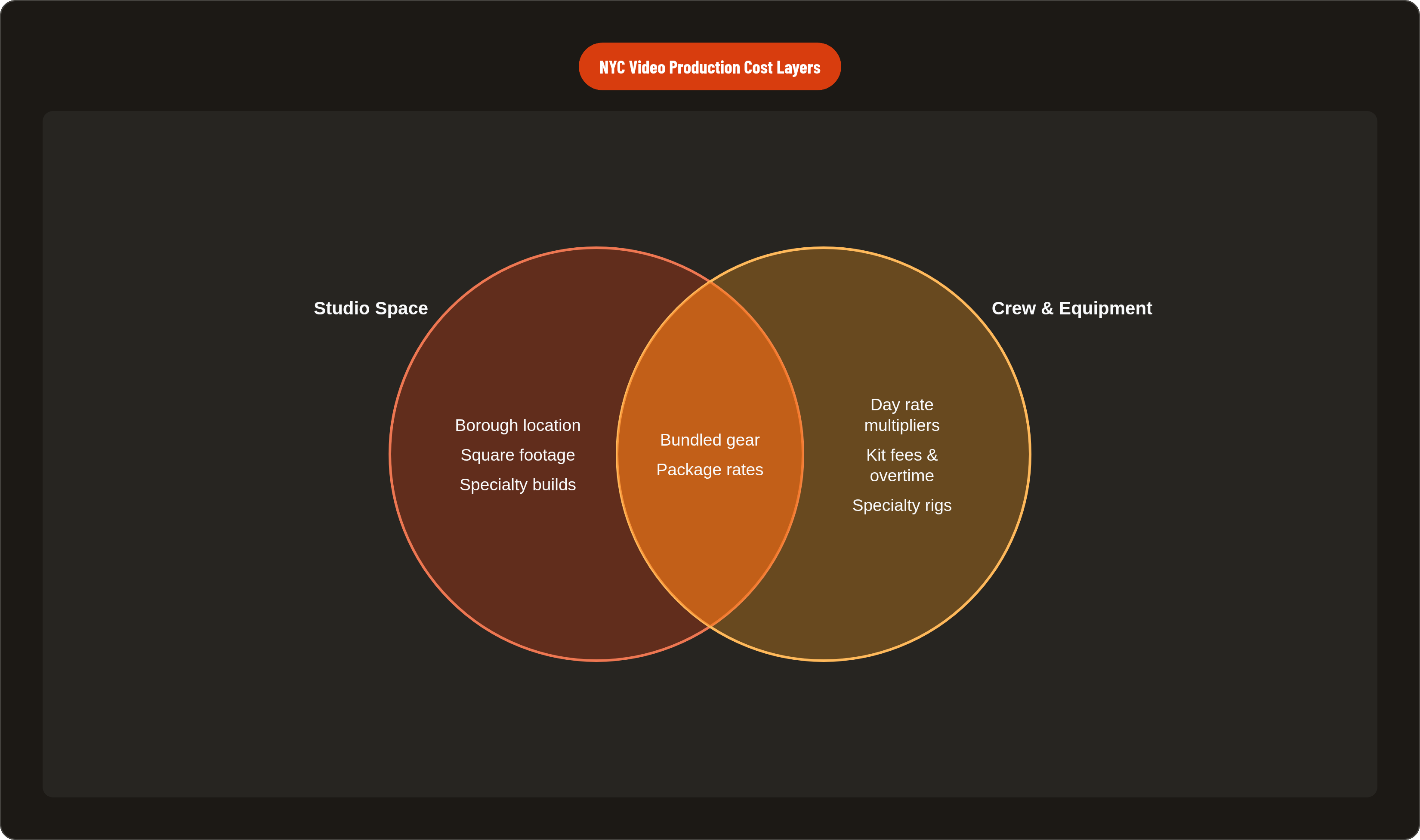
Video production studio rates in New York City span an enormous range, and the confusion is structural, not accidental. A "studio rate" can mean bare square footage, or it can fold in crew, equipment, and post-production; buyers comparing quotes are often not comparing the same thing. Understanding how each cost layer works, and how they compound, is the only way to read a rate card accurately and build a budget that holds.
NYC is the country's second-largest production hub after Los Angeles, with nearly 60 qualified production facilities across the five boroughs and close to 2 million square feet of studio space. That density is an advantage. It also means the spread between the cheapest and most expensive options is genuinely vast. The figures throughout this piece reflect 2025 to 2026 market data; treat them as planning anchors, not locked prices, because rates move with demand.
How Studio Type and Borough Determine the Baseline Space Cost
Not all studio rentals are the same product. A marketplace listing, a cyclorama stage, and a full commercial soundstage are priced differently for structural reasons, and comparing their hourly rates directly produces a misleading picture.
Marketplace platforms like Giggster and Peerspace show the full range: video studio bookings in New York run from $19 to $5,000 per hour, a span that reflects every tier from a bare room to a flagship soundstage. More useful anchors: the average hourly rate for music video and production spaces on Giggster sits at $242 per hour; Peerspace puts the soundstage average at $121 per hour, with smaller venues closer to $101 per hour and larger ones around $375 per hour.
The borough spread is real and consistent. Manhattan soundstages run $1,500 to $5,000 or more per day. Brooklyn and Queens offer comparable square footage for $800 to $2,500 per day. Outer-borough studios are not inferior; they're simply less expensive to operate, and that savings passes through directly.
Within a single market, studio type creates its own pricing tier. Cyclorama wall studios run $90 to $200 per hour depending on size and included gear. Showroom or minimal brand presentation spaces land around $70 to $150 per hour. Bare creative spaces with no specialty build sit at the lower end of marketplace listings.
One counterintuitive pattern worth flagging: weekends are the most-booked days for video studios in New York, yet Saturdays and Sundays average roughly 20% cheaper than weekday rates. Buyers who assume weekends carry a premium can use that assumption profitably by flipping it.
Minimum booking requirements, typically two to five hours, mean the published hourly rate often understates actual minimum spend. A $90-per-hour cyclorama with a two-hour minimum is a meaningful floor before anything else is added.
What Named Studios Actually Charge Across the Price Spectrum
The named options in New York illustrate how the tiers actually play out in practice, and the spread is wider than most buyers expect.
At the budget tier, Love Studios NYC offers smaller studios from $65 for a three-hour block, with their cyclorama Studio 14AB booking at $190 for a 10-hour day, among the lowest day rates for a specialty space in the city. FD Studios NYC, with Manhattan and Brooklyn locations, starts at $60 per hour with 24/7 access and online booking, built for teams that need flexibility over facility scale.
The mid-tier is where most professional commercial shoots land. Astoria Prime Studios in Queens starts at a few hundred dollars for a half-day, positioned for emerging creators and smaller commercial productions that need a legitimate professional environment without flagship pricing.
In the premium tier, Chelsea Studios NYC starts at $1,200 per day, a rate that reflects both the Midtown Manhattan location premium and full-service positioning. Be Electric Studios' Studio 11 in Long Island City offers 21,500 square feet with 21-foot ceilings and a 65-foot wide cyclorama, a large-format facility priced accordingly for productions that need genuine scale.
At the flagship and specialty level, Silvercup Studios operates 240,000 square feet across 23 soundstages. Rates are negotiated per project, not publicly listed, and the facility sets the benchmark for large commercial and broadcast production. Silver Spoon XR in Manhattan operates an LED volume stage with a nearly 50-foot wide ROE LED wall and real-time motion capture, a virtual production category that operates on entirely separate pricing logic from traditional studio rental.
The pattern is consistent across all tiers: space cost scales with Manhattan proximity, square footage, specialty build, and included services. A buyer choosing on rate alone without confirming what's included will reliably mismatch budget to need.
Crew Costs and Why Day Rates Understate the Real Number
Studio space is often the first number buyers focus on. Crew cost is usually the larger one.
Standard NYC production crew day rates run roughly $1,000 to $2,500 for a director, $800 to $1,500 for a producer, $800 to $1,500 for a director of photography, $600 to $1,200 for a gaffer, $400 to $800 for a sound technician, and $150 to $300 per day per production assistant. A lean crew for a simple shoot lands in the low thousands per day. A full crew for a complex production can reach well into five figures for a single day.
The multiplier problem is where buyers consistently get caught. Day rates are only roughly the majority of actual crew cost. Kit fees add a meaningful percentage on top. Overtime contingency adds another 10 to 20%. Employer payroll taxes compound further. A quoted day rate becomes materially higher in practice, and buyers who budget on quoted rates alone will run short.
NYC carries a significant premium over mid-market U.S. cities. That delta is not negotiable through vendor selection; it's embedded in the labor market. One 2026 market shift worth noting: streamer rates, which compressed during the 2023 to 2024 pullback, have rebounded to at or above 2022 levels in major markets. Commercial work remains the most stable production category.
For SaaS and B2B video buyers specifically, crew scope is the most controllable cost variable. A clearly scoped single-camera interview setup requires a fraction of the crew a multi-angle commercial shoot demands. The brief drives the crew size, not the other way around, and that means the brief is where budget control actually happens.
Equipment Rental Rates and How They Stack Onto Space and Crew
Camera packages run from the hundreds to low thousands per day for standard configurations. Supporting gear adds quickly: backup cameras, lenses, and support gear can add significantly per day on top of the primary camera package. Professional lighting packages run hundreds to over a thousand dollars per day. Sound recording equipment adds several hundred dollars per day. Drones, specialty rigs, and advanced lighting can add $500 to $5,000 per day depending on complexity.
The compounding effect is where buyers who look only at studio rates get surprised. A premium studio day rate, before crew, leaves the equipment budget entirely unaddressed. On a well-equipped shoot, equipment alone can match or exceed the studio space cost.
Many mid-tier and boutique studios include basic lighting and audio in their day rate. Confirming what's bundled versus billed separately is the first practical question to ask any studio before signing a booking agreement.
For leaner B2B video projects, particularly talking-head explainers and product demos, equipment costs are compressible when the production is scoped tightly from the start. The camera-plus-lighting-plus-audio stack for a single-subject shoot is a fraction of a multi-setup commercial package, and that compression is available to any buyer who defines the deliverable before sourcing the studio.
Post-Production Costs That Buyers Forget to Budget For
Post-production is where the gap between what buyers plan and what they actually spend tends to be largest.
NYC editors charge roughly double-digit to low-triple-digit rates per hour. A two-minute finished video with a few days of editing can cost several thousand dollars in editing alone, before color or motion graphics. Professional colorists charge hundreds to thousands of dollars or more per day; for a commercial or brand video, grading typically spans multiple sessions. Simple titles, lower thirds, and transitions run from the low hundreds to several thousand dollars for the package. Motion graphics push hourly rates meaningfully higher than basic editing cuts. Three-dimensional animation sits at the top of the post-production rate scale.
Pre-production writing is the line item that most often gets skipped entirely. Professional scriptwriters in NYC charge hundreds to several thousand dollars for concept development and a full script. Skipping the script doesn't eliminate that cost; it relocates it to editing, where fixing structural problems is slower and more expensive than solving them before the camera rolls.
The practical summary: post-production for a polished two-minute brand video can equal or exceed the cost of the shoot day itself. For SaaS explainer videos specifically, the script and motion graphics are often where the real differentiation happens. A technically competent shoot built on a generic script still produces a generic video, and no amount of color grading corrects for that.
Permit Costs and Location Fees That Apply Inside Studio Shoots
Shooting anywhere in NYC requires permits. This applies even to locations that feel private or low-profile, and the assumption that a controlled interior exempts a production from permit requirements is a reliable source of last-minute budget problems.
Interior location permits run roughly $300 to $800. Street and outdoor scenes add $500 to $2,000 or more depending on location and disruption level. Rooftop shoots carry additional insurance requirements plus permit fees that can reach several thousand dollars. High-profile locations, including Central Park, Times Square, and busy Brooklyn commercial blocks, can involve a permit, a location fee, and sometimes required police presence, with costs totaling $1,500 to $5,000 or more for a single location.
Studio shoots avoid most permit exposure, which is one practical reason brands with tight budgets default to controlled studio environments rather than location shoots. The cost and logistical simplicity of a studio day often compares favorably to the permitting and coordination overhead of a comparable location shoot.
Insurance is a parallel requirement. Most studios require proof of production insurance as a booking condition. It is a real line item, not a formality, and sourcing it should happen during pre-production, not the day before the shoot.
How the Layers Assemble Into Total Project Budgets by Tier
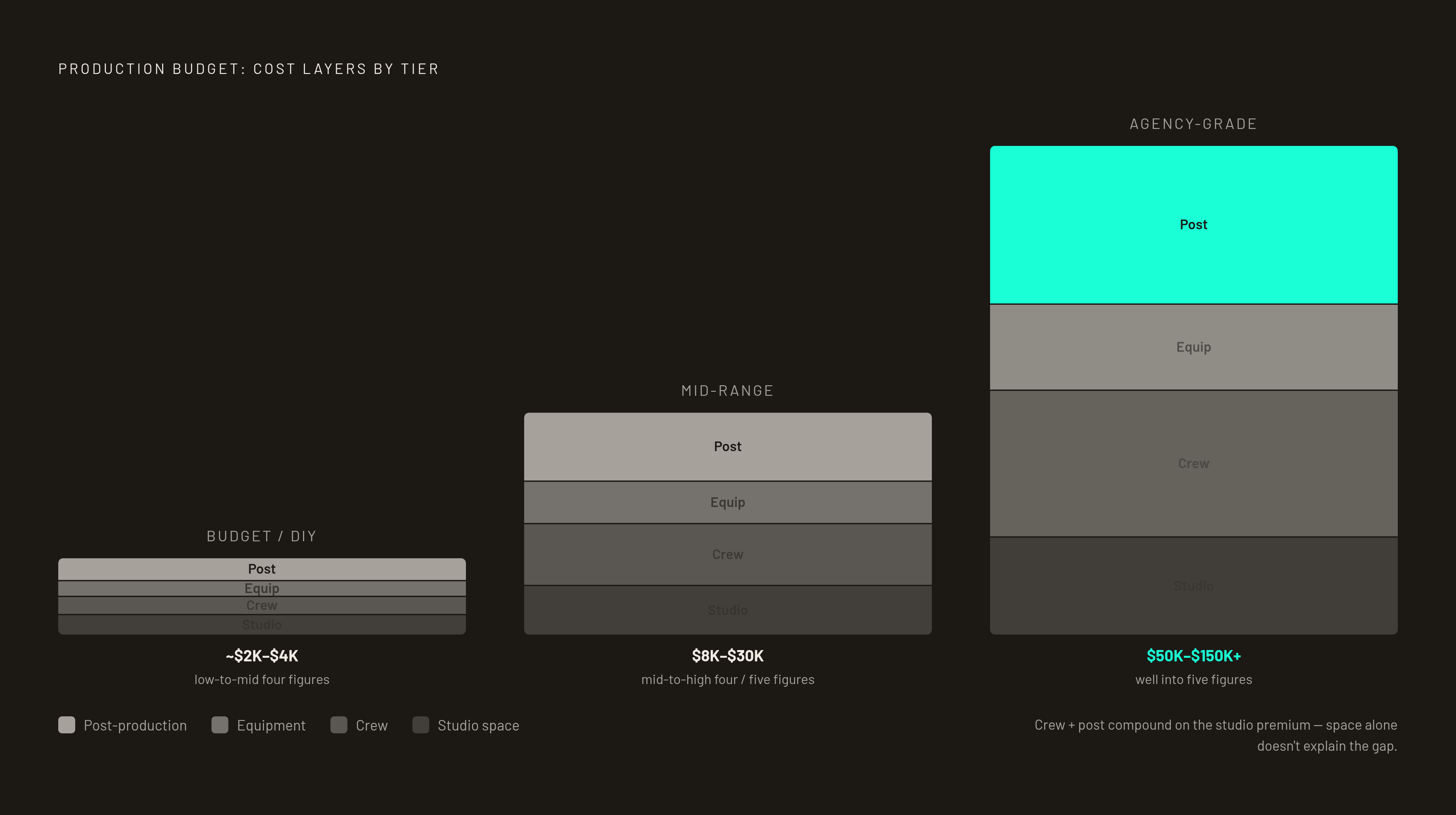
With each layer defined separately, the assembled totals by production tier become legible.
The budget and DIY tier, built for solo creators or early-stage teams, uses studio space at the low end of marketplace listings ($60 to $190 for a half- or full-day block), minimal or no hired crew, basic equipment included in the studio rate, and simple editing handled internally or via a freelancer at the lower hourly range. Total realistic range: low-to-mid four figures for a simple deliverable.
The mid-range professional commercial tier uses a studio in the $800 to $2,500 per day range, a lean professional crew covering director, DP, sound, and one PA, a standard camera and lighting package, and professional editing with a basic color grade and simple motion graphics. Total realistic range: mid-to-high four figures, often pushing into five figures for a finished 60 to 90 second piece.
The full-service agency-grade tier uses a Manhattan soundstage at $1,500 to $5,000 or more per day, a full crew across all roles, a high-end camera and specialty lighting package with possible drone or specialty rig, and multi-day post-production with a colorist, motion graphics, and revision rounds. Total realistic range: well into five figures; complex commercial productions exceed this substantially.
The tier boundaries are not fixed. The biggest lever is crew size and shoot-day complexity. A tightly scoped brief can produce professional results from the mid-range tier. The decision to shoot in New York versus a secondary market also carries real dollar implications: the same crew and studio day costs materially more in NYC, and buyers who relocate shoots to secondary markets sometimes do so specifically to recapture that delta.
Where Production Companies and Full-Service Studios Fit for Buyers Who Want a Bundled Option
Many buyers, especially SaaS and B2B brands, have no interest in sourcing studio, crew, and post-production separately. They want a single vendor who handles the full production. That's a legitimate preference, and it's well-served by the New York market. The risk is evaluating bundled quotes without understanding what the underlying components cost, which leaves a buyer with no basis for judging whether a package is fairly priced or padded.
The sections above provide that basis. A full-service production company that quotes a flat project fee is pricing the same layers: space, crew, equipment, and post. Knowing what each layer costs individually is what lets a buyer read a bundled quote with accuracy.
For B2B video buyers evaluating full-service vendors, a few things separate the options that consistently produce differentiated work from those that produce generic output regardless of production quality. First, look for deep familiarity with the product category, not just production craft. Vendors who don't engage substantively with what makes a product different tend to produce work that looks competent and says nothing. Second, script and strategy should be included in the scope, not positioned as an upsell. The script is where positioning happens; a vendor who treats it as secondary to the shoot day is telling you something about their priorities. Third, a clear deliverable scope, specific in length, number of revisions, and output formats, is what makes a quote genuinely comparable across vendors. Ambiguity in scope is where budget overruns originate.
When evaluating any bundled quote, ask vendors to confirm what the studio day rate includes versus excludes, how post-production is scoped and priced, whether script and concept development are in scope or additional, and how revisions are handled. Those questions separate vendors who've built a coherent production model from those who are assembling a quote opportunistically.