Can a Distributed Team Run a NYC Video Shoot Without Flying In
It can, if one remote director directs and a local producer executes.
A distributed team can run a video shoot in a city without flying anyone in. The condition is clear separation of creative direction, local execution, and post, with one person holding creative authority throughout. Remote production works when each role has clear responsibilities and handoffs.
Why distributed teams are attempting NYC shoots without flying in
Most production teams are now distributed by default. Running a shoot remotely is therefore a routine staffing question. Creative direction, physical production, and post no longer need to happen in the same room or even the same city. Teams need to work out how to coordinate them without losing control of the work.
NYC makes that question especially worth answering. Its dense crew market and concentration of brands and executives make it an attractive place to shoot, while its locations and permit infrastructure create plenty of logistics for an absent team to manage. The opportunity and the difficulty come together. Access to experienced people does not remove the need to coordinate how they reach the location, get equipment inside, and complete the shoot.
One NYC shoot commonly supplies several outputs across channels and formats, so a production failure can affect an entire campaign. That makes the staffing model a creative decision as much as a travel decision. The team needs footage it can use for every planned output, beyond proof that filming happened.
What makes NYC different from every other city a distributed team might shoot in
Production in this city is dense and vertically stacked. Crews ride the subway to call time, equipment moves through freight elevators, and one block may require a residential building, a restaurant, and a shoot location to cooperate. Those are ordinary production conditions here. A location is not just a background, but a set of access arrangements that someone nearby must manage.
Permitting adds a separate layer of coordination. The Mayor’s Office of Media and Entertainment, or MOME, does not have jurisdiction over private property, property owned by other government entities such as MTA or Port Authority, or State or Federal property. NYC Parks requires both a MOME permit and a separate Media Production Authorization for filming in parks. A subway shoot needs approximately three weeks. The schedule therefore depends on which property the production uses.
MOME requires insurance documentation to come from a broker or agent ahead of the project application. A remote team that treats the permit as a form to complete after everything else is booked can miss that dependency. The paperwork and the location schedule have to fit together.
Location choice can reduce the friction. Brooklyn’s industrial waterfront, Queens’ residential blocks, and Staten Island’s quieter streets typically offer easier parking holds and fewer competing shoots than Midtown or SoHo. Meanwhile, the crew market includes directors of photography, gaffers, stylists, and editors with network-show and national-campaign experience, often at rates suited to corporate or social budgets.
The core argument — separation of roles is what makes remote direction work
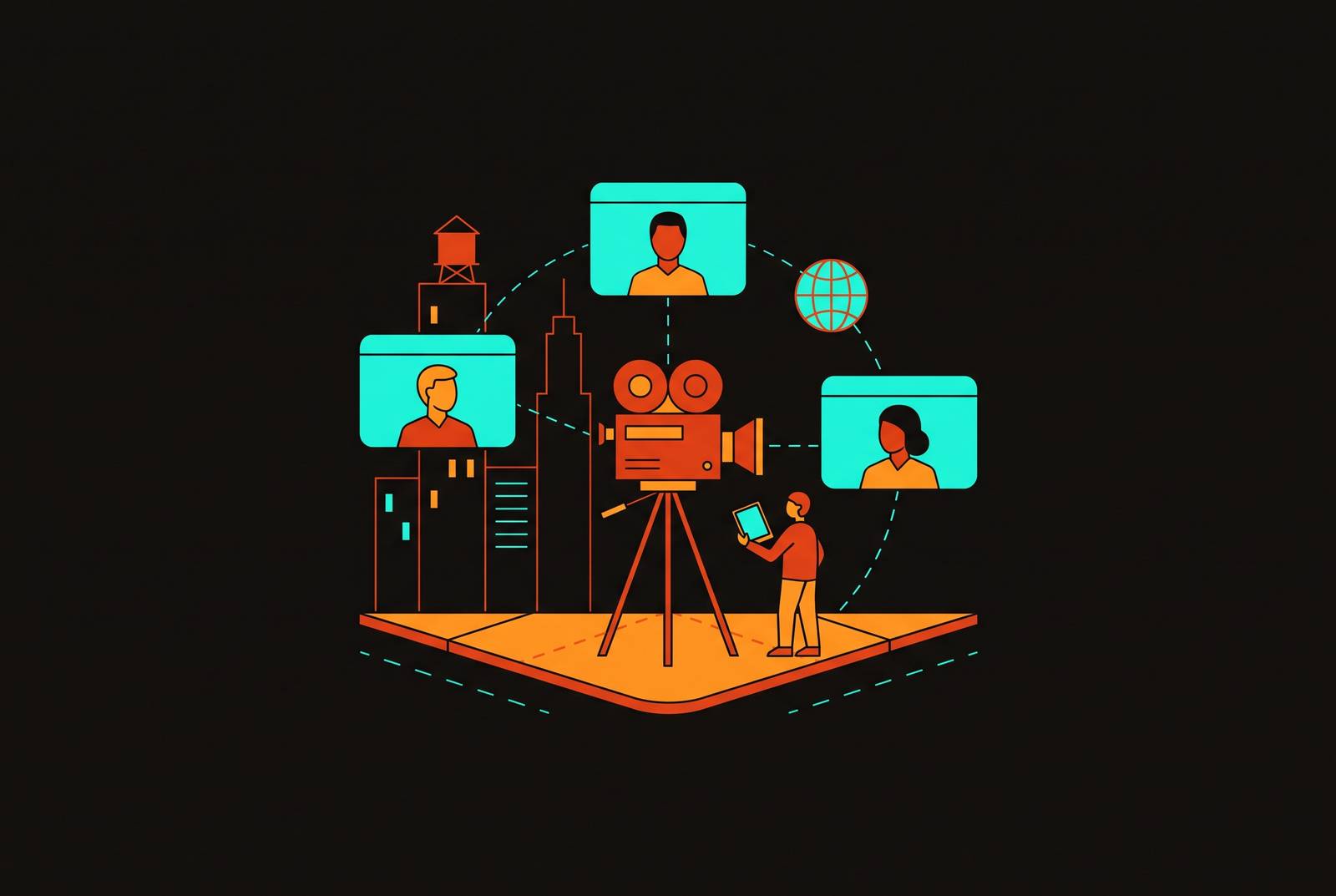
The remote creative director owns the brief, shot list, visual and narrative decisions, and real-time approvals. The local line producer or production company owns crew booking, permits, locations, insurance, equipment, and the schedule. The post team owns editing, color, sound, and delivery. These are distinct jobs with coordinated handoffs. Trying to fold them into an on-site team without preserving remote creative authority defeats the model.
Geography can be distributed, but creative authority cannot be vague. One named director must have final say, and the local crew must recognize that authority from day one. The practical staffing model is a remote creative director paired with a trusted local production lead.
How to brief and book a local NYC crew you have never met in person
Finding qualified people in NYC is a solvable sourcing problem. ProductionHub, Upwork, and Twine have active NYC listings used for crew sourcing. For a shoot involving permits, insurance, and location logistics, the practical choice is a local line producer or production company. Their established MOME relationships, familiar application process, and insurance broker absorb work the remote creative team should not have to improvise.
Broadcast Management Group supports productions across Manhattan, Brooklyn, Queens, The Bronx, Staten Island, Jersey City, Hoboken, Long Island, and Westchester. LocalEyes runs dedicated NYC crews, with work produced across Manhattan, Brooklyn, SoHo, the Financial District, and Chelsea. NYC Video Pros offers flat-rate turnkey corporate production and has remote direction and hybrid crew options as separate services.
The remote team’s job is to make the brief precise before booking. Lock the shot list, reference images, lighting notes, audio requirements, and approved locations before the crew reaches the set. A remote brief needs more detail than an on-site brief because fewer decisions can rely on an informal conversation beside the camera.
That brief must also prepare the footage for post. Set the folder structure, file naming, and handoff points so the footage is organized before it reaches the editor. Make the remote director’s approval authority explicit in the same handoff.
Maintaining creative control on the shoot day without being in the room
Once booked, the crew still needs a way to take direction that works. For the remote director, that means purpose-built monitoring and a clear communication route. Teradek Core lets the team use live video feeds for remote monitoring. OpenReel also supports remote oversight and control of some camera functions for self-recorded talent using their own devices. The tool has to match the production.
The connection has to support it, too. Uncompressed remote-direction workflows require sustained bandwidth, and an unreliable connection weakens the director’s ability to judge what is happening. For hybrid productions, REMI, or Remote Integration, centralizes switching, graphics, monitoring, and transmission through cloud control infrastructure while supporting on-site crews. Broadcast Management Group’s Cloud Control Center™ is an example used for NYC productions. Infrastructure supports the staffing model, but it does not settle who gets to give instructions.
Mustache addressed that problem by separating its client channel from the channel producers used to speak with the on-set crew. The purpose was to stop brand executives from slowing production with direction outside their expertise. Remote access can invite a CMO or company president who would not normally attend a shoot to check in and start directing it.
Performance direction needs its own human bridge. Corporate executives and other non-professional talent can find it jarring to look into a lens while listening to a disembodied voice. The remote director should brief the on-set producer to relay direction in person when necessary. Creative authority stays with the director, while the producer helps the person on camera understand and use the direction.
The post workflow that lets a distributed team move from raw footage to finished cut without delays
Post starts with decisions made before filming. The brief needs to spell out the file structure, proxy strategy, review platform, and handoff points so the editor gets footage they can use. Otherwise, the distributed team loses time at the moment it should begin editing.
In a server-side proxy workflow, footage is uploaded once and lightweight editing copies are generated centrally. Editors download those proxies. This can let an editor begin cutting within minutes of the shoot wrapping, before drives arrive. Proxy and original folder structures must match so the edit can relink to the originals for finishing. H.264 at 1080p is the broadly compatible proxy specification for review and editing, with ProRes Proxy as the platform-specific alternative.
Review then needs to keep decisions attached to the cut. Frame.io integrates with Adobe Premiere Pro and Final Cut Pro for timeline uploads and timestamped feedback, though rendering or exporting still occurs. Louper supports synchronized playback so participants see the same frame at once, as well as high-resolution livestreaming of work in progress. These tools give reviewers a shared reference. They do not remove the need to decide when a version is ready for review.
Spell out three handoff states to keep the work moving. Footage is uploaded, proxies are ready for editing, and a cut is ready for review. Assign someone to confirm each state for the next person. With clean handoffs and consistent folders, follow-the-sun work across time zones can reduce turnaround from days to hours.
Where the remote model breaks down and what to do about it
Some shoots need an on-site eye. The decision turns on whether the director can reliably see the work, guide the performance, and exercise authority from elsewhere. If the location cannot sustain the bandwidth needed for live direction, monitoring stops being a dependable basis for approvals. An on-site presence may then be the cleaner answer, while couriered drives can address footage transfer alone.
The decision also depends on which crew and equipment are available. Secondary markets can have narrower talent pools and fewer equipment options, although NYC’s depth makes that constraint less pressing there. Software cannot provide the people and equipment the shoot needs on location.
The organizational threshold is just as firm. If nobody has recognized final creative authority, remote access can add decision-making friction. Separate communication channels help only when the people using them respect that authority. A decentralized shoot without an authoritative creative director is an unsupervised one.
Identify during pre-production which elements can be directed remotely and which need someone watching in person. That gives the team a reason to send someone in when necessary, rather than treating either travel or remote working as a principle that overrides the shoot’s needs.
The pre-production checklist that makes the whole model hold together
Before booking, check that the creative brief is locked. It needs the shot list, reference images, lighting direction, audio requirements, and approved locations. Name the remote creative director and state that this person has final say on frame and performance. Choose the monitoring tools and test the connection at the actual location. Record which elements need an on-site eye if remote direction cannot support them.
For local execution, establish whether the shoot touches public property and build the relevant permit lead time into the schedule. Allow approximately three weeks for subway shoots. Confirm that insurance meets MOME minimums and that the broker can submit ahead of the application deadline, or establish whether a private location removes the MOME requirement. While scouting, check the MOME Hot Spot Map for neighborhoods that have been filmed too often and places where construction is under way. Set up separate crew-direction and brand-stakeholder channels before call time.
For post, share the folder structure and naming convention before anyone uploads footage. Confirm proxy specifications and server-side generation so editing can start promptly. Choose who will confirm that footage is uploaded, proxies are ready, and a cut is ready for review. Each check resolves a decision that would otherwise interrupt production or editing. When those decisions are settled, the finished cut does not feel remote to the client, because the creative authority never left.