NYC Neighborhoods with Video Production Studios for Startups
Picking the right neighborhood cuts production costs more than picking the right studio.
NYC has more than 670 rentable video studio spaces across the five boroughs, from 500-square-foot rooms to 5,000-square-foot production floors. Finding a studio rarely trips anyone up. Picking the wrong neighborhood does, and that mistake costs a startup more than picking the wrong studio ever will.
Every cluster in this city has its own personality: price tier, gear stock, loading logistics, even the crew that hangs around it. Corporate video work in NYC runs $10,000 to $25,000 on average, and anything close to TV-grade production climbs past $40,000, sometimes past $100,000. Add friction from the wrong location, bad parking, no freight elevator, a client who won't cross a bridge, and that number gets worse before a single frame gets shot.
Most founders pick the studio first and the neighborhood second. Match your project type, budget, and crew size to a neighborhood first, then go find the studio inside it. That order matters most for SaaS and B2B startups, whose shoots usually need controlled lighting, clean audio, and a product-focused setup rather than a cool backdrop. Chelsea gets treated as the default because it's the name people know, but that default only makes sense when the shoot actually needs a cyc wall or the client's location is the whole point.
How NYC's production cost structure compares to other markets
Live-action production in New York runs roughly 15 to 25% above comparable rates in San Francisco. Crew rates, gear rental, and the friction of shooting in a dense city all push the number up.
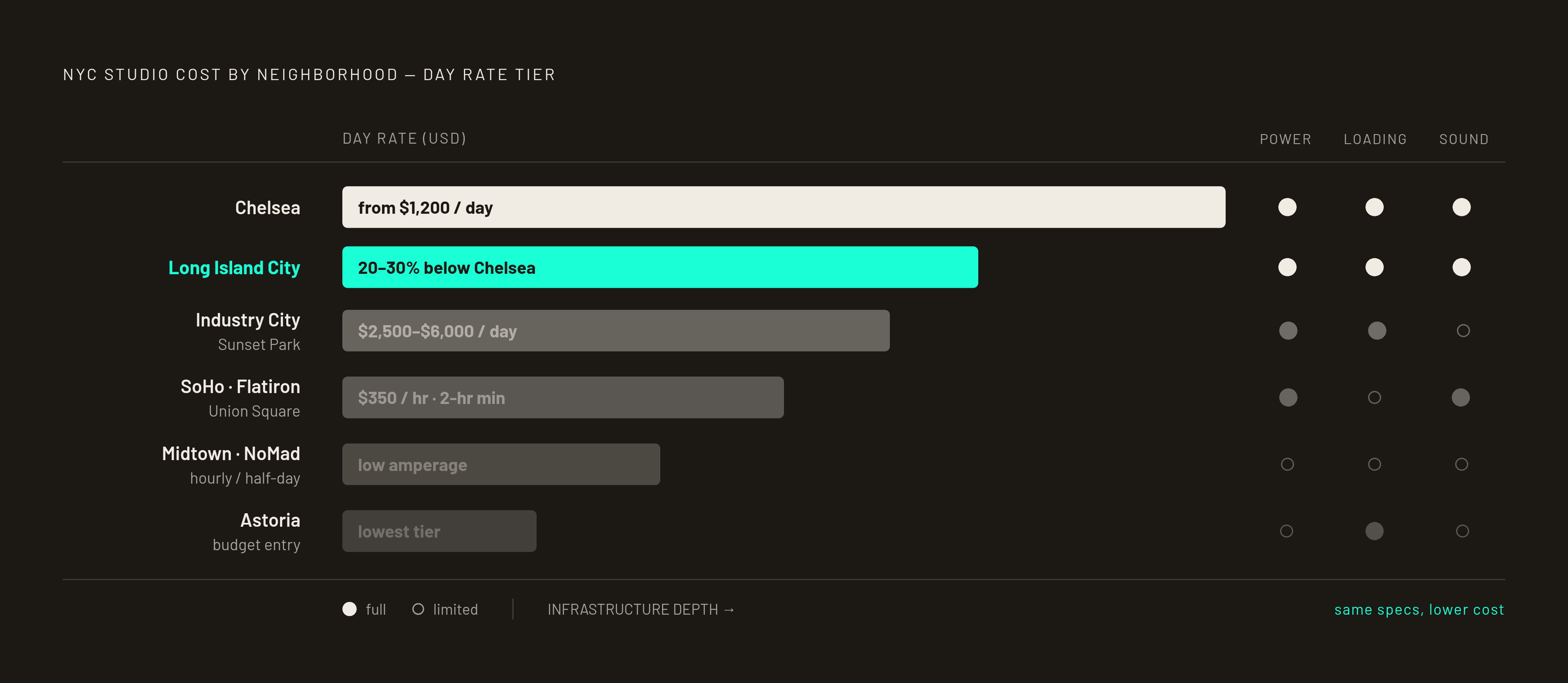
That premium isn't spread evenly, though, and this is where most budgets leak without anyone noticing. Long Island City studios price 20 to 30% below equivalent Chelsea spaces for the same infrastructure: same power, same soundproofing, same square footage. Two studios ten minutes apart by subway can carry wildly different day rates, and paying the Chelsea number rarely buys anything the LIC studio doesn't already offer with the same gear.
Part of what that premium buys in Manhattan is depth of crew. New York's IATSE base is the deepest on the East Coast, so day rates run high, but gaffers, sound mixers, and grips who've worked hundreds of commercial days are on hand here in a way they aren't in smaller markets.
Most startups treat video spending like a fixed cost, but neighborhood choice works as a lever on that budget: the same shoot, run in a different zip code, comes out cheaper without cutting a single production value. For B2B SaaS teams making videos meant to close deals, picking the right studio type matters far more than chasing square footage.
Chelsea: Manhattan's most established production neighborhood and what that costs you
Chelsea was a working studio neighborhood long before the High Line opened and the condo towers went up around it, and the infrastructure still reflects that history.
Contra Studios runs a 5,000-square-foot private floor with two cyc stages and a full soundstage built for film, photography, webcasting, and live streaming. MCM Creative offers a soundproof, climate-controlled white cyc with a lighting grid rated at 140 amps. Chelsea Studios NYC has multiple cycloramas and green screens, with day rates starting around $1,200.
This neighborhood fits fashion brands, corporate clients, and content creators who need a central Manhattan address, or whose talent won't travel to an outer borough. The drawbacks are structural: demand stays high, parking means street parking, and the price tag is baked into the zip code before anyone walks in the door.
For a SaaS startup shooting a product demo or a talking-head series, Chelsea delivers real polish, but the cyc wall or the address needs to be doing actual work for the shoot to justify it, and most of the time it isn't. Treat Chelsea as the benchmark: it sets the ceiling on Manhattan studio cost, and the floor on infrastructure quality.
Midtown, NoMad, and the Murray Hill corridor: convenience-first studios for founder-led shoots
Midtown's studio stock leans toward content creation over large-scale production. David DuPuy Studios in NoMad runs 1,550 square feet with 11-foot ceilings, built for photographers and videographers working solo or in small teams.
The value here is access, plain and simple. Midtown is where clients, investors, and press already are, so a founder can shoot an interview or a product walkthrough without asking anyone to cross a bridge. There are real limits: loading is tight, there's no drive-in truck access, and amperage runs lower than a proper production facility.
The best use case is narrow. Single-camera interviews, podcast video, social content, anything a two-person team can run without a gaffer and a 10-ton truck parked outside, fits here fine. Many of these studios rent by the hour or half-day, which suits a startup that doesn't need, or can't afford, a full studio day.
SoHo, Flatiron, and Union Square: natural light, lifestyle backdrops, and the post-production layer
These neighborhoods work for lifestyle content over controlled corporate shoots. The look of SoHo is itself a production asset; the cast-iron facades and cobblestone corners do work a backdrop can't fake.
Union Square Loft has 9-foot Broadway windows for natural light, plus lighting rigs for a more controlled look, treated audio, and a 2-hour minimum at $350 an hour. The same building's 7,000-plus square-foot rooftop, with unobstructed Manhattan views, is reserved for photo and film work, useful for founders who want skyline context in brand footage. Studios in the Flatiron corridor suit film, video, photography, and corporate events under one roof.
This cluster is also where a lot of lower Manhattan's post-production relationships sit. ShellacNYC operates as a SoHo post house in this area, so a startup shooting with one vendor and editing with another can walk between the two instead of routing footage across the city. Most B2B SaaS startups won't need a lifestyle backdrop, but if the product has a consumer angle, or the shoot is about brand identity rather than a feature demo, this cluster earns its spot.
Industry City and Sunset Park: Brooklyn's most production-ready infrastructure for startup budgets
Industry City houses 65 media and production businesses on one campus, a production district built for the work, with infrastructure planned in from the start rather than added to a converted loft after the fact.
The complex runs multiple studios inside converted industrial buildings, with high ceilings, freight elevators, and drive-in loading docks. Pricing sits mid-range, roughly $2,500 to $6,000 a day depending on the stage, a real discount against a comparable Chelsea stage.
The practical advantages stack up fast. A crew can park a 10-ton truck on site, most spaces carry at least 200 amps of dedicated power on cam lock, and rental houses and prop shops sit nearby instead of scattered across the borough.
Sunset Park, right next door, is getting deeper support of its own: Steiner Studios and the NYC Economic Development Corporation broke ground on a Sunset Park facility in 2025, which should thicken the vendor and crew base in this corridor over the next few years. This area fits startups doing a multi-scene product demo, a brand film that needs room to actually work, or any project where crew size and gear volume would overwhelm a Midtown studio. The honest trade-off is transit time from Manhattan, and clients unfamiliar with Brooklyn sometimes push back on the location. This is a pick for teams comfortable running their own shoot day without hand-holding.
Bushwick: the low-cost, high-flexibility option for scrappy startup shoots
A Grattan Street studio in Bushwick rents for $55 an hour, clean and compact, well suited for a quick-turn asset that doesn't justify a full production day. Stoodio One on Randolph Street runs 2,500 square feet with pre-rigged RGB LED lighting and 24-hour access, a strong fit for music videos and stylized branded content.
The creative culture here skews independent. Studios are usually run by working creatives rather than production companies, which means more flexibility and less pressure around minimum spend.
A bigger shift is happening in the background, though it won't change much for startups this year: a $552 million investment in new studio infrastructure, including a facility at 242 Seigel Street in Bushwick, is underway and expected to create roughly 2,400 jobs. Over the next several years, that buildout should thicken the neighborhood's support ecosystem: more rental houses, more gear, more crew on hand.
Right now, Bushwick is the neighborhood for self-tapes, short-form social content, podcast video, anything with a tight brief and a fast turnaround. It's a tougher call for a product that needs to look enterprise-grade, since the aesthetic leans creative and indie, and the infrastructure doesn't support a large crew day.
Red Hook: infrastructure arriving, not yet ready for startup use
A 225,000-square-foot production facility is under construction in Red Hook, backed by Bungalow Projects and Bain Capital. Separately, Samson Stages is pursuing a 330,000-square-foot studio and soundstage conversion in the same neighborhood. Both are large-scale, long-horizon projects, and neither is startup-accessible today.
What this buildout eventually produces matters, though: a support ecosystem of rental houses, post houses, and concentrated crew that could benefit smaller productions in a one-to-three year window. Keep an eye on Red Hook if a multi-year production strategy is on the table, but don't scout it for a shoot six months out. There's nothing to book yet.
Long Island City: the most underused value play in the NYC studio market
LIC sits just a short subway ride from Midtown Manhattan, and the case for paying a Chelsea or Midtown premium to stay close mostly falls apart when the alternative is that quick a trip.
The pricing backs that up: LIC studios run 20 to 30% below equivalent Chelsea spaces for comparable infrastructure, same power, same soundproofing, same square footage. That's the single most useful number in this whole guide. Logistics often beat the Manhattan alternative outright too, with better parking and better loading access than most spots in Brooklyn.
Silvercup Studios anchors the neighborhood's production identity as one of New York City's major full-service film and television production facilities, and its presence has built a surrounding ecosystem of crew, vendors, and rental houses that independent shoots draw on. Several studios in LIC are suited for film and photo shoots, virtual production, live-stream and broadcast events, and corporate functions. Newer studio stock has continued to come online in the neighborhood, adding to what was already there.
This is the fit for startups that want real production infrastructure, loading docks, proper power, sound isolation, at a meaningful discount. Most teams skip past LIC because leaving Manhattan feels like a step down, but the distance is a single subway stop, and the studios there carry the difference. Skipping LIC to stay in Chelsea is the most common overspend on this entire list.
Astoria: legacy production infrastructure with a new wave of investment
Kaufman Astoria Studios has a long-established presence in the neighborhood, and that continuity has built a deep crew and vendor ecosystem that independent productions can tap into even without booking a stage there directly.
The neighborhood has attracted new facility investment in recent years, adding to production infrastructure that was already dense. Smaller studios in the same area offer a more budget-friendly entry point, letting startups work near major-facility infrastructure without paying major-facility rates.
The real advantage of Astoria over LIC has less to do with the studios themselves and more to do with what surrounds them: more crew on hand, more rental options, more production-adjacent services within a short drive. Transit to Midtown runs slightly less direct than from LIC, but for a self-contained crew, that's a non-issue. This neighborhood fits startups already working with a director or DP based in Queens, or teams that want access to Kaufman Astoria's adjacent services without renting a stage inside the building.
How to match your startup's project type to the right neighborhood
A handful of variables actually decide which neighborhood makes sense, and running through them takes less time than a single round of studio calls.
Start with project type. A talking-head interview needs almost nothing compared to a multi-scene product demo, a stylized brand film, or a batch of social shorts. Then factor in crew size: a two-person team versus a full crew with equipment trucks changes everything about loading and parking. Client and talent logistics matter too, since someone has to figure out who's traveling and from where. Budget tier splits roughly into under $5,000, the $10,000 to $25,000 range, and anything above that, and timeline closes the loop; a same-week quick-turn shoot rules out neighborhoods that need advance booking and long lead times.
Once those variables are pinned down, the neighborhood choice gets simple:
- Need real infrastructure, mid-budget, flexible on borough: Industry City or Long Island City.
- Need a Manhattan address, small crew, client-facing shoot: Midtown.
- Consumer lifestyle content, natural light a priority: SoHo, Flatiron, or Union Square.
- Tight budget, fast turnaround, stylized aesthetic: Bushwick.
- Queens-based crew or an adjacent vendor ecosystem matters: Astoria.
Chelsea still has its place: large crew, maximum infrastructure, budget genuinely isn't the constraint. For most startups on this list, though, it's the neighborhood people default to out of habit rather than the one that actually fits the job. Match the job to the zip code before booking anything, and that habit is what keeps a $10,000 shoot from quietly turning into a $15,000 one.