Explainer Video Cost Ranges for Early-Stage SaaS Startups
Budget $4,000 to $7,000 for a video that actually converts prospects.

The retention gap alone makes video difficult to argue against. Prospects retain 95% of a message delivered through video versus roughly 10% from text, per DemandSage's 2026 research. SaaS sites with a product video convert at approximately 4.8% compared to 1.9% without one. That delta is the entire business case for spending anything on production. Add the broader consumer signal (82% of buyers say video directly convinced them to purchase something) and the argument for video is empirically settled.
Here is what none of those figures say: they do not distinguish between a $500 freelancer video and a $25,000 agency production. The case for any particular tier requires a completely different argument, one grounded in your specific buyer, your product's current stability, and the quality threshold required to hold attention in the first place. The statistics prove you need a video. They say nothing about what kind.
How the Four Pricing Tiers Are Actually Structured in 2025–2026
Before 2024, the market organized itself into three agency tiers plus DIY. In 2025, a fourth category became real: AI video agencies, sitting between freelancers and traditional studios in price and often matching studios on speed. That shift expanded the viable option set at the $2,000–$8,000 range considerably, and it matters because it means more decisions, not fewer.
The four tiers as used throughout this piece: Tier 1 covers DIY and AI tools, total project cost typically under a few thousand dollars. Tier 2 covers freelancers, running from a few hundred to $5,000. Tier 3 covers mid-market studios and AI agencies, from $2,000–$15,000. Tier 4 covers premium agencies, starting at $15,000 and extending well past $50,000.
These tiers overlap in price, which is the part founders miss. The $2,000–$5,000 band is reachable from Tier 2, Tier 3, or a stripped-down Tier 4 engagement. What actually differentiates them is who owns the creative process, how many specialists are involved, how much strategic input is embedded in the engagement, and how revisable the output is when your product changes in six months. Price is a starting signal, not a reliable proxy for quality.
Wyzowl's survey of 242 production companies put the average price for a 60-second explainer at $8,457 in 2024. That anchor places the market's center of gravity firmly in Tier 3.
Tier 1. DIY and AI Tools: What the $0–$1,500 Range Actually Produces
The tool landscape here is mature. Synthesia offers a free basic plan and paid tiers starting around $18–$29 per month on annual billing, with a Creator tier at roughly $64–$89 per month. Vyond starts at $58 per month billed annually, with a Professional tier around $100 per month and no free plan, only a trial. Canva, Descript, and HeyGen cluster in a similar monthly range.
What you get is template-driven output: AI avatars or stock motion graphics, no custom characters, no original illustration developed specifically for your product. The visual fingerprint of a template is not subtle — sophisticated B2B buyers recognize it the same way you recognize a stock photo smile, where something registers as off before you can articulate what. That recognition is a trust signal running in the wrong direction.
What you do not get is anyone who understands your product's differentiation. There is no creative director shaping the narrative, no scriptwriter asking what makes your solution distinct from the three competitors the prospect evaluated last week. The founder supplies all of that while also operating the tool. That division of labor sounds manageable until you are two hours into Vyond and still on the opening sequence.
The real cost in this tier is time, and it is chronically underestimated. The dollar cost is low; the opportunity cost for a founder in product or sales mode is significant.
This tier has legitimate applications: internal onboarding, team training, product update walkthroughs for existing customers, testing a message hypothesis before committing real production spend. What it cannot do is compete for a cold prospect's attention on a homepage hero. Template output reads as low-investment to a buyer who is simultaneously evaluating three other vendors, and that perception is difficult to overcome with good copy alone.
Tier 2. Freelancers: Where the $500–$5,000 Range Creates Real but Manageable Risk
Entry-level and template-based freelancer work typically lands between $500 and $2,500. A senior, specialized freelancer producing a polished 60-second piece can reach $5,000. North American studios and senior freelancers bill $100–$250 per production hour. Eastern European and Asian teams run less, but they introduce coordination overhead across time zones that founders reliably underestimate. Not because the talent is weaker, but because asynchronous feedback loops turn a two-day revision cycle into a week.
The structural problem in this tier is the generalist constraint. One person handling script, illustration, animation, and voiceover direction simultaneously cannot replicate what a specialized team produces. The quality ceiling is not talent; it is the cognitive and temporal limits of a single practitioner trying to excel across disciplines that professional studios staff separately. That is not a criticism of freelancers. It is arithmetic.
What founders get right in this tier: more customization than DIY tools, a human collaborator who can incorporate feedback, faster turnaround than most mid-market agencies. What goes wrong is predictable. Portfolio samples represent a freelancer's best work under ideal conditions; your project gets executed under every other condition. There is no strategic input on messaging; the founder still owns that entirely. And revision management falls almost entirely on the buyer, which means the project moves at the pace of your calendar.
The best use case: a startup that already has a tight, tested script and needs execution help rather than strategic development. Secondary videos — a feature tour, a FAQ walkthrough, a customer success story — also fit. Using a freelancer to build your primary conversion asset while your messaging is still being figured out is where this tier consistently disappoints, and it is the scenario founders walk into most often.
Tier 3. Mid-Market Studios and AI Agencies: The Range Where Most SaaS Companies Should Be Looking
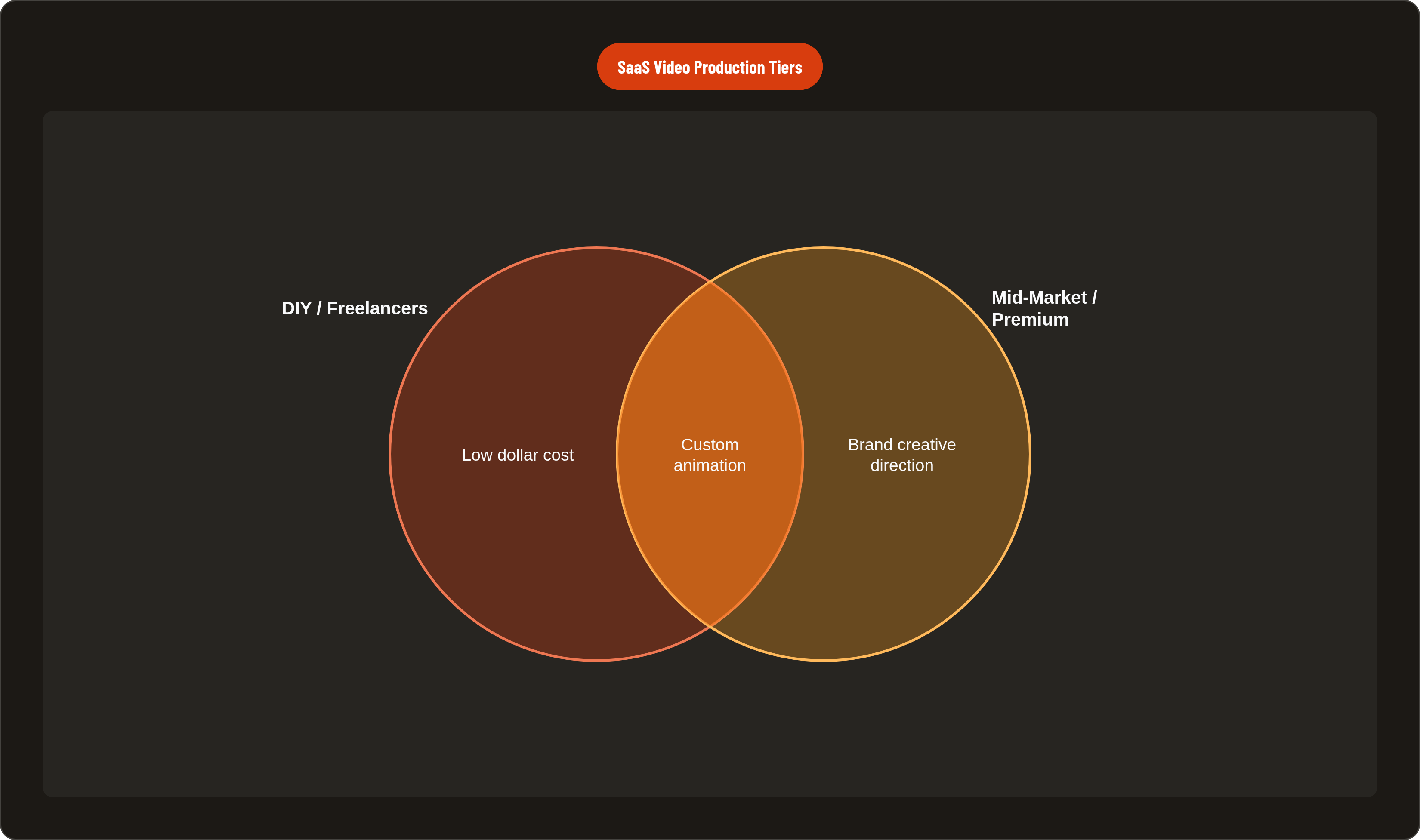
For a 60–90 second video with custom animation, voiceover, and sound design, this tier runs roughly $2,000–$15,000. Research across more than 100 studios puts the average around $8,700, with the quality-to-cost sweet spot for startups at approximately $4,000–$7,000. That range is where the price begins to buy things that actually change what you receive.
Specifically: a producer who manages the process so the founder is not the project manager; a dedicated scriptwriter, who is usually the single highest-leverage role in a SaaS explainer; specialized animators rather than a generalist attempting everything; and structured revision rounds built into the workflow rather than negotiated after you have already consumed them.
The labor math is direct. A 60-second explainer requires 40–80 hours of combined specialist time. At blended agency rates, that produces the $8,000–$15,000 range seen at most mid-market shops. The money is going somewhere real.
Geography still moves the number at this tier. US studios average meaningfully more than European studios for comparable deliverables. A well-credentialed European or international studio can deliver mid-market quality at the lower end of the range, which is legitimate arbitrage worth pursuing before committing to a domestic quote.
AI agencies function as a genuine sub-tier: faster turnaround, a lower price floor, but limited capacity for deep product storytelling. They are appropriate when speed and volume matter more than strategic narrative development.
One firm worth naming directly in this tier is Letterspade, which is purpose-built for B2B SaaS and focused specifically on distilling product differentiation into a 60-second narrative rather than producing generic explainer content. The distinction between a studio that makes explainer videos and one that understands SaaS buyer psychology is not cosmetic when your conversion rate is what you are actually optimizing for.
Animation Style as the Largest Single Cost Driver Inside Any Tier
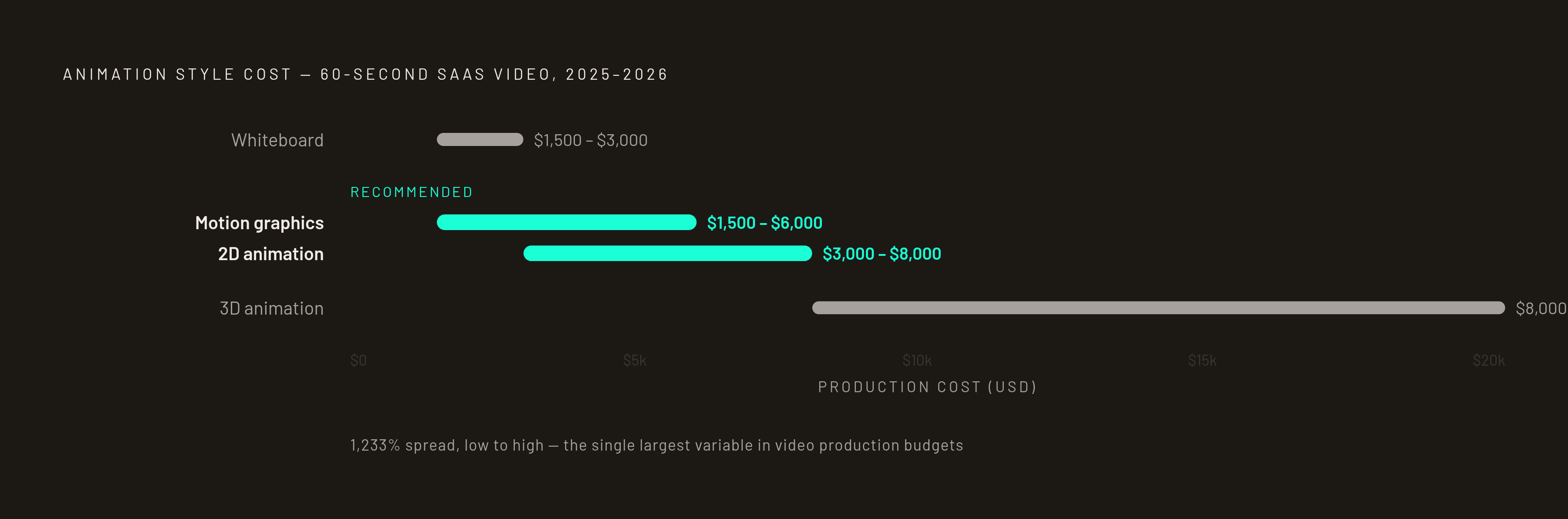
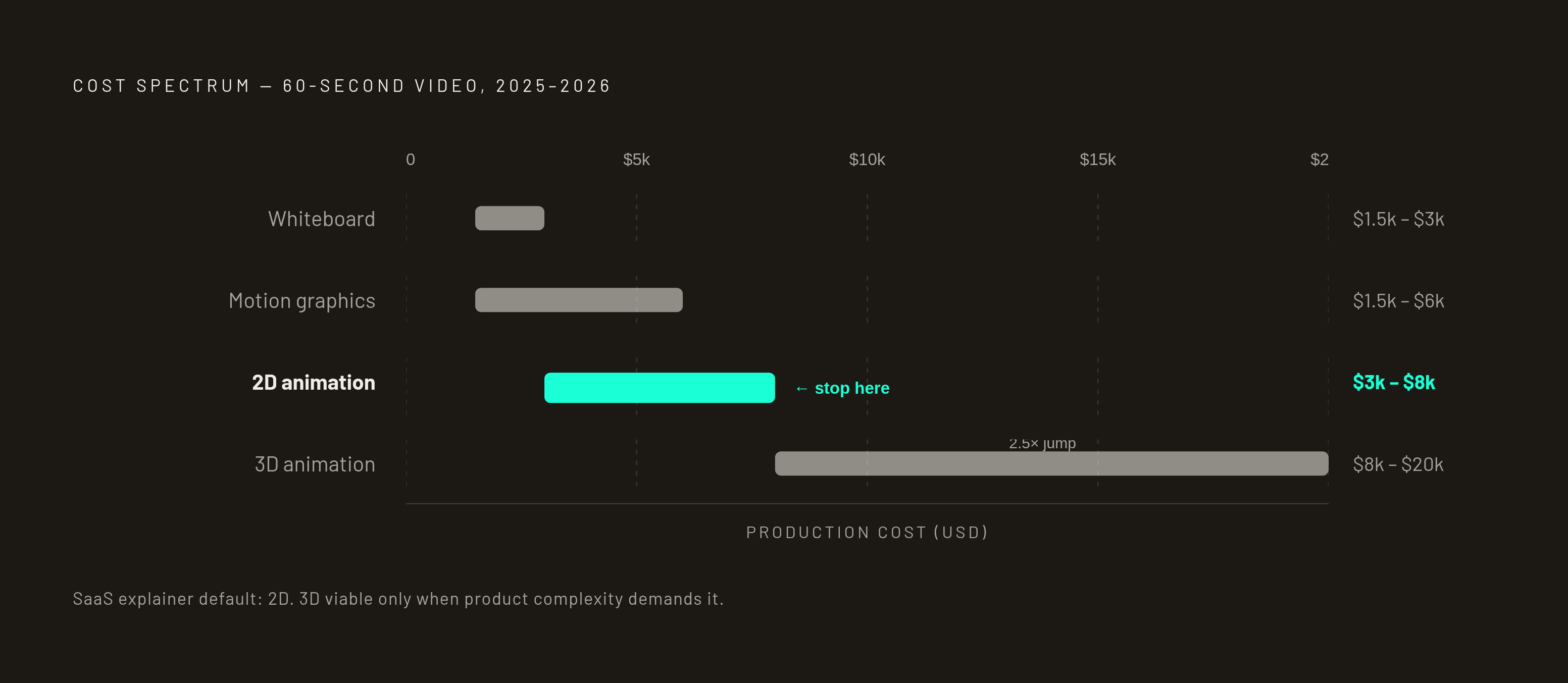
Animation style determines more of the final price than almost any other single decision. Differences of several hundred percent between styles are not unusual, and this is the variable most founders underweight when they receive a first quote.
The four main styles and their 2025–2026 ranges for a 60-second video: whiteboard animation runs $1,500–$3,000, the simplest visual approach and fastest to produce, but it reads as low-effort to many SaaS buyers who associate it with an earlier era of B2B content. Motion graphics and kinetic text run roughly $1,500–$6,000; this is the standard for dashboard demos and data-driven messaging, typography-led rather than character-driven, and often the right choice when the product UI is the story itself. 2D animation runs $3,000–$8,000, the default for most SaaS and app explainers, flexible and scalable, hitting the sweet spot between expressiveness and cost. 3D animation runs $8,000–$20,000, labor-intensive across modeling, texturing, and rendering, and rarely justified for early-stage SaaS unless the product is a physical-digital hybrid.
Practitioner consensus points consistently toward 2D vector animation and motion graphics as the standard for SaaS product explainers. They show UI clearly, update more easily than live action, and do not require a 3D budget to look credible.
Live action starts around $5,000 and can exceed $20,000. The critical tradeoff is updateability. Animated source files can be revised when the product changes; live action requires a reshoot — it is a sunk cost wearing a finished video's clothes. For early-stage SaaS, where the product will almost certainly change within the first year, the updateability argument for animation is economic, not aesthetic. A video with a longer useful life is better capital allocation at the pre-Series A stage, and that calculus is worth running before any style decision is made.
Tier 4. Premium Agencies: When $15,000–$50,000+ Is and Isn't the Right Call
A few reference points illustrate where this tier actually sits. Epipheo produces 2D animated explainers in the $15,000–$45,000 range. Yum Yum Videos starts at $7,500 but most flagship work ships in the $15,000–$30,000 band. Demo Duck publicly recommends spending at least $16,000 to "do it right."
What the premium tier purchases that lower tiers cannot: brand-level creative direction rather than just production execution; deep discovery and messaging strategy built into the engagement before a single frame is drawn; senior talent in every specialized role with no generalists filling gaps; a fully custom visual language developed from scratch for your brand.
When this makes sense for an early-stage SaaS company: post-Series A or B, when the brand is established and the target audience is clearly defined. When the video will run as paid media at scale, where production quality directly affects cost-per-impression efficiency. When the piece is a flagship conference or investor-facing asset where first impressions carry outsized reputational weight.
When it does not make sense: pre-product-market-fit, when the messaging will shift within six months. If the core question about your product's positioning is still open, a premium agency's creative process will resolve nothing. That is strategic work that has to happen before production begins, and most premium agencies will not tell you that, because their intake process rewards production-ready briefs and has no structural incentive to send you back to do more positioning work first.
How Video Length Interacts with Budget (and Why 60–90 Seconds Is the Defensible Default)
Most studios price on a 60-second base, with additional length scaling proportionally at most shops, though a meaningful subset offers discounted rates for added length.
The cost scaling is non-linear in a way founders rarely anticipate. A two-minute version does not cost double a 60-second version. Fixed costs (script development, voiceover session, storyboard, project kickoff) do not scale with length. Variable costs (primarily animation hours and revision rounds) do. The real-world ratio is roughly 1.5x–1.7x for double the length, not 2x.
The conversion case for shorter is well-established. Videos under 90 seconds that lead with the user's pain point, show the solution clearly, and end with a single unambiguous call to action outperform longer treatments for top-of-funnel SaaS prospects. The impulse to go longer is almost always about founder comfort with product complexity, not buyer need. I have seen it happen directly: a video converting well at 75 seconds gets extended with two minutes of feature detail the founder wanted included, and the numbers drop. The product did not get worse. The video did.
For most pre-Series A founders, 60–90 seconds is sufficient to establish the problem, show the UI-driven solution, and deliver a CTA. Budget separately for a 30-second cut optimized for paid social, even if the hero video runs longer. A shorter paid social version has different production economics than simply trimming the main video, and it serves a distinct purpose in your acquisition stack.
Hidden Costs That Add 20–40% to Most Agency Quotes
The quoted price on most agency proposals is not the final price. The gap between quote and invoice is predictable, and it is addressable if you know where to look before you sign.
Voiceover is the most consistent add-on. A professional VO artist with broadcast rights (typically in the low-to-mid hundreds of dollars range) is frequently excluded from base quotes or listed as a separate line item with usage rights language that limits where you can deploy the finished video. If the quote says "voiceover included," ask specifically whether that includes licensing for paid media distribution.
Music licensing follows the same pattern. Royalty-free library tracks are typically included; premium licensed music or custom composition is not. The difference between a track that actually fits your brand and the track bundled into the base quote can run $200–$1,500 depending on source and usage scope.
Revision rounds are where scope creep materializes. Most mid-market studios include two to three structured revision rounds per production phase. Rounds beyond that are billed at $100–$250 per hour. Founders who have not finalized their script before production begins routinely exhaust their included revisions during the script phase alone, before animation has started. By the time that becomes clear, the incentives on both sides of the table have already shifted.
Captions, exports in multiple aspect ratios for social platforms, and source file delivery are frequently excluded from base packages. Source files (the layered project files that allow future revisions without starting from scratch) can add meaningfully to a final quote at agencies that treat them as a premium deliverable. Negotiate source file ownership before signing, not after delivery. After delivery, you have no leverage.
Finally, the kickoff and strategy phase is often unbundled from production at Tier 3 and Tier 4 agencies. A discovery workshop or messaging sprint (which you genuinely need if your positioning is still being developed) will appear as a separate engagement or get added to the proposal only if you ask. If an agency's onboarding process does not include substantive questions about your product differentiation and target buyer before they begin scripting, that absence will show in the final video. Every time.