When a Startup Is Too Early to Invest in Professional Video
Professional video wastes money before product-market fit is real.
Buyers get convinced by Video. No one argues with it. But those stats, big purchase-intent jump, solid marketer-claimed ROI, all show video running in firms with steady messaging, a defined audience, and channels already set up. Early-stage companies lack all of it, yet most people jump right to spending money without asking if they're prepared. Reverse the steps, pouring cash into production before your message holds firm, and you won't get clarity. What it buys is confusion, just well-lit.
Video can't forge product-market alignment. It amplifies whatever's already true about a company's message, for better or worse. When your message keeps shifting, hiring a professional shoot crew just blasts the bad one louder and costs way more to fix.
What PMF actually requires before a dollar goes to production
Andreessen's take holds: you need a market that wants what you satisfy. Quick to state, hard to pull off. Before any video spend pays off, each founder must have certain items confirmed rather than wished for, and when you skip that checklist it's why first video budgets burn up.
First comes a stable ICP. No persona deck; a describable buyer you can put in a line, seen winning deals often, never by chance alone. Next, you need your repeatable value proposition working: one framing landing across different buyers rather than building a new pitch each conversation. Another requirement is knowing why someone is prepared to purchase now, not later. Last, signs of demand, buyers coming to you instead of you hunting them down.
Of every format, video punishes you most when any of these is missing. Writing a script locks you into a single problem, audience, and value proposition. Before hitting PMF, you're still working out those pieces on the fly during phone meetings and dead-end pitches plus clumsy pivots. Many startups go under after making something for the market buyers do not want; video carries the same failure mode, in miniature, packed into footage of 90 seconds with no easy changes.
Positioning keeps changing in discovery, and production work is only as steady as the Positioning behind it. Polish and production value won't fix a message that's fuzzy. It only makes a fuzzy message seem costly; expensive-looking confusion does more damage than plain, cheap confusion since it convinces buyers that confusion was intentional.
What professional production actually costs and what that means for runway
Basic online clips go for $1,500–$5,000. For an explainer or business video, expect $4,500-$20,000. Brand films and commercials often exceed $15,000 and can top $50,000. For professional work, costs run $5,000 to $50,000 based on size plus the number of deliverables included in the deal.
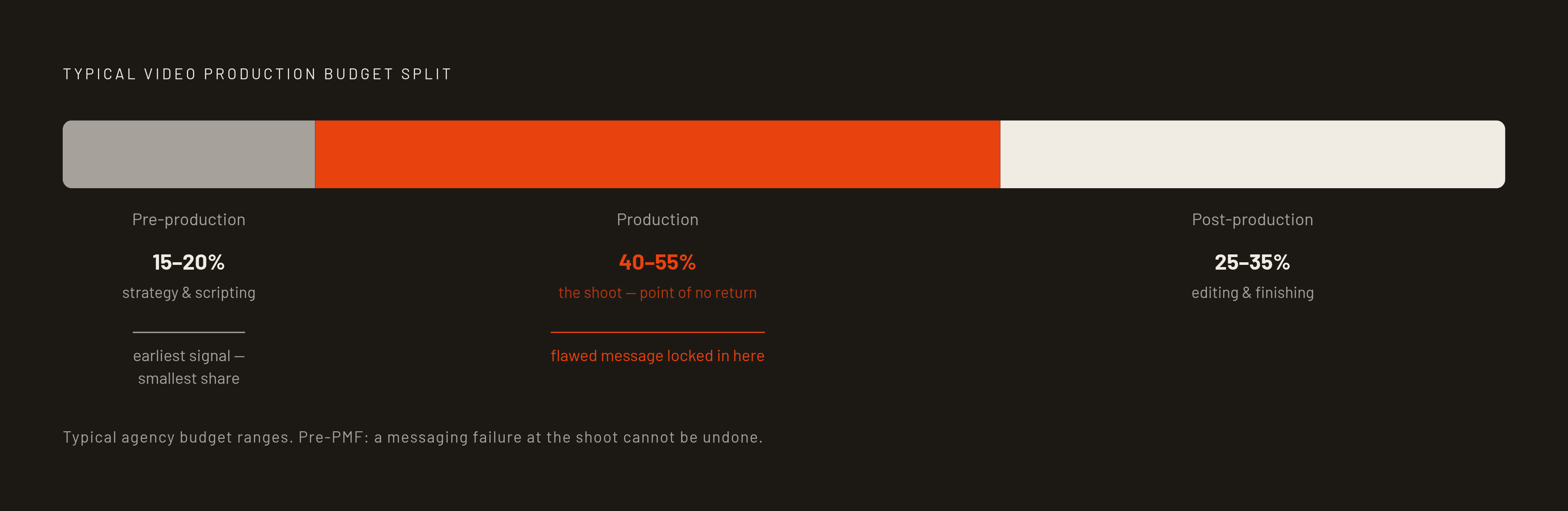
So what does all that spend go toward? Pre-production, covering strategy and scripting, typically eats 15 to 20%. The shoot itself, production, runs 40 to 55%. Editing and finishing eats the last 25 to 35%. For a business still figuring out its message, that allocation is upside down: the bulk of the money goes to shooting and cutting material that might not have deserved shooting at all, while pre-production, the stage that would have spotted the issue first, receives the least.
One production shoot with a gaffer, DP, boom op and PA costs between $3,000 and $8,000, before any talent sees money. Carta shows startups spending roughly $25,000 monthly before their first round, then nearly $80,000 once funded. A $10,000 to $20,000 production during seed stage carries consequences well past an ad budget entry. One to three weeks of your entire operating budget, gone on a single asset you cannot un-shot.
Most founders don't have much Runway to spare, so this isn't a theoretical worry. In First Round Capital's 2024 State of Startups poll with 1,000+ founders, a 61% share had under 18 months runway left, while another 29% share had under 12. CB Insights checked 431 VC-backed startups that closed, and 38% said having no money left was the main reason. Badly timed video spending hits founders hard, in real, measurable ways. That money is gone for good, spent right when the startup has the least room for error.
The messaging instability problem that pre-PMF video locks in
Video tops the list of hard-to-change formats in any startup's toolkit. Before PMF, a script commits you to one audience plus one value proposition that are still in flux. That landing page can be rewritten within hours. You tweak pitches between meetings. Once shot, a video just sits there until you pay for a reshoot.
This failure pattern appears so frequently in the production world that it's got its own label: milestone status for any brand video. One founder reaches a stage, a person says they should have some brand video, the brief is made without any strategy, and production happens. It appears acceptable. It just sits there on your homepage. It has no effect, since who it served was never settled before shooting began, a pattern Lemonlight lays out. The failure here isn't in production. The visuals were likely fine and the cut came together well. The production spend locked in that strategy failure.
At that stage, they often ask the piece to say it all: each tool, each scenario, each prospect type, since they still don't know what wins business. It touches a dozen topics superficially without making any stick. Trying to please investors, buyers, and partners at the same time, it lands with no one. Production teams often spend longer on pre-production for startup teams, since messing up the message during this stage costs the most. If they still can't state a short ICP plus a benefit buyers hear again and again, they need more market learning. Skip the video brief.
The specific signals that indicate a startup has crossed the threshold
Raising a round doesn't tell you anything, and leaning on it that way is how most founders misjudge the moment. A Series A startup with fuzzy positioning can fall behind a seed-stage one with repeatable signal on video. Stage isn't the only thing that counts, though.
Messaging comes first: one pitch closes deals for different buyers while its framing holds steady. If the one-pager still gets rewritten every two weeks, the script will too, for the same reasons.
Next comes ICP specificity. A founder must describe the buyer's job, the business, what set things off, and the objections, from signed deals, not some whiteboard hypothesis they sketched. Your video must target a specific audience, or it talks to all people and lands with nobody.
Next, this video needs one clear purpose. Making Investor trust you. Landing page sales. Shortening the time to close deals. Each video does one thing. If the brief reads "raise awareness and drive signups and build credibility," that's not a brief, it's a wish list, and every video should solve one identifiable business problem or it isn't worth producing yet.
Next comes clarity around distribution. Where does this thing end up living? Who finds this, and how will they arrive? A large share of the outcome comes from distribution, while the video itself accounts for the rest. A $10,000 production is already lost before its first scene is filmed without a marketing path, so any smarter allocation keeps 25% or more of spending for ads and distribution, beyond the actual shoot.
Number five, income that repeats. Don't rely on a single flattering customer tale. You need a clear pattern from multiple finished deals to see what won them over.
The check itself is straightforward. Could any founder say, from concrete deals instead of aspiration, who the video targets, what that guy should do next, and where it shows up? If so, a video spend actually makes sense. Without real facts, just guesses, all the production polish in the world closes nothing.
Where authentic founder video outperforms production spend at early stages
Consumers who say they completely believe brand marketing total just 4%. The main reason to avoid rushing toward polish is this: professional production promises to fix a credibility gap sitting within the format itself, nowhere else. Founders mostly believe added polish gets them greater credibility. It buys you less at the start.
70% of consumers say they prefer buying from brands where the founder tells the story directly, and founder-led video often outperforms polished brand content on watch-through rate. Users are 2.4× more likely to see UGC as real than obviously brand-made material. People tend to see creator-led clips as more real than polished studio-style videos, with higher attention and memory. Too much polish kills credibility and pushes people away.
Before product-market fit, this shows up in specific, practical ways. A 60-second, direct-to-camera founder explainer, shot on a laptop camera or a phone, builds more trust than a polished brand film at seed stage. One screencast walkthrough, narrated by the founder's voiceover, shows a buyer how it works and why it matters. Research shows products with demo videos have a higher conversion rate than those without, meaning that format itself carries greater impact than whatever production level gets attached. Cheap, fast work also closes the cycle sooner: the founder learns which messaging resonates before committing any of it to a $15,000 spend.
One small catch. Shoppers on apps like Instagram reward authenticity most. B2B SaaS aimed at big corporate accounts works differently, where video made with no-budget software can signal unflattering things about the makers' real commitment and credibility. This doesn't mean skipping production spending. It makes the case to test cheap, fast formats, learn what lands first, then committing that lesson to more spend.
The formats that earn professional spend at each funding stage
If professional spend is justified at Pre-seed or seed, limit it to a handful of formats. An interview-style founder piece with company and staff B-roll, at $2,000-$5,000. A walkthrough of your software, on-screen or with a touch of real footage, shaped around a single job-to-be-done, not the entire toolkit. For backers, a pitch video, 60 to 90 seconds about the big idea, with authenticity carrying more pull than polished cinematography. A small team, a short script plus one quick session on set are all you need, since these formats hold up when made in-house. Spending serious cash now, until the message gets stabilized, is the top misallocation for this stage, and remains avoidable.
At Series A, professional spend begins paying off in ways you can track with measurable numbers. One clear audience, a single issue, one ask: the explainer sits in this stage's heart; consumers, 89% of them, say brand video moved them to buy, Wyzowl's data shows. Customer testimonials cost between $1,500 and $4,000 apiece, filmed remotely or face-to-face, and a few good ones spread through ads, landing spots, and email sequences in ways one overview video can't. Here too, hiring video begins to pay off, fighting for staff against firms with more famous brands attached.
After Series B, the goal changes again: you're showing you lead the industry instead of landing one sale, using company videos, buyer success stories, and expert pieces. Expected spend is about $50,000-$150,000 a year, usually with a production partner attached instead of one-off outside vendors. Here, production value carries more weight, since the market leadership on display is itself, in effect, something being bought.
At every stage, the approach holds: professional production for customer-facing plus investor-facing work that drives conversion, with founder and team-shot material covering the rest, social posts, announcements, and internal updates. B2B SaaS may benefit from earlier polish, as involved tools call for clear details and buyers may see production value as a signal of seriousness. The core issue stays the same, though. Can the message stay stable on camera? No matter the stage, a solid production partner allocates significant time to pre-production work, locking down that script, who your audience is, plus distribution before rolling. That pre-production stage sets the payoff for the entire effort well before someone yells “roll.”.