What Drives Up the Cost of a B2B Video Production
Pre-production choices and format selection drive most B2B video budget swings.

In B2B, video costs vary wildly. Good work might come with a quote of $2,000 or one for $50,000, and either amount makes sense. The gap depends on a few choices at key stages, choices that can raise costs or hold them down. Buyers budget for the shoot itself and skip other phases, then end up blindsided when that invoice arrives. Knowing where the cash ends up is what sets the far cheaper video apart from a storyboard-identical cut that costs several times as much.
Phase allocation, budget's fundamental structure
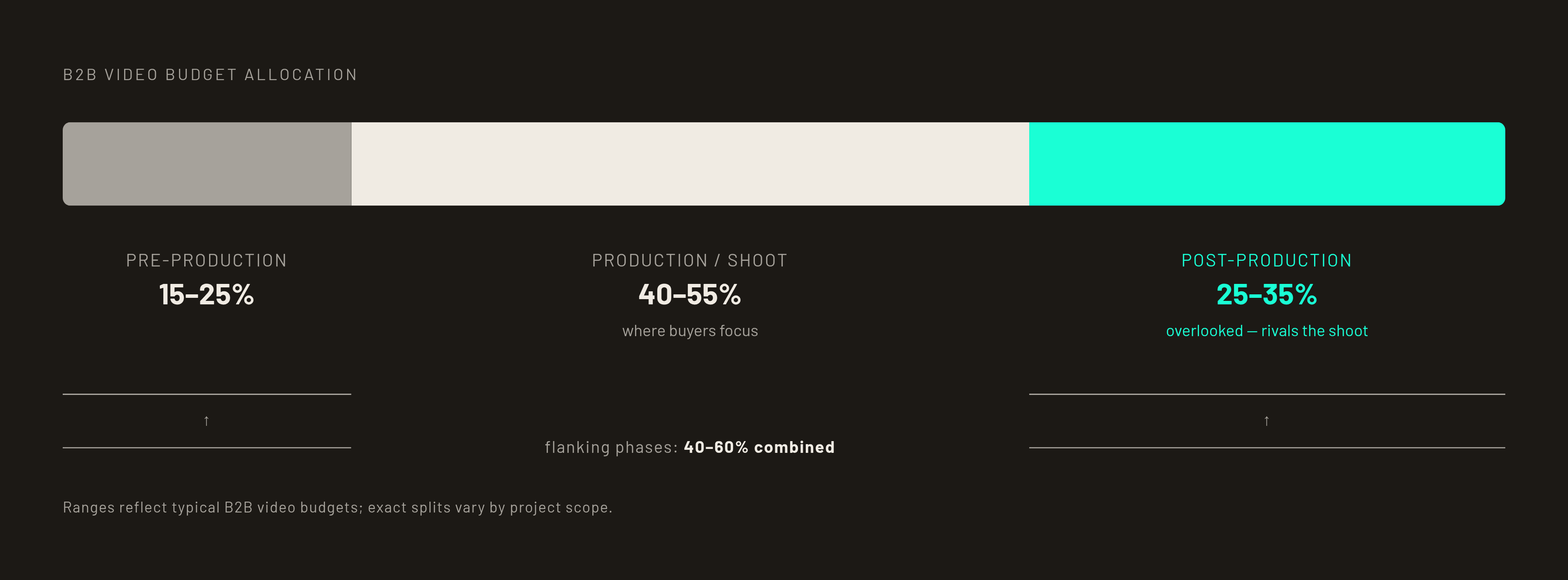
Every video, no matter the format or vendor, works through pre-production, then production, finishing with post-production. Pre-production runs between 15 and 25% of the spend. The shoot itself accounts for 40 to 55%. Vidico.com benchmarking shows post-production running 25 to 35%.
Buyers who budget for shoot-day costs alone (the crew, studio space, day rate, and talent) will lowball the whole thing. Post-production, including editing, audio work, and revision rounds, costs the same as the shoot itself does. Occasionally it tops it.
This phase has no filming or action yet determines if the other stages keep costs in line or spend too much. Pre-production handled carelessly pushes costs up down the line.
Pre-production: the phase that determines how expensive everything else becomes
This phase spans writing scripts, storyboarding, scouting locations, and casting. Nobody's on set yet, so buyers tend to underrate it. Skipping pre-production merely postpones costs without reducing them. It only delays payment.
A solid script paired with a precise storyboard reduce required shoot time while preventing expensive reshoots. Rush this part to cut costs, and the bill returns in a reshoot fee, or another revision pass. Every gap the script leaves open resurfaces later, either as a call forced under clock pressure on a shooting day or as a change asked for once a rough assembly goes out.
Script difficulty itself drives the price. B2B scripts need several stakeholder approvals, and a check for technical details is common with SaaS tools built from actual code, while compressing a truly complex offering into what buyers get within 90 seconds. It’s more difficult to craft than a basic ad, and needs extra rounds before it works.
Giving Scriptwriting to whoever's cheapest as a commodity job still carries problems. That problem shows up down the line during post, pushing past the writer's fee per hour.
How live action and animation compare in price
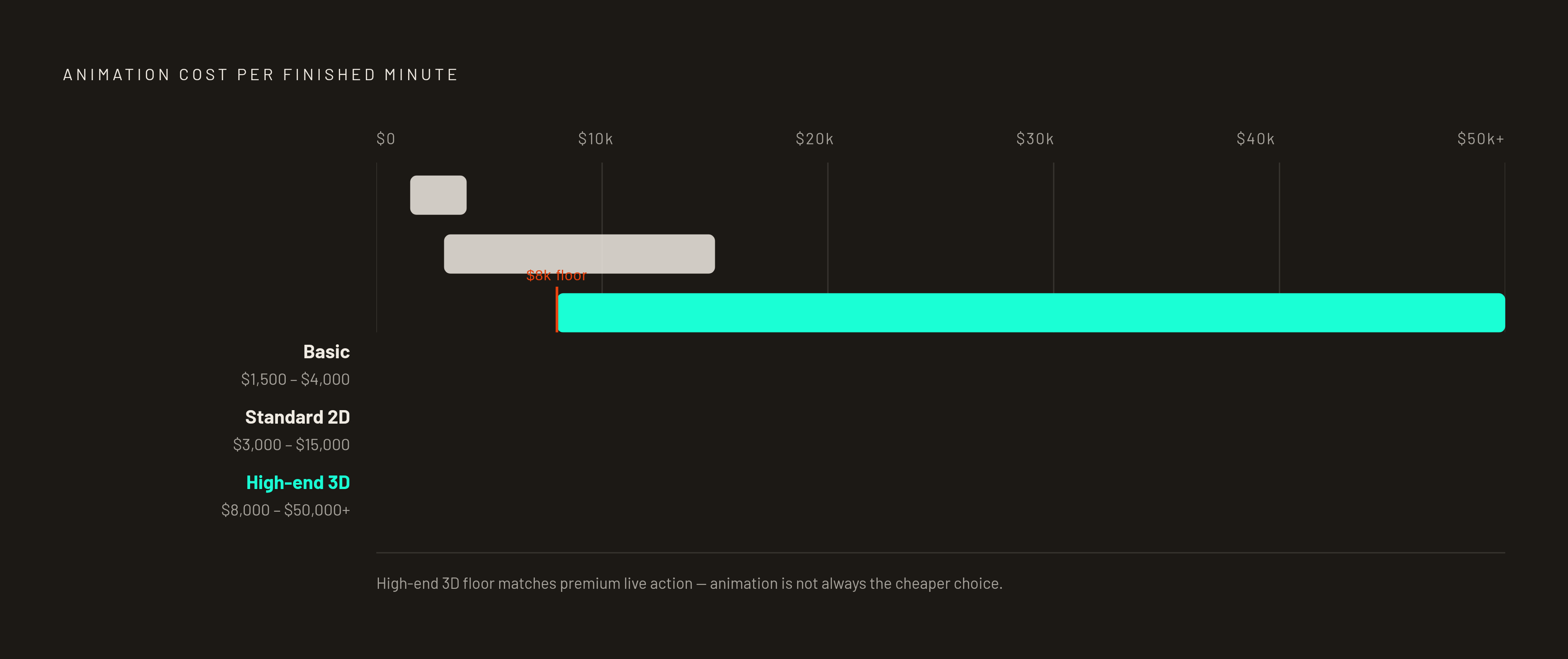
Live action, animation, or a mix often changes the B2B budget more than anything else. Most folks think animation costs less. That’s true for cheaper and average projects. At the high end it breaks down, and people buying get hit on a 3D-quote price.
Live action carries high fixed costs. According to motifmotion.com, hiring skilled film workers costs between $5,000 and $25,000 daily before post-production even starts. Throw in talent, location permits, catering, wardrobe, plus one bad storm, and overruns pile up quickly. With the live shoot confirmed, those production costs are nearly impossible to cut.
Animation spans far more ground, and the chosen look drives the cost, not "animation" as a term:
- Basic animation costs $1,500 up to $4,000 for each completed minute.
- $3,000 to $15,000 for a standard 2D animated explainer
- High-end 3D animation: $8,000 to $50,000-plus for each completed minute (sources cited)
The most expensive 3D work runs roughly equal to premium filmed footage, and occasionally higher. Animation invites extra rounds of revision compared with footage. Unlike shooting on set, animation never yields a "final take", so buyers stay tweaking motion well past when any live-action team wraps. Mixing filmed conversations with moving charts or pop-up labels costs more, and Vidico says the extra runs 10 to 20% above one style.
In B2B SaaS, the format often isn't optional. No one can film software's backend at work. Animation is the only option for showing how it works. What matters is which format serves the message, and what quality in that format costs. Which format carries the idea, and what that format runs.
Crew size and specialization: how headcount turns into day-rate math
Crew costs climb most from a pair of variables: headcount and each person's specialization.
Per-person day rates, based on vidico.com's 2026 numbers:
- A director pulls in $800 to $2,500 daily.
- The cinematographer runs $600 to $2,000 per day.
- $400 to $1,200 for each day of shooting
- Sound specialist: day rate of $400 to $1,000
One camera person costs $1,000 through $3,000 daily, while an entire team charges $5,000 through $15,000. A full team on a two-day shoot incurs additional costs beyond a single day's rate. One long day may reduce some overhead compared to multi-day shoots.
Specialized roles, such as those requiring technical expertise for product demos, cost more and someone who truly knows what's being demoed. These positions typically command higher day rates.
Simple sit-down stories, in-house product demos, and direct-to-camera pieces: a small team can manage all of that well. A brand narrative with several rigs, several spots, and detailed blocking calls for the whole crew, and that crew is generally the biggest cost on the whole budget.
On-camera talent and voice: when people in front of the camera become a significant line item
Crew gets one budget, talent gets another. Who operates the gear and who appears on screen each get their own line item.
Hiring people to appear in video costs from $500 to $5,000 daily based on their background and name. Non-union actors ask $50 up to $500 hourly. SAG-AFTRA talent typically starts at a higher daily rate, and pay climbs for main parts, licensing, or brand endorsements, even in a brief ad push.
Voiceover work runs differently: Voiceover work can range from a few hundred to over a thousand dollars per session.
Picking a staff member rather than booking talent scraps the fee on paper, yet the spend stays, it shifts. People from the company require extra direction beforehand, additional shots during filming, plus editing afterward to fix what a pro performer would have nailed quickly. Using a credible team expert on screen works more for technical buyer needs than having polished talent say words they can't follow, and that choice makes sense for much B2B SaaS production. Viewers lean harder on whoever made the product than on someone hired to fake it.
Gear, site, and the costs of managing a shoot location
Before drones, gimbals and lighting rigs are included, Gear rental can cost thousands per day, depending on the equipment needed. Gear claims the biggest chunk of hardware costs, followed by lighting and rigs.
Location costs have their own rules. Studio rental runs $500 to $3,000 a day depending on the market, with New York and Los Angeles well above that floor. Production in a large urban hub can cost 30 to 50% more than across the Midwest or a Southern region for similar work, making the location both financial and artistic. Out-of-town or overseas shoots pile flights, lodging, plus permits onto the base location fee.
Location and gear work against one another, and buyers miscalculate here. A studio means lower weatherproofing demands and fewer rigs for location-specific lighting. Filming inside a real workspace or storage building requires extra gear to deal with things no one can change. Many B2B videos are filmed at a client's workplace, cutting any location fee outright, though pre-production must still plan for clutter, acoustics, plus sun first. Without that scouting, the shoot day eats time handling issues a walk-through at the location would have spotted.
Post-production: the phase where budgets most often spiral beyond the original quote
Since it takes place off-site once the shoot wraps, Post-production blindsides buyers, even though 25 to 35% of budgets get eaten up by it. Here, those pre-production shortcuts start costing more.
Before revision rounds begin, one finished minute needs 10 to 20 hours for color work, editing, motion graphics, audio, and review. By job, based on 2026 rates, cutting footage costs $75 to $150 per hr, while a standard company film usually takes 20 to 40 hrs.
Someone skilled in After Effects and Cinema 4D bills noticeably more than a person handling basic cuts-only work, because those added details push up the rate per hour, not just the total time. Many firms include one or a pair of rounds of revisions. More rounds mean higher fees, and the number a job requires traces to how well the script and outline were defined before the shoot started.
Cut corners during pre-production, those costs just shift elsewhere. Instead, it relocates into editing, where time is among the most expensive parts of the job.
Video length and scope: why a 60-second video can cost more than a five-minute one
Most people assume a lengthier video costs more. Common sense fails here, and it fails more than many buyers assume at first.
What drives the cost isn't runtime. The 60-second spot featuring motion graphics with hired talent can cost more than any five-minute interview. With less time to work with, every moment of film has to earn its keep, and that concentration of effort hits the budget instead of cutting it.
Per-minute benchmarks show the trend. Entry-level productions cost $1,000 up to $2,000 per minute. Professional-grade work costs $3,000 to $5,000 per minute. Top-tier videos with tailored animation, professional talent, and film-quality equipment cost $5,000 to $10,000-plus per minute.
Costs remain fixed regardless of runtime, which drives this entire trend. Setup work runs the same for short or long cuts, so a brief piece ends up costing more per minute when that steady spending gets split across a smaller length.
Asking for a short runtime doesn't get a lower quote by default, and buyers who lead with "keep it under a minute" as a cost-saving move usually end up paying more per second, not less. What counts is the video's job and how it gets made, not how long it runs.
Agency, freelancer, or in-house: how the production model shapes total cost beyond the per-project quote
A vendor setup shifts the cost picture beyond what one invoice shows. Going with a freelancer typically brings cheaper day rates and a smaller team, but the buyer takes on more of the production oversight: handling schedules, revisions, and script alignment. A firm puts overhead in the quote, with staff and specialists ready, so raises its baseline fee but saves the buyer's own hours and chance of stalled work. Fixed salary bills hit in-house crews no matter the output, paying off with heavy workloads but hurting when things slow down.
No single approach is automatically the least expensive. Every option moves the burden to money, hours, or uncertainty. The best choice comes down to how frequently production runs and the amount of oversight a client can honestly spare, and going with an independent contractor to cut costs on work that has regular deliverables means that difference gets eaten up in management.