Freelancer vs. Agency Video Production Cost Comparison
Hidden costs turn freelancer bargains into expensive mistakes once revisions and equipment pile up.
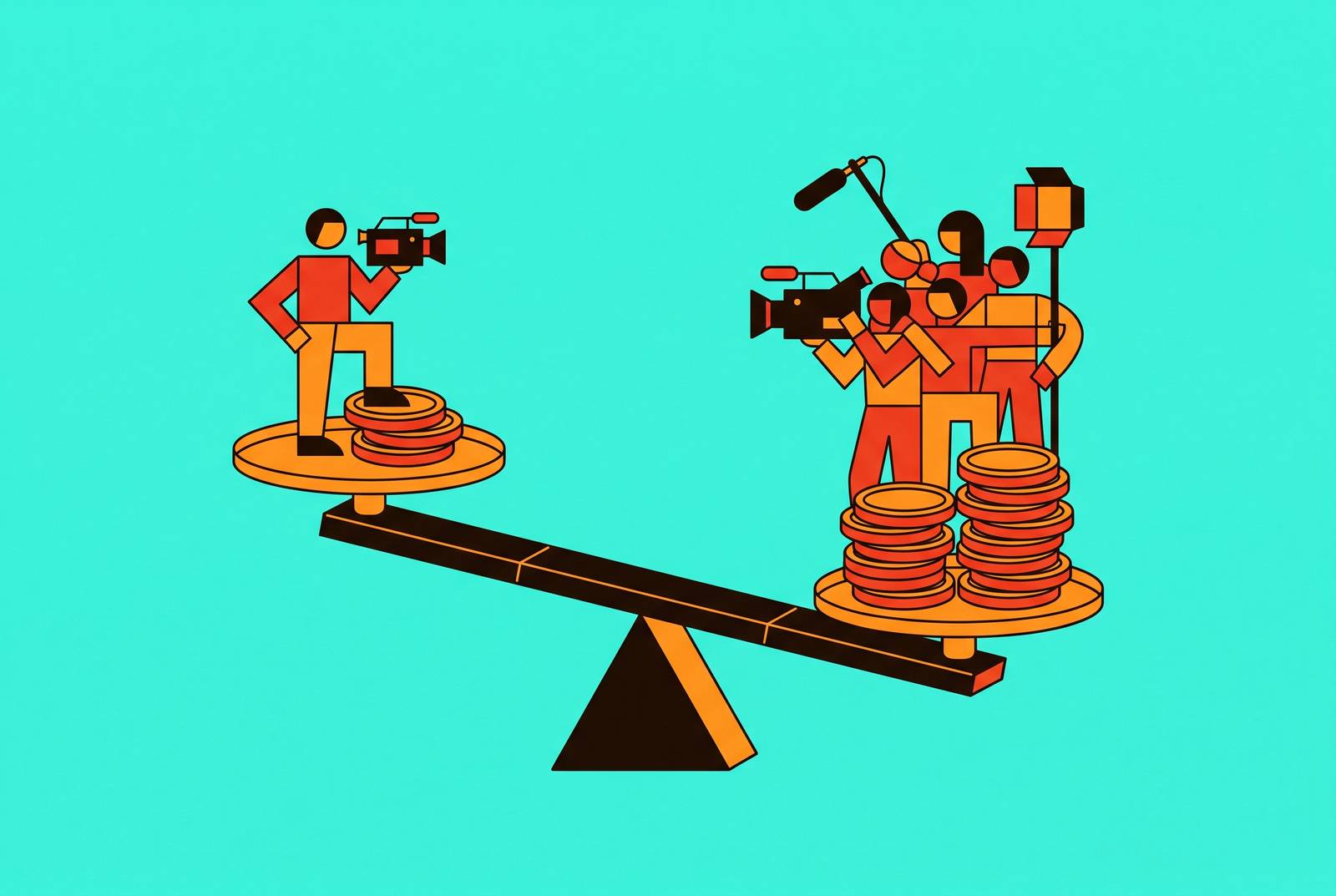
A bad habit drives video pricing: buyers look at day rates, not what is delivered. Choosing rates over results nearly always ends up costing more than the video. Freelancers appear cheaper at first glance. In practice, once every hidden cost surfaces, it frequently isn't. That's the mistake most buyers make, and it's the point this article will prove.
What the three production models are actually selling
The main factor that changes video costs isn't the video itself. It's the creator and what they're liable for if things go wrong.
A freelancer is a solo contractor with lower rates, flexible scope, and the buyer puts together the team and handles all handoffs from shooting to editing. An agency brings strategy, direction, editing, and often motion design together in one place. When you hire an agency, you're buying a final product, not labor hours. The buyer is purchasing a finished result someone else answers for. An in-house team is the most expensive option: salaried staff with high fixed costs, and it only makes financial sense if you're producing 8 to 12 videos monthly. For lower volumes, outsourcing is cheaper in nearly every case.
A freelancer trades hours and know-how. Agencies sell responsibility for outcomes. The difference explains why costs vary, and comparing them like equal bids misses the point from the start.
Someone's got to manage scope, and it's never listed separately on an invoice. Somebody has to keep the shoot on track, notice when a project goes beyond the original quote, and figure out if a revision is fair or just scope creep. With a freelancer, that job falls on the buyer, whether the buyer signed up for it or not. Agencies include creative depth and strategic input in their rates, but freelancers charge extra for them. Skip this, and the buyer either pays an agency too much for work a freelancer could do, or pays a freelancer too little for work needing a producer’s support.
What freelancers actually cost across experience tiers
The wide range of freelance rates by experience can surprise buyers who only price one tier before signing.
New freelancers with 1–3 years charge $40–$90 an hour. Mid-level freelancers with three to seven years charge $90 to $200. Senior freelancers, seven-plus years, charge $200 to $500 an hour. Daily fees match these levels: $400-$800 for juniors, $800-$2,000 for mid-level, and $2,000-$4,000+ for seniors. The cost of a standard filming day is typically $600 to $1,200, just for the shoot.
Editing is charged on its own, and it’s the cost most clients overlook when planning their budget. Hourly rates are $55 to $170, depending on complexity. Most mid-level jobs chew through 10–30 editing hours, adding a significant sum to the bill. That's the number that turns a "$2,000 video" into a $5,000 one after the fact, and it catches almost everyone who priced the shoot day and stopped there.
The freelance day rate seems high compared to a salaried camera operator's hourly pay, until you factor in self-employment tax, gear expenses, insurance, and unpaid weeks between jobs, all bundled into one number instead of spread out in a salary and benefits. That extra charge isn't just profit. The price reflects the true costs.
A 2-minute promo video with filming and editing by a mid-level freelancer runs $2,000 to $5,000. What that figure doesn't cover is equally important: who wrote the brief, who coordinated the shoot day, who chased down the third round of revisions. Those tasks either use up the buyer's own time or show up later on the invoice as a change order.
What agencies actually cost and what that rate is buying
That $50–$200 hourly range is just a rough guide, since agencies don’t charge by the hour. Most charge per project following a first discovery session, making the hourly rate more of a reference than a real bill item.
Small projects cost between $5,000 and the tens of thousands. Mid-sized projects often cost between $15,000 and above. Big projects cost $40,000 and above, and most agencies require a $5,000 minimum per project.
A 2-minute promo that runs $2,000–$5,000 with a freelancer will set you back $5,000–$20,000 at an agency. The difference is real, but you're not getting a better color grade. It pays for a strategist crafting the brief before filming starts, a creative director challenging the product, a producer managing logistics, organized post-production, and a person responsible if the video fails.
SaaS companies must stop seeing the two models as one and the same. Agencies that get both the product and buyer can make a vague pitch hit home in 60 seconds. A freelancer competently does what's given, but executing isn't translating. That’s built into how each model works, and it’s the point where the agency’s higher cost either pays off or falls short.
How video type shifts the cost calculation before you choose a vendor
Choices shrink based on format, long before price matters.
A 15-60 second clip shot on one camera with minimal edits costs a few thousand dollars or less. A skilled freelancer working alone can most easily handle this format, so using an agency is often unnecessary. Standard corporate and explainer videos, professional crew, scripted, branded graphics, 1 to 3 minutes, run from several thousand to tens of thousands of dollars. Here, freelancer and agency prices overlap, and managing the project scope becomes more decisive than the daily rate.
Animated explainers cost between $3,000 and $15,000 for each finished minute. A team’s needed, illustrator, animator, sound designer, working step by step, so one freelancer can’t handle it all without farming out chunks. Commercial and brand films, with multi-day shoots, professional talent, and heavy post-production, cost $15,000 to $50,000-plus. It’s automatically an agency job, just managing it shuts out most one-person shops.
The budget breakdown by phase stays the same regardless of the video producer. Pre-production, scripting, planning, casting, eats 15 to 25% of the total. Production, filming, crew, equipment, takes 40 to 55%. Post-production, editing, color, audio, graphics, runs 25 to 35%.
Buyers often cut pre-production to save cash, but it always ends up costing more later through reshoots and added revisions. Cutting corners here won’t cut costs. It just shifts costs later and calls it a "revision."
Someone buying a 90-second animated SaaS explainer doesn't compare freelancers and agencies on a level playing field. The format had already limited the options before price talks began.
The hidden costs that make freelancer quotes grow and agency quotes shrink
Freelancer quotes seem low upfront since they often omit key details.
Renting a pro camera setup costs $800-$2,400 daily, plus $500-$1,500 for lights, grip gear, and sound. On-screen talent costs $500-$1,500 daily, based on their experience and usage rights. Each extra revision costs $500 to $2,000. Revising a video later when the product shifts can incur substantial additional costs. Translating a video into another language incurs additional costs.
The buyer’s time isn’t factored in here, and that’s the real unseen expense. Managing the team, reviewing edits, handling revisions, and tracking late work, that's scope management, and it looks free on paper. In reality, it takes hours away from regular work duties every week until completion.
Reverse the perspective, and agency quotes that seemed high at first appear far more sensible when you add equipment, talent, and the buyer’s time to the freelancer’s total. A true match-up isn’t rate versus rate. Freelancer quotes almost never show the total cost of production, including the buyer's time, up front.
What scope management and accountability are actually worth
Bringing in a freelancer makes you the one running the show, planned or not. The buyer handles briefing quality, shoot day logistics, revision order, and final delivery, but not every buyer knows enough about production to do it well.
That can work sometimes. With a tight script, an experienced marketing lead, and a clear deliverable, a buyer can manage a freelancer relationship smoothly. The freelancer works, the buyer oversees, and the lower rate is truly earned.
It breaks down under different conditions: multi-asset projects, tight deadlines, a product that needs real narrative translation (an abstract SaaS feature that has to become a compelling 60-second story, for instance), or a team with nobody free to absorb the coordination load. Each condition on its own raises the risk significantly. Put two of those together, and hiring a freelancer often ends up costing more than the agency's quote they were supposed to beat, mainly because no one accounted for coordination problems until they occurred.
An agency's overhead pays for a producer who takes charge of the brief immediately, a creative director who challenges the product story before scripting, and a process designed to spot issues in pre-production rather than in the edit bay, where freelance budgets often silently disappear.
Scalability matters too. Agencies handle mid-project scope changes, switch editors, and manage two tasks simultaneously. A freelancer who falls ill or gets pulled into another client’s urgent work has no backup, making them a single point of failure.
For B2B SaaS specifically, production quality was never the issue. It's compressing what makes a product genuinely different into a story that holds up in 60 seconds. It requires genuine strategic thought before filming starts, and that's precisely why the agency model commands a higher premium for this type of work over, for instance, simple event coverage.
How to match the vendor model to the actual decision in front of you
Hiring a freelancer works when the brief is clear and the buyer has someone to handle production without it turning into a full-time task. A freelancer is a good fit when the format is straightforward, single-camera, short-form, minimal animation, and low volume, where a retainer isn't practical (⟦L1⟧a senior freelancer retainer for one or two polished pieces monthly costs $3,500 to $8,000⟦/L1⟧). It's most effective if you already have in-house creative or marketing leaders handling strategy.
An agency is the better choice when the product requires genuine strategic thinking, not just solid execution. An agency is best if a project includes multiple deliverables, animation, or hired talent, because poor coordination there costs much more than the agency fee. It counts when the in-house crew can’t handle the extra work without letting go of other tasks, or when the goal is growth, steady monthly work, localised editions, or long-running ad help.
B2B video studios that specialize in SaaS and technical products occupy a helpful middle ground. They offer the strategic focus and responsibility of a full-service agency, but focus on one clear goal: making complex products appealing to those unfamiliar with them. Companies with complex differentiations that are hard to explain generically usually find that the extra spend on specialized studios pays off most clearly through this specificity.
One key question works for any model: does the vendor grasp what sets the product apart, or just use a template? That answer determines if the cost difference between freelancer and agency is a wise move or a costly error, either way.
Successful video doesn't need high-end spending. Many firms see solid outcomes with just a few grand. You need to spend according to the job's actual requirements. Mixing up cheap with right is the biggest costly error a buyer makes here, and it's nearly always the buyer who skipped the scope talk who does it.