Specialized vs. General Video Agencies for SaaS Startups
Specialist agencies convert SaaS buyers where generalists fall short.

The numbers aren't subtle. SaaS websites with product videos convert at roughly 4.8%; those without convert at roughly 1.9%. Explainer videos lift free-trial-to-paid conversions by around 37%. Onboarding video correlates with significantly lower churn. These figures require explicit sourcing to be actionable — teams evaluating video investment should verify them against primary research before building a business case around them. Video's return isn't confined to top-of-funnel acquisition; it restructures the unit economics of the entire growth model, from first click through renewal.
And yet the majority of SaaS homepages still don't feature a product video. That gap between what the data supports and what teams actually ship almost always comes down to uncertainty about execution, specifically, who should build it and whether they can actually pull it off.
89% of consumers say video quality affects how much they trust a brand — a figure attributed to Wyzowl's annual State of Video Marketing report, which should be consulted directly to confirm methodology and sample. A poorly executed video doesn't just underperform quietly. It actively corrodes credibility with the exact buyers you needed to win. That means a single video is simultaneously carrying conversion weight, trust signals, trial activation, and brand perception. The stakes per asset are genuinely high. Which makes the choice of who builds it a business decision, not a creative preference. The debate is what kind of team can execute video that works specifically for software, and why the answer looks almost nothing like what you'd choose for a consumer brand.
What a General Agency Actually Optimizes For, and Why That Diverges from SaaS Goals
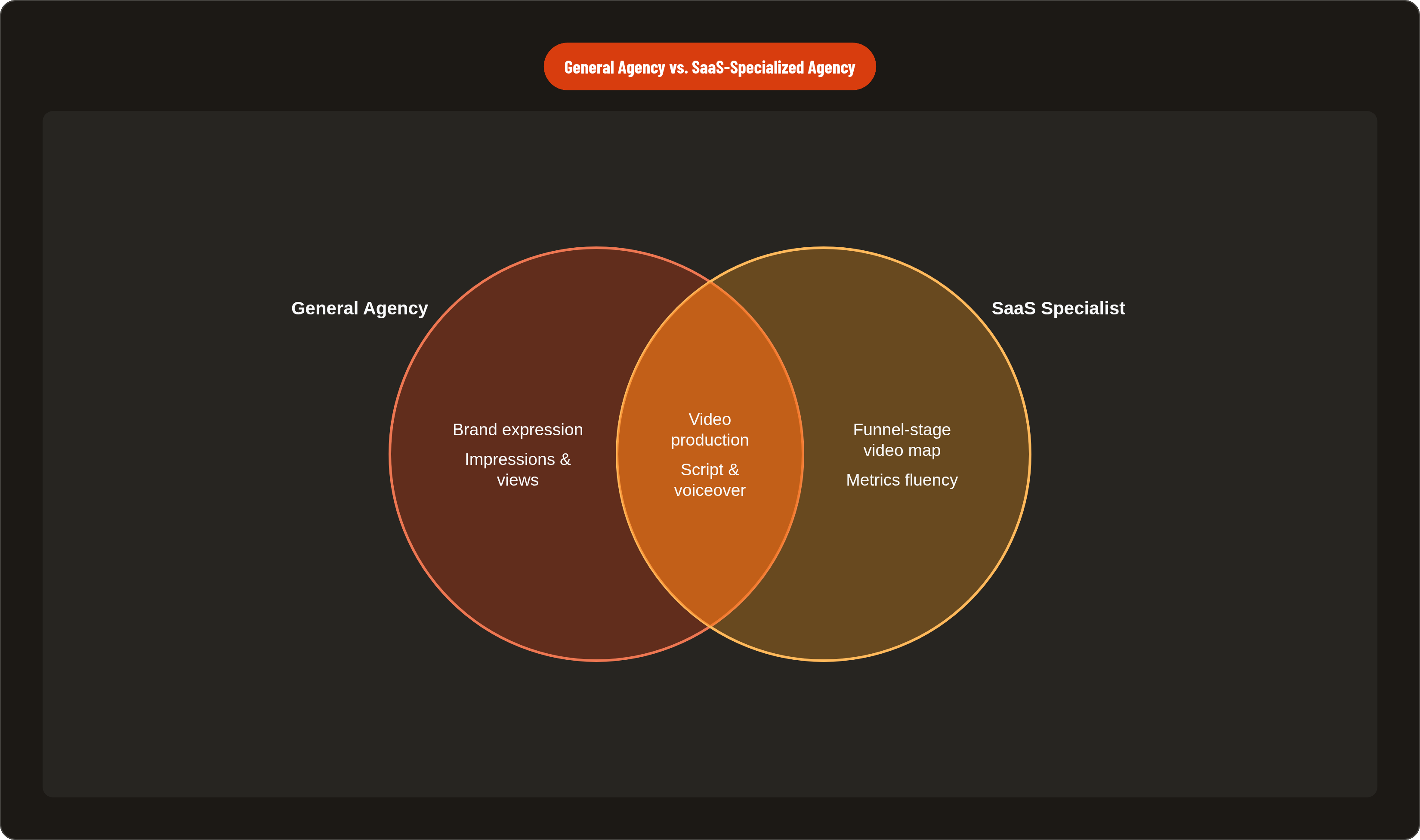
General agencies are built around impressions, views, and aesthetic recognition. That makes sense when you're selling a beverage or a shoe, where awareness drives purchase decisions that happen fast, individually, and often emotionally. SaaS buying doesn't work that way.
SaaS needs signups, MQLs, trial activations, pipeline velocity. The sales cycle is longer. The buying committee is larger. The decision criteria are primarily functional, not aspirational. A general agency can produce a video that performs well by its own internal benchmarks and miss every number that actually matters to a growth team.
A company invests in a visually polished explainer, it gets respectable LinkedIn traction, the creative team is proud of it, and it drives zero demos. The messaging was generic. The pain points weren't specific enough to land with the actual buyer. The CTA went to a homepage instead of a trial flow. The video addressed a brand awareness problem the company didn't really have.
There's also a content strategy mismatch that rarely gets named. General agencies produce one video and distribute it everywhere. But a single message doesn't work across awareness, consideration, and decision stages in a B2B funnel. The buyer who has never heard of your category needs different framing than the buyer who is already comparing you to two other vendors. Building one video and expecting it to serve both is how you end up with a video that serves neither.
Then there's the subcontracting problem: some generalists quietly outsource production to a specialist, add a markup, and deliver a finished product without ever developing real domain knowledge. The client pays more and still doesn't get SaaS-fluent messaging.
The deeper structural issue is buyer-committee thinking. A CIO evaluating enterprise software cares primarily about security and integration. The CFO at the same company cares about cost reduction and payback period. One video cannot speak to both without a deliberate stakeholder strategy, and that kind of thinking isn't instinctive to a team that learned its craft in consumer advertising. It has to be built over years of getting it wrong and adjusting.
The Specific Capabilities That Make a SaaS-Specialized Agency Different
The hardest thing to do in SaaS video is take invisible software and make it comprehensible in under two minutes without resorting to vague abstractions. That requires technical translation: knowing what to show, in what order, and through what visual framing will actually land with a technical buyer who has seen a hundred explainer videos and is allergic to fluff. You need both product literacy and visual storytelling present simultaneously. One without the other produces either accurate-but-boring content or beautiful-but-meaningless motion. There is no briefing a talented generalist animator into this; the agency either has the muscle or it doesn't.
Funnel-stage awareness matters just as much, maybe more. Specialist agencies don't think in terms of a single hero video. They build a video map. An awareness-stage buyer who doesn't yet recognize the problem needs a short social clip that names a pain they've been living with. A consideration-stage buyer needs a product explainer that demonstrates real differentiation, not just category membership. A decision-stage buyer comparing vendors needs a demo walkthrough or ROI-framed content that answers the specific objections standing between them and a signed contract. These are structurally different assets with different jobs, and collapsing them into one video is a reliable way to produce something that does none of those jobs adequately.
Buyer-committee specificity follows from that. B2B SaaS purchases involve multiple stakeholders with different priorities and different professional vocabularies. A specialist agency builds a suite of assets that speaks to those distinct roles rather than producing a single piece that attempts to reach everyone and lands with no one.
Metrics fluency is the operational version of that strategic orientation. Understanding CAC, LTV, activation rates, and trial-to-paid conversion means production decisions are organized around what actually moves those numbers. The script isn't written to sound polished; it's written to reduce the friction that's killing conversion at a specific funnel stage.
Industry-vertical depth compounds over time and can't be faked. Agencies that have spent years working in fintech, healthcare, or cybersecurity understand which proof points build credibility with buyers in those verticals, which compliance signals matter, and which framings will immediately read as naive. None of that transfers from consumer work.
The hardest capability to develop, and the one most worth probing in an agency evaluation, is positioning distillation: taking a product's genuine differentiation and compressing it into 60 seconds without flattening it into something that sounds like every other software company. A specialist agency forces that work upstream, in the brief and scripting phase, so the production serves a sharp point of view rather than papers over the absence of one.
Named Specialists in the SaaS Video Space and What Each Is Known For
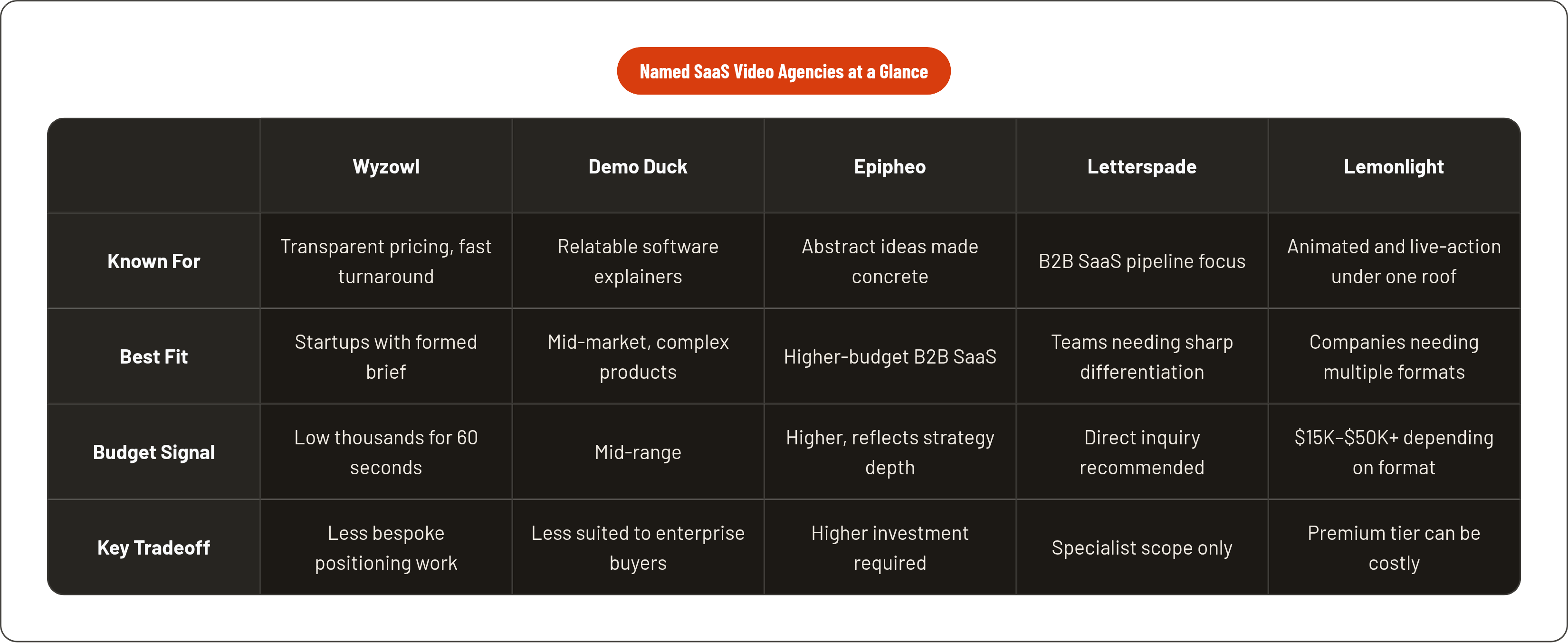
These aren't ranked. Different agencies suit different stages, budgets, and production needs. The right question is which profile fits the specific job.
Wyzowl is known for transparent pricing and fast turnaround, with production starting in the low thousands for a 60-second video. For startups that want professional output without extended timelines or opaque quotes, Wyzowl removes the budget uncertainty that slows decisions. The tradeoff is that it operates at higher volume, which means less bespoke positioning work and more execution against a brief the client brings fully formed.
Demo Duck has built a reputation for making software feel relatable. Their explainer work blends clarity with personality in a way that reduces the corporate demo feel that can kill engagement before the product even gets introduced. They are a strong fit when the product is technically complex but the buyer is more mid-market than enterprise.
Epipheo works at the intersection of meaning and motion, with a track record in B2B SaaS and a particular focus on making abstract ideas concrete. Their production skews toward higher budgets, which reflects both production quality and the depth of strategic work that goes into scripting.
Letterspade is built specifically for B2B SaaS, with a focus on distilling complex product differentiation into short-form video that functions as a sales tool rather than a brand artifact. The orientation is toward pipeline impact. For teams that know their product well and need an agency that can compress that differentiation into something buyers act on, Letterspade is worth a direct conversation.
Lemonlight covers both animated explainers and live-action production, with animated work starting in the $15,000 to $20,000 range and premium or live-action work running $20,000 to $50,000 and above. For companies that need both formats under one roof, Lemonlight offers continuity across asset types without switching vendors mid-project.
Across any of these options, three questions cut through the sales conversation quickly: Do they work primarily with SaaS companies? Do they understand your funnel stage, or do they default to producing one video for everything? Do they have category-relevant examples, meaning videos for products that solve a similar kind of problem, not just videos that match your aesthetic preference?
When a General Agency Is Actually the Right Call
Specialists don't always win. It depends on what the job actually is.
General agencies are a legitimate choice in specific scenarios. When the narrative and demo path are already fully locked and the need is strong filming, editing, and reliable delivery to spec, a generalist can execute competently on a clear brief. When the project is a rebrand, a full brand identity build, or a multi-channel campaign that includes television, out-of-home, or print, a general agency's breadth becomes a genuine asset. When the company needs event support, live streaming, or broad creative production that isn't tied to a sales funnel, the range of a generalist shop is appropriate.
One useful distinction: general agencies are architects of brand expression; specialized production partners are builders of conversion infrastructure. Both are real disciplines. But they aren't interchangeable, and mistaking one for the other is how budgets produce assets that don't move a number.
The scenario where a generalist actually works: a SaaS company with strong in-house product marketers who have already solved the positioning and messaging problem can hand a generalist a tight brief and get competent execution. The hard thinking has been done internally; the agency's job is purely production.
The scenario where it falls apart: hiring a generalist and expecting them to figure out the messaging. That's where the "beautiful video, zero demos" outcome comes from. The agency does what it knows how to do. It just isn't the thing the business needed.
What SaaS Video Production Actually Costs Across Agency Types and Company Stages
Budgets vary dramatically by stage, scope, and agency type, and any single number presented in isolation is misleading. The figures below reflect publicly available pricing information and vendor-reported ranges, which should be confirmed directly with each agency before budgeting. For a 60 to 90-second animated explainer with voiceover and sound design: Wyzowl starts around $5,000; Yum Yum Videos typically runs $7,000 to $15,000; Epipheo ranges from $10,000 to $20,000 depending on complexity; Lemonlight's animated work starts at $15,000 to $20,000, with premium or live-action production at $20,000 to $50,000 and above. For broader reference, simple social content runs $1,500 to $5,000; medium corporate or explainer videos run $4,500 to $20,000; complex brand films run $15,000 to $50,000 and above.
The hidden costs are where teams consistently get surprised. Revision fees run $400 to $1,000 or more per round. Music licensing adds hundreds to thousands of dollars. Script changes after animation has begun can cost $500 to $800 per round, because motion that's already built has to be rebuilt from that point forward. Budget a 20 to 30 percent contingency above any vendor quote and get that number into the internal approval process before you sign anything.
On timeline: standard production runs three to five weeks from kickoff. Anything under three weeks typically sacrifices script refinement or revision rounds. For a SaaS product, those aren't optional phases. The script is where the messaging problem gets solved or doesn't. Compressing that timeline to hit an arbitrary launch date is one of the more expensive shortcuts available, because you still pay for the full video, you just get one that doesn't work as well.
For pre-seed or pre-PMF teams, AI-powered editing, scripting, and voiceover tools have reduced median production costs enough to make iterative testing genuinely viable. Testing messaging through lower-cost AI-assisted production before committing to a full agency budget is a legitimate approach, particularly for teams that aren't yet certain what their differentiation is or who their primary buyer is.
The right comparison isn't cost per video. It's cost per conversion, trial activation, or qualified demo. At that level of analysis, the cheapest video is almost never the least expensive option.
How to Assess Whether an Agency Can Actually Translate Your Product's Differentiation
Almost every agency says they've worked with SaaS clients. That answer tells you nothing. The real question is: can you explain what makes our product different from the alternatives, and show me a video where you did exactly that for someone else?
Portfolio signals that indicate genuine SaaS fluency are specific. Look for videos that name a concrete problem before introducing the product. Look for evidence the agency has built different videos for different funnel stages rather than one hero video repurposed everywhere. Look for proof the agency understands the buyer, not just the product: persona-specific language, relevant proof points, CTAs tied to a conversion goal rather than a vague impression of category relevance.
Red flags in an agency's sales conversation are equally diagnostic. If they lead with production style before asking about your ICP, your funnel, or your conversion problem, they're optimizing for the wrong thing. If they can't articulate what makes a SaaS explainer structurally different from a consumer brand spot, they haven't built that capability. If their case studies measure views and engagement rather than conversions or pipeline influence, they're measuring what they know how to measure, which is not the same as what matters to your business.
The brief quality test is the most reliable signal available before you commit. A specialist agency should be asking about your current trial-to-paid rate, your ICP's top objections, and which funnel stage has the biggest drop-off before they ask about brand colors or preferred animation style. If the discovery conversation feels like a creative intake form, that's informative about how they'll run the entire engagement.
For early-stage startups still refining their messaging, the right agency functions as a thinking partner on positioning, not just a vendor who executes a brief. Ask the agency directly how they've helped clients sharpen their positioning, and listen carefully for whether they have an actual process or a polished non-answer.
Production quality is table stakes at any professional price point. What you're actually buying is whether the agency can compress your differentiation into something a buyer understands in 60 seconds. Test that capability in the sales conversation itself, before any contract is signed.