Red Flags in Video Agency Portfolios for Tech Products
SaaS agencies without specialized experience will learn your product on your budget.

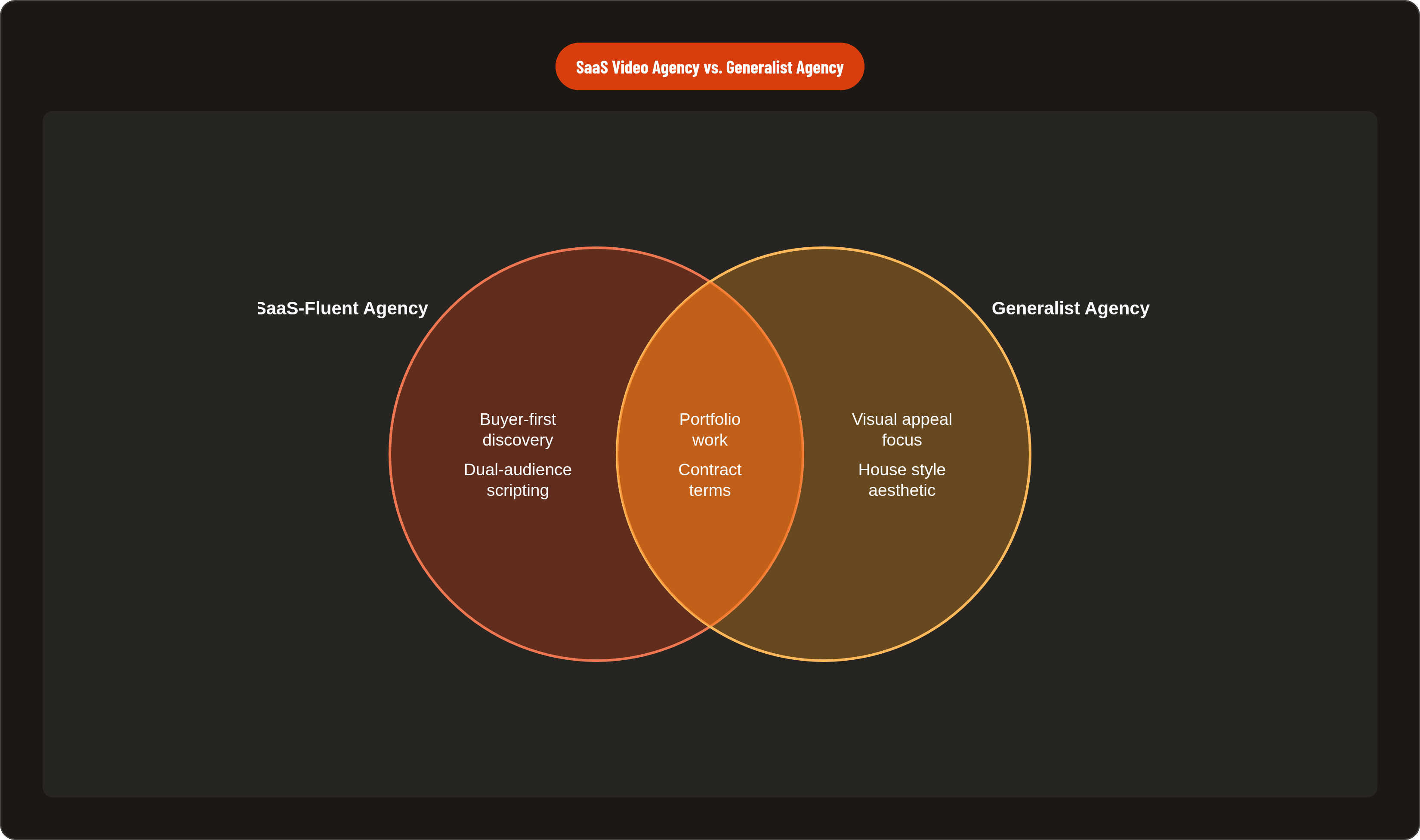
Consumer commercials, healthcare spots, and retail campaigns share almost nothing with a SaaS explainer at the level of cognitive demand. Consumer work needs visual appeal, emotional resonance, brand coherence. A SaaS video needs all of that, plus the ability to write simultaneously for a VP evaluating ROI and an engineer evaluating integration architecture, plus the skill to demonstrate a workflow without losing a non-technical viewer in the first twenty seconds. The cognitive load is categorically different.
A reel split across healthcare, retail, and lifestyle apps tells you one thing clearly: this agency has no repeatable process for SaaS. Every engagement is a first attempt. They will learn your product category on your budget and on your timeline.
The verification test happens in the first conversation. Notice whether they open with questions about your ideal customer profile, your positioning, and the specific objections your buyers raise on sales calls. Or notice whether they lead with a capabilities deck. That single choice maps directly to how they would approach your product video. Agencies fluent in SaaS are constitutionally curious about the buyer before they think about the camera. Agencies without that fluency lead with what they can do, not with what you need.
A SaaS-only focus means every prior project sharpened the same skills the next client needs, rather than a generalist library assembled across categories with nothing in common.
How showreels hide incompetence that full-length work would expose
A highlight reel is an agency's best thirty seconds from dozens of projects. It is not representative of what you will receive. By definition, it excludes everything that failed.
What showreels routinely conceal: weak script structure that holds for the first few beats before collapsing under the weight of actual product explanation; poor pacing precisely where the solution demonstration lives; generic closing calls to action that bear no relationship to the client's actual sales motion. None of that appears in a reel. All of it appears in the video you pay for.
Request complete videos in your content category. Full SaaS explainers, full product demos, full onboarding sequences. Alongside each sample, require context: the client, the stated objective, and what happened after the video launched. An agency that resists sharing full-length work is telling you the complete picture doesn't hold up. That resistance is diagnostic information. Take it seriously.
The difference between an agency that finished a project and one that produced a result
A portfolio full of beautiful work with no stated objectives is a mood board, not a portfolio. Aesthetics without accountability tells you the agency thinks in deliverables rather than outcomes, and that distinction will define every interaction you have with them.
A genuine case study contains a named client, or at minimum a clearly described vertical and company stage; the specific problem the video was built to solve; where in the funnel it was deployed; and what changed after launch, even directionally. "We've helped B2B SaaS companies communicate their value" without a single name or measurable result is not a proof point. It is a placeholder dressed as one.
Agencies that think in results use language like "reduced time-to-close" or "improved trial-to-paid conversion." Agencies that think in deliverables describe deliverables: "we produced a two-minute explainer with motion graphics." The vocabulary is the tell.
Process detail matters too. A case study that explains how stakeholder alignment was achieved, or how a compressed timeline was navigated, tells you more about what it's actually like to work with that agency than any visual sample does.
Why portfolios that show only one-off projects hide a scalability problem
A reel of isolated, high-concept singles can look impressive while concealing that there's no repeatable production infrastructure underneath it. The first project goes beautifully. The second engagement, when you need a homepage explainer, onboarding clips, and ad variants simultaneously, is where the absence of system becomes expensive.
Look for series work: multiple episodes with consistent visual language and shared structural logic. Look for campaign packs: different format cuts of the same core video adapted for long-form, short-form, square, and story placements. Look for evidence of a shared graphic system across outputs, consistent lower-thirds, title card conventions, a motion graphics library that deploys without being rebuilt from scratch each time.
What the absence of these signals is an agency optimized for boutique, high-touch, singular projects. That model produces genuinely exceptional one-off work. It becomes a bottleneck the moment your content needs scale or velocity, because there is no reusable system underneath the craft. An agency with an asset system ships revisions in hours. An agency reconstructing your brand's visual architecture from scratch on every deliverable ships them in weeks.
When an agency pitches cameras and cinematography instead of strategy and distribution
An agency that leads its pitch with equipment specs, drone capability, or cinematographic look is revealing its optimization target. The video as object, not the video as commercial tool.
A strategy-first pitch sounds different. It includes questions about where in the funnel the video will live, which single buyer objection the video needs to neutralize, a reasoned point of view on optimal length given the distribution channel, and a proposed measurement approach tied to funnel metrics like demo bookings or trial starts rather than view counts alone.
For SaaS specifically, this distinction is not a matter of taste. A video targeting a VP of Marketing and a video targeting an engineering lead require different scripts, different tonal registers, different lengths. An aesthetics-first agency treats them identically because it has no framework for differentiating them. A beautifully produced video that addresses the wrong objection for the wrong buyer accomplishes nothing, regardless of how it looks.
The orientation of a strategy-first agency is video as a sales instrument. The strategic questions, what does this video need to do, for whom, at which funnel stage, precede every creative decision. That sequencing is not a process preference. It is the operational difference between a video that moves pipeline and one that wins a design award nobody asked for.
How to tell whether the scripts in a portfolio were written by someone who understands SaaS
The script is where domain ignorance is hardest to disguise. If you know what to listen for, it is also the easiest place to catch the problem.
The signs are consistent. The video opens with company history or founding narrative instead of buyer pain. It describes features rather than workflows or outcomes. It relies on generic benefit language, "saves time," "boosts efficiency," without any specificity about the mechanism. It pitches either too soft or too jargon-heavy because it cannot hold a business buyer and a technical evaluator in the same frame at once. The closing call to action disconnects from the actual sales motion, offering "learn more" for a product with a ninety-day enterprise cycle.
SaaS-fluent scripting requires comfort with concepts like activation thresholds, payback period, integration architecture, and buying committee dynamics. The person approving the budget and the person who will use the product daily have different anxieties and different vocabularies. A well-constructed script addresses both without losing either. That is genuinely difficult to do, and most agencies don't attempt it because they don't know they're supposed to.
Ask directly: were the scripts in their portfolio written by a copywriter with SaaS product experience, or by the creative team? Most studios have clients explain their own product and then hand back a script that sells it incorrectly. The confidence, or conspicuous lack of it, in the answer tells you everything.
What rigid house style across a portfolio says about brand adaptability
A portfolio where every video looks like the same video, same motion language, same color palette, same typographic personality, is showing you an agency that bends clients toward its aesthetic rather than subordinating its aesthetic to each client's brand system.
For SaaS buyers this is a practical problem. Enterprise companies have established brand systems with documented guidelines. A video that doesn't integrate with those systems creates visual dissonance in the sales conversation. A startup whose homepage explainer looks like it belongs to a different company has a credibility problem with buyers who notice the inconsistency, and discerning buyers always notice. Series work and sales enablement content need to match the product UI, the website, and the slide deck.
What genuine brand adaptability looks like in a portfolio is visually distinct projects, each of which feels native to the client's established identity, held together by craft and clarity rather than a shared house aesthetic. The motion choices, color logic, and typographic decisions should each feel like an expression of the client's system.
Ask them to show you two portfolio pieces that look nothing alike. Then ask how each was shaped by the client's brand rather than internal defaults. The answer, specifically how they talk through it, tells you whether adaptability is genuine capability or a talking point.
Contract-stage signals that confirm what the portfolio already suggested
By the time you reach contract negotiations, the portfolio has already told you most of what you need to know. The contract stage either confirms that read or contradicts it.
Pricing red flags surface quickly. The absence of a phase-by-phase cost breakdown, with pre-production, production, and post-production each itemized separately, obscures where your money goes and where scope disputes will emerge. "Unlimited revisions" language that quietly excludes script changes, reshoots, or late stakeholder feedback is not unlimited revision; it is a trap. Suspiciously low headline numbers without clear exclusions almost always precede a change order conversation after production has already started.
IP and usage rights require explicit scrutiny. You need a clear statement of who owns the final video, the raw footage, the project files, and the licensed audio assets. Time-limited usage rights that require renewal create recurring cost and operational friction. Platform restrictions that constrain how sales or marketing can deploy the asset limit the video's commercial utility directly. The treatment of AI-generated elements, ownership, liability, and indemnification, is increasingly material as AI tools enter production workflows and should be addressed explicitly in the contract rather than left to interpretation after a dispute arises.
Scope-of-work red flags include willingness to begin without anything in writing, verbal agreements about deliverables that have no written counterpart, and contracts that make no reference to brand guidelines or confidentiality.
One more signal that most buyers overlook: communication behavior during the pre-sales phase is predictive. Consistent delays during the pitch stage reliably forecast delays once production is underway. The attentiveness an agency extends to winning your business is generally the ceiling of the attentiveness it will extend to serving it.
The questions that separate a genuine SaaS video partner from a production vendor
The portfolio tells you what they have done. These questions tell you whether they understood why it worked.
Ask them to walk you through how they would approach scripting for a product with both a technical buyer and a business buyer in the same purchasing committee. A production vendor describes a process. A genuine SaaS partner describes a framework grounded in the distinct anxieties of each stakeholder and the specific juncture in the sales cycle where the video will intervene.
Ask what they would need to know about your sales motion before committing to a recommended video format and length. An agency that can answer this has a point of view on distribution. One that deflects it, or treats it as your problem to solve, has none.
Ask how they handle screen capture quality, demo environment setup, and UI versioning across the production cycle. This question is a competence filter. It has a correct answer, and agencies that have produced SaaS product videos at scale know it immediately.
A missing discovery process is the single clearest indicator that domain fluency is absent. Discovery is not a courtesy gesture. It is the first deliverable. An agency that skips substantive questions about your ideal customer profile, your buyer objections, and your sales cycle is telling you it lacks the vocabulary to ask them.
The sequencing is not optional: discovery before creative direction, buyer objection before script, distribution channel before format. That order exists because it is the only order that produces a video which actually performs rather than one that merely gets delivered.