Scripting Explainer Videos for Complex B2B Products
Master the script architecture before you worry about production polish.

Scripting an explainer video for a complex B2B product is a distillation problem, full stop. Your job is to strip a sophisticated product down to the one thing that makes a buyer lean in, and every structural decision, hook, problem framing, proof, call to action, has to serve that single goal. Get the architecture right and production value becomes secondary; get it wrong, and no amount of polish saves you.
Video isn't a differentiator anymore. Wyzowl's 2026 State of Video Marketing report puts usage at 91% of businesses, and explainers specifically are the second most-produced format at 68%. Nearly every buyer, 98% by that same report, has watched one to learn about a product, and that's saturation. The advantage isn't having a video anymore; it's having a better-scripted one. HubSpot's 2024 data backs this up directly: 74% of B2B buyers say they're more likely to purchase after watching an explainer for a complex product. The format works, but it only works when someone did the hard thinking before a single frame got animated.
What makes a B2B buying audience fundamentally different from a consumer audience
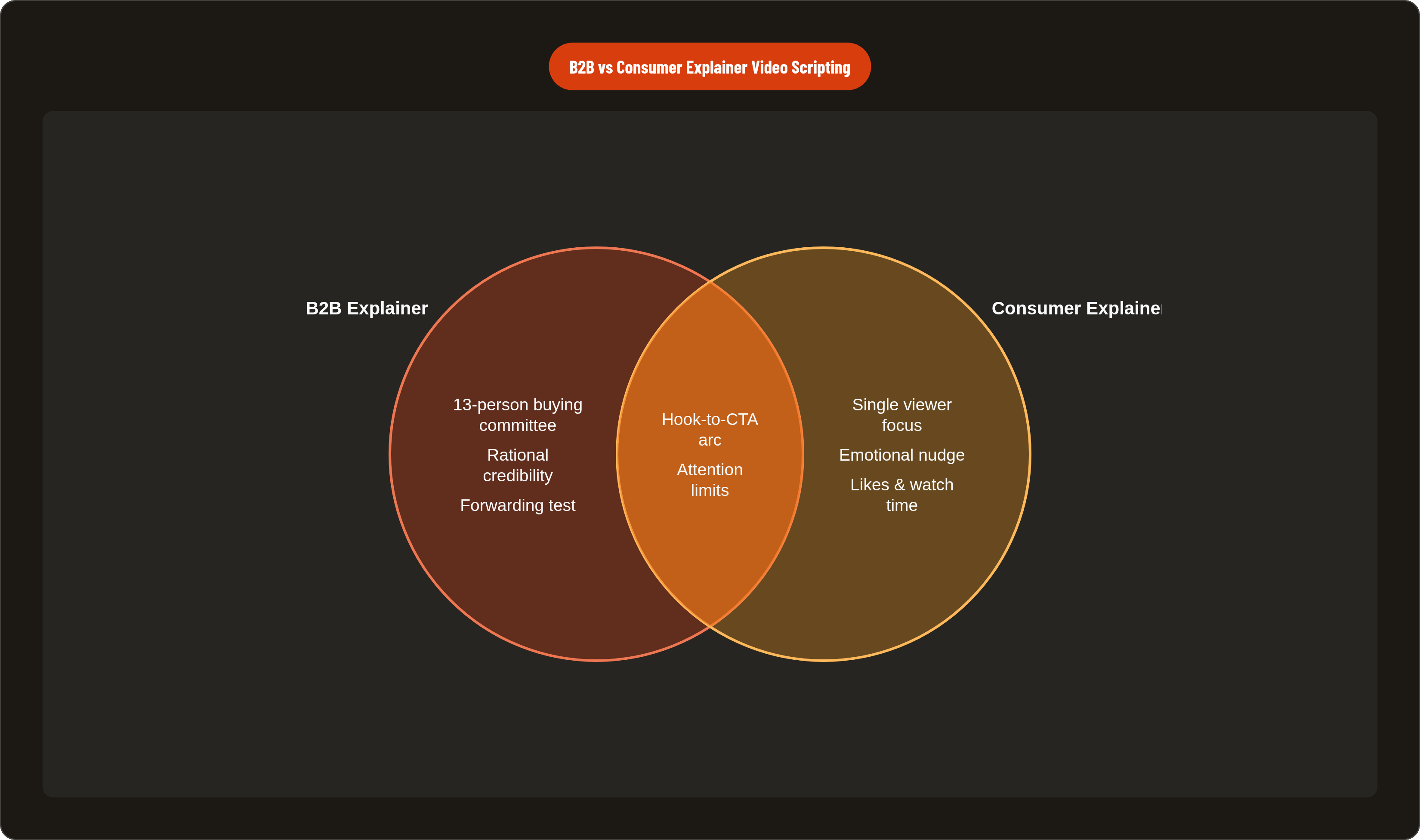
Forrester's State of Business Buying, 2024 report found the average B2B purchase involves 13 stakeholders, and close to 89% of buying decisions cross multiple departments. That number alone should change how you think about scripting.
This isn't really a viewer problem; it's a forwarding problem. Your video has to survive being shared without you or your salesperson in the room to explain the parts that got skipped. Two audiences exist at once: the person you reached directly, and the colleagues that person now has to convince on your behalf. Finance wants cost justification. IT wants integration details and compliance answers, while operations wants to know how much time they get back. None of them are asking the same question, and none of them watched the video hoping to feel something; they watched it hoping to be convinced.
Consumer scripting models, built around a single viewer and an emotional nudge, produce surface engagement: likes, watch time, maybe a click. That kind of engagement doesn't move a 13-person deal through a pipeline. For AI-adjacent products, the buying group often gets even larger; security, legal, data governance, and AI ethics teams all expect a seat at the table now. Which means the script can't be written for one person's priorities. It has to carry rational credibility that multiple stakeholders can each independently find relevant, even though they're looking for entirely different things.
The distillation problem at the center of every complex-product script
Here's the pattern I see over and over: the first draft is a narrated feature list wearing a script's clothing. It's not a story, it's an inventory.
There are two ways this fails. Either the script stays so shallow it never earns technical credibility, or it gets so dense with jargon that the actual value proposition disappears somewhere around word 40. Worth saying plainly: heavy jargon is not a sign of depth, it's a sign of someone who hasn't done the work of simplifying yet. Real authority looks like taking a complicated system and describing its outcome in a sentence a smart stranger could repeat back to you.
Features tell you what a product does. Benefits tell you what your life looks like after you're using it, and scripts that lead with features lose the viewer before the value ever lands, because nobody watches an explainer to learn a spec sheet.
Try this test: can you reduce the product to the one thing that makes a skeptical CFO lean forward in their chair? A script can't be rescued by production polish if that single sentence doesn't exist yet. Your job as the writer isn't to compress the product documentation into 90 seconds. It's to find the single sharpest angle on what makes this thing different, and build everything else outward from there.
How length and pacing constraints shape what the script can do
The data on attention here is stark. Vidyard's 2024 Video in Business Benchmark Report, which looked at over 943,000 videos, found a 65% completion rate for videos under a minute, compared to just 20% for anything over 20 minutes. Drop-off is steep, and it happens early. Wyzowl's 2026 survey backs this up from the marketer side: 71% believe 30 seconds to 2 minutes is the sweet spot.
Translate that into words. At a natural speaking pace, roughly 150 words fill a minute, so a 60-second script runs about 150 words, and ninety seconds gets you to roughly 225. Room like that is scarce, and that's the point: the constraint is a forcing function. When you've only got 150 words, every sentence that doesn't move the argument forward is a sentence that pushed out one that could have.
For a genuinely complex product, the fix usually isn't a longer video. It's several shorter ones, each built around a single focused argument instead of trying to cover everything at once. This is also where explainers and demos get confused, and that confusion costs you. An explainer compresses value into 45 to 90 seconds to earn the next conversation. A demo shows the interface in detail to close one. Try to do both in the same video and you end up with something that doesn't fully succeed at either job. Funnel placement follows naturally from this: a homepage explainer has to assume zero context, because that's your coldest traffic. A sales-cycle explainer answers one specific objection and stays short enough to drop into an email without feeling like homework.
The four-beat structure that gives a complex script's spine
Every strong B2B explainer follows the same arc: hook, problem, solution, call to action. Each beat has one job, and it's the same job every time: earn the next five seconds of attention.
The hook has to open in the viewer's world, not the company's. Use language specific enough that the right buyer thinks, "that's me," within the first breath. Three hook types work reliably for technical products: a named pain point, a striking industry number, or a counterintuitive question that makes someone reconsider an assumption they walked in with. What never works: opening with the company name, the founding year, or a mission statement, since nobody clicked play to learn your origin story.
Problem framing comes next, and it has to be stated in the buyer's own language, not the internal vocabulary your product team uses in standups. This section should make the viewer feel understood before you ask them to believe anything. Two frameworks apply well here. PAS, which stands for Problem, Agitate, Solution, works when the buyer already feels the pain and just needs it named. AIDA, Attention, Interest, Desire, Action, works better for colder audiences who need you to establish relevance before they'll sit still for the rest.
Solution and proof introduces the product as the answer to the category, not as a company announcement. Immediately follow with one concrete proof point. That proof can be a named customer, a specific metric, or a workflow improvement someone would recognize from their own job. Abstract phrases like "enterprise-grade" or "best-in-class" carry zero weight here; they're filler, and viewers have learned to skip right past them. For technical audiences specifically, naming a real integration pain point, API rate limits, data mapping friction, whatever it actually is, builds engineer-to-engineer credibility that no amount of generic benefit language can match. The how-it-works portion needs enough real detail to feel honest. Software buyers are naturally suspicious of animation that hides what the actual product looks like.
The call to action should ask for exactly one thing, tied directly to where the buyer sits in their evaluation. Give someone three options and you'll usually get zero conversions; decision paralysis kills more explainer videos than bad hooks do. Match the ask to the funnel stage: a free trial or demo request for warm traffic, something lighter like "see how it works" for colder viewers who aren't ready to commit yet.
Writing for a buying committee without losing the individual viewer
Here's the tension nobody tells you about going in: a script written for everyone lands with no one, but a script written for one person doesn't survive getting forwarded to the other 12 stakeholders.
The resolution is sequencing. Lead with a problem every stakeholder recognizes, then layer in proof that speaks to each of them individually. The pain point in your hook should sit at the business level, not the role level. "Deals stalling in late-stage evaluation" speaks to sales, finance, and ops all at once, without forcing you to pick a favorite. Save the role-specific credibility for the proof section, where it's cheap to pack in: one operational metric for ops, one integration detail for IT, one compliance note for legal. Each line earns a different person in the room without costing you the others.
Tone matters more than people think. Language that builds trust with a technical buyer, something like "integrate your entire tech stack in minutes" instead of "RESTful architecture with JSON payloads", tends to work just as well on an executive. Clear outcomes translate across roles, while jargon doesn't translate at all; it just excludes people.
Try the forwarding test before you call a script finished. Read it out loud and ask whether a champion could summarize it to a colleague in two sentences. A script that fails this test hasn't solved the distillation problem, no matter how clean the prose reads on the page. This matters more than it sounds like it should: the 2024 Demand Gen Report Content Preferences Benchmark Survey found 49% of B2B buyers say video and audio content actively helps them make purchasing decisions. The video your champion forwards is doing sales work that the actual salesperson can't do directly, because they're not in the room when it gets watched.
Where visual decisions reinforce or undercut the script's argument
Run the sound-off test on every script. Most B2B video on LinkedIn and social feeds autoplays without audio, so if your script's core argument can't survive on captions and on-screen text alone, you've built something that fails silently, literally.
Animation versus real product UI is a decision the script has to make, not something you leave to the production budget. Animation earns its place when the concept matters more than the interface, which is usually true higher in the funnel, where the viewer doesn't yet have a framework for judging the product on its own terms. Real UI becomes necessary once the buyer is actively comparing vendors and needs to trust that what they're looking at is real and functional. Software buyers have been burned before by slick animation that turns out to be covering for a clunky product, so they're conditioned to distrust it now.
This choice isn't cosmetic; it changes what the script is even allowed to say. Animation gives you room to simplify, while real UI demands the script be honest about how complex the interface actually is, because the viewer is watching the real thing. Pacing should follow the same logic. A proof beat with a named customer needs a beat of silence to actually land, and a feature walkthrough that drags loses exactly the viewer it was trying to win over.
What good distillation actually looks like when scripting starts from scratch
Start with the problem the buyer is actively losing sleep over, not with the product itself. The product's job in the script is to resolve that problem, not to introduce itself and hope the buyer connects the dots.
Here's how the process actually runs in practice. List every feature the product team wants included, then cut anything a skeptical CFO would question or that doesn't directly resolve the problem you opened with. Write the call to action first, before anything else: what's the one action the viewer should take by the end? Work backward from there, asking what proof makes that action feel justified, what solution framing earns that proof, and what problem framing earns that solution. Once you've got a draft, read it out loud at 150 words per minute. If it runs long, cut from the middle, the solution elaboration, never from the hook or the CTA, since those two beats are load-bearing.
The real test of a finished script: someone who's never heard of your company should be able to state the product's core value in one sentence after watching it once. An unsolved distillation problem shows up right here, and no editor is going to fix that in post.
Production value sits downstream of all this. Landing pages with embedded video convert at rates up to 86% higher, but that lift belongs to scripts that earned it, not to videos that simply exist because someone on the team said "we should probably have a video." Get the architecture right and production becomes execution; get it wrong, and no amount of polish brings it back.