Product Demo Videos for B2B SaaS Buyers
Video demos drive 2.5x higher conversion rates than sites without them.
The preference isn't close, and it has not been close for a while. Seventy-three percent of B2B decision-makers now prefer watching a product demo video over reading a white paper. Brightcove's research breaks this down by vertical: 91% of B2B tech buyers, 75% of B2B manufacturing buyers, 68% of B2B financial services buyers. Ninety-six percent of people use video to learn about products and services. At that level of penetration, video isn't a channel preference. It's the infrastructure buyers have already built their evaluation process around, and most vendors are still treating it like a nice add-on.
What matters commercially is what video does inside a buying group. Buyers are 44% more likely to share a product video with colleagues than a brochure, and the average buying group for complex B2B solutions now sits at 8.2 stakeholders, up 21% since 2015. That shareability stops being a soft metric and starts being a revenue variable. The champion who finds your video on a Tuesday afternoon forwards it to a CFO and an IT lead by Wednesday morning. That video is now doing your introduction in a room you were never invited into, and it is doing it without you — like a very persuasive employee who never needs a lunch break.
Average consumption length for B2B marketing video has dropped from six minutes in 2022 to four minutes and fifteen seconds in 2025. Attention is contracting. For SaaS teams, the absence of video doesn't read as a preference for depth or written nuance. It reads as a fundamental misreading of how buyers actually want to learn.
What happens to conversion when a product video is present versus absent
SaaS websites with product videos convert at approximately 4.8%; sites without one convert at approximately 1.9%. That's roughly a 2.5x lift from a single asset. Howdygo's research across more than 200 SaaS companies found that 88% of software buyers will not book a sales call without having seen the product in action first.
And yet, 30% of SaaS companies show no part of their product without requiring a sales conversation. Only 30% offer a demo video featuring real UI. The gap between what buyers require and what vendors provide is not subtle. It has not happened by accident, either. Most teams understand they need video; they just haven't committed to building the right one, usually because "the right one" requires hard decisions about audience and problem that nobody wants to make before production starts.
Analysis across tens of thousands of deals in more than 20 B2B SaaS pipelines shows higher win rates when demos are part of the process. Worth being precise about what that data reflects: it includes live and interactive demo formats, not video exclusively, so the win-rate lift isn't attributable to video alone. But video is the only demo format that scales to self-serve without scheduling friction. A live demo requires both parties to be available simultaneously. A video requires neither, which means it's doing evaluation work at 11pm on a Sunday when no rep is anywhere near a laptop.
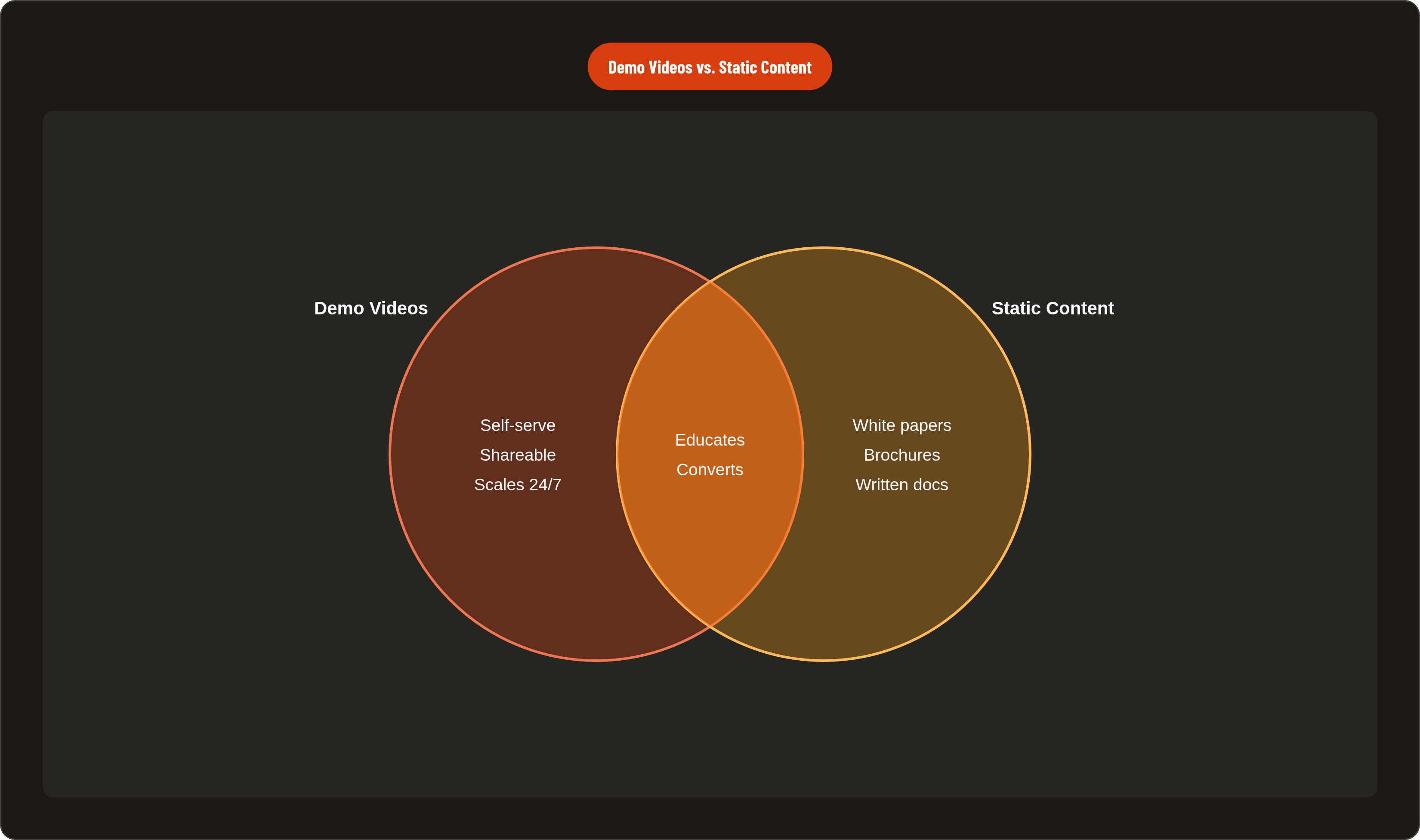
The four demo video formats and where each one belongs in the buyer's journey
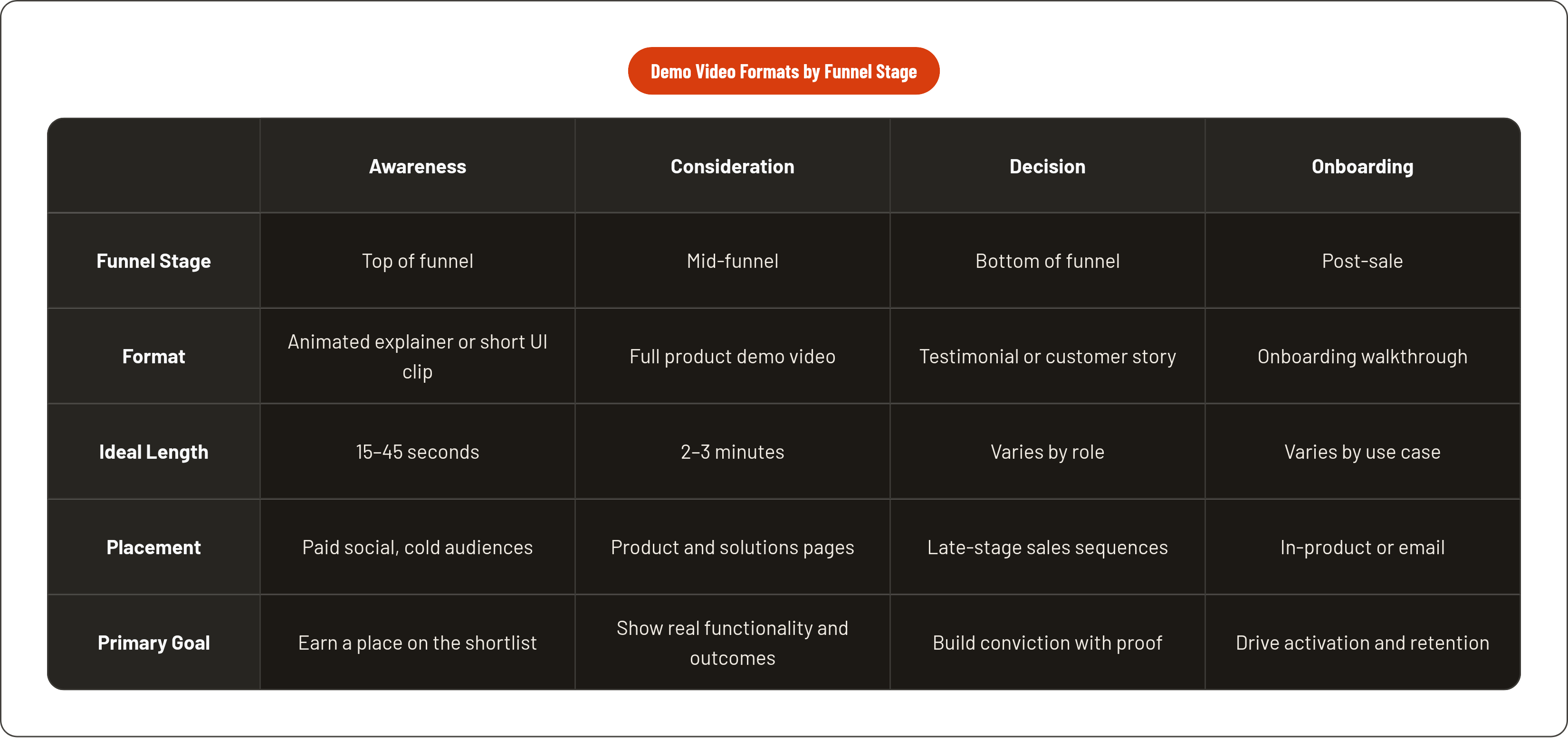
Not every video serves the same function. Confusing them, or more commonly, collapsing them into one general-purpose asset, is where the budget goes and where the results don't follow.
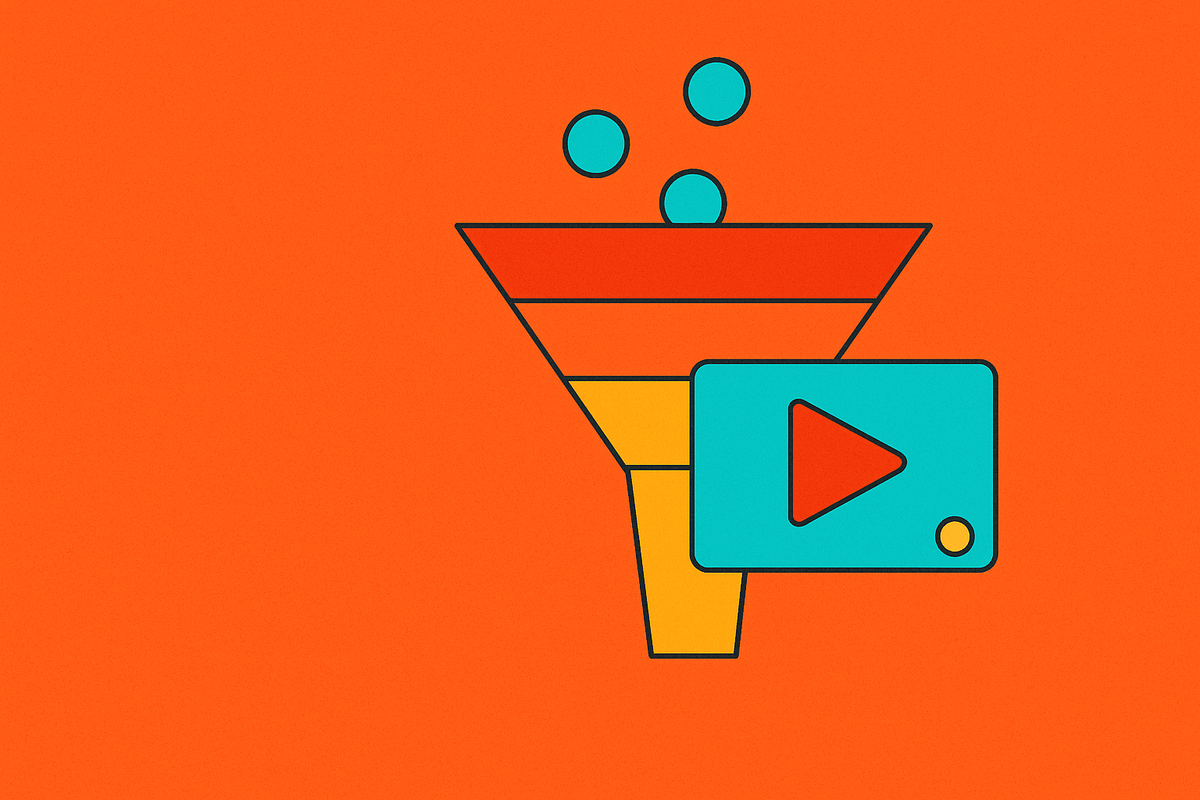
Top of funnel: awareness
At the awareness stage, animated explainers do most of the work. Seventy-three percent of marketers use them to simplify complex concepts for cold audiences. Short UI clips running 15 to 45 seconds work for LinkedIn paid social targeting audiences who don't yet know your product exists. The only goal here is earning a place on the shortlist. The buyer isn't ready to evaluate functionality; they're deciding whether to pay attention at all. Most teams over-engineer this format because they want to communicate everything while they have the viewer. That impulse is exactly wrong.
Mid-funnel: consideration
This is where the full product demo video belongs: two to three minutes, placed on product pages and solutions pages, visible inside sales sequences. The viewer has self-selected. They want to see real functionality, not a conceptual animation.
Slack's approach at this stage is instructive. Clean screen recording plus voiceover, structured around real-use workflows rather than a feature checklist. Zendesk's overview demo uses voiceover narration over actual interface recordings, framed entirely around the buyer. Their opening line: "Let's say your customers mostly send emails." That framing has accumulated hundreds of thousands of views on YouTube, not because the production is elaborate, but because the orientation is correct from the first sentence. The product shows up as evidence. It's not the subject.
Bottom of funnel: decision
At the decision stage, testimonial and customer story videos carry the weight. Fifty-three percent of B2B buyers prefer video case studies over written testimonials. HubSpot produces separate role-specific demo videos for sales, marketing, and customer success teams; each one feels purpose-built because it is. Monday.com leads with buyer aspiration before moving into micro-scenarios that show tangible outcomes, which grounds the aspiration in something the buyer can actually verify rather than just accept on faith.
Post-sale: onboarding
Onboarding video is a distinct use case, functioning as a retention and activation tool rather than a marketing asset. It matters, but it belongs to a separate conversation.
For most SaaS teams, the practical priority is unambiguous: build the mid-funnel product demo video first. That format is directly substituting for what a sales rep used to do on a first call, and it's the one with the largest gap between its commercial importance and the attention most teams give it.
How long a demo video should be and why the two-minute threshold matters
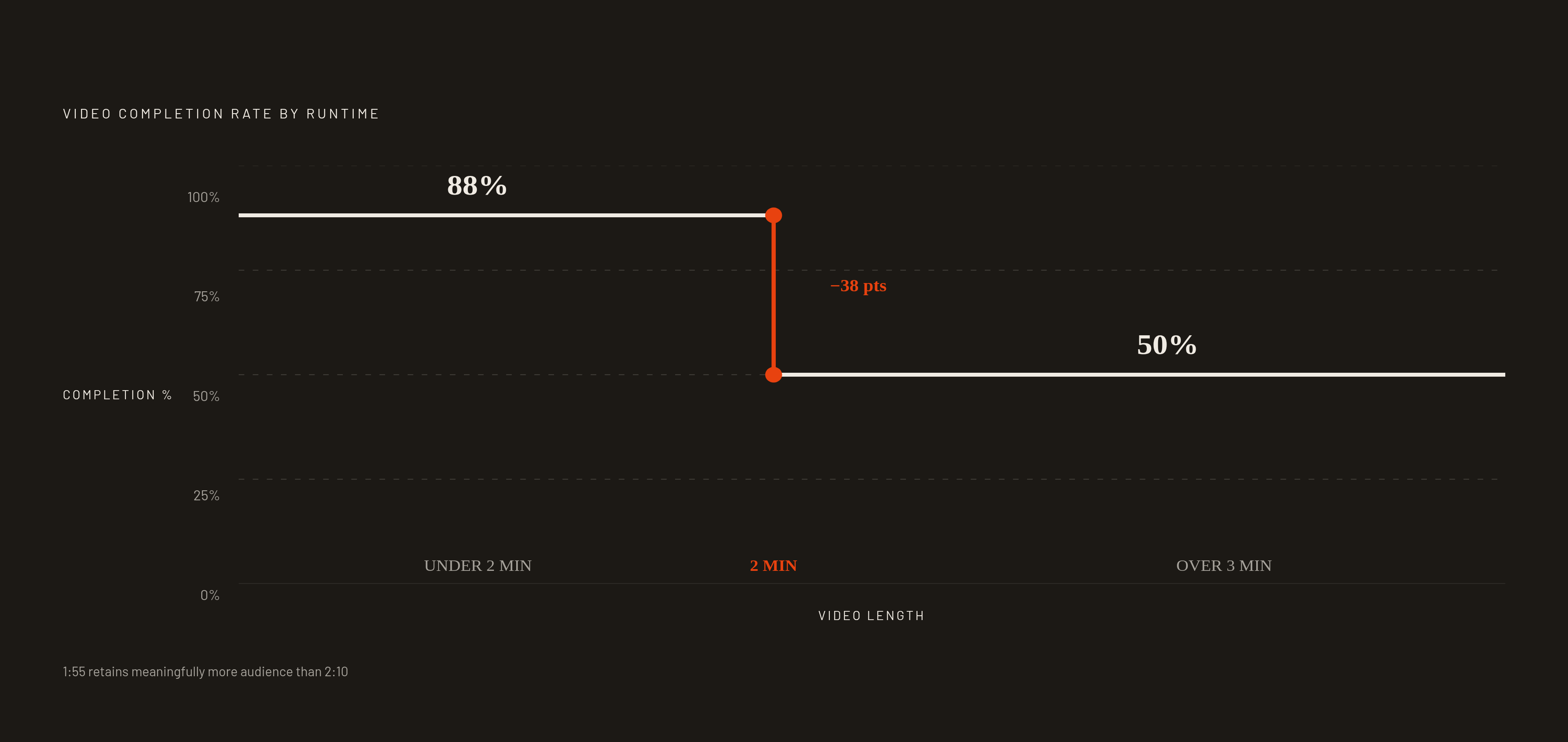
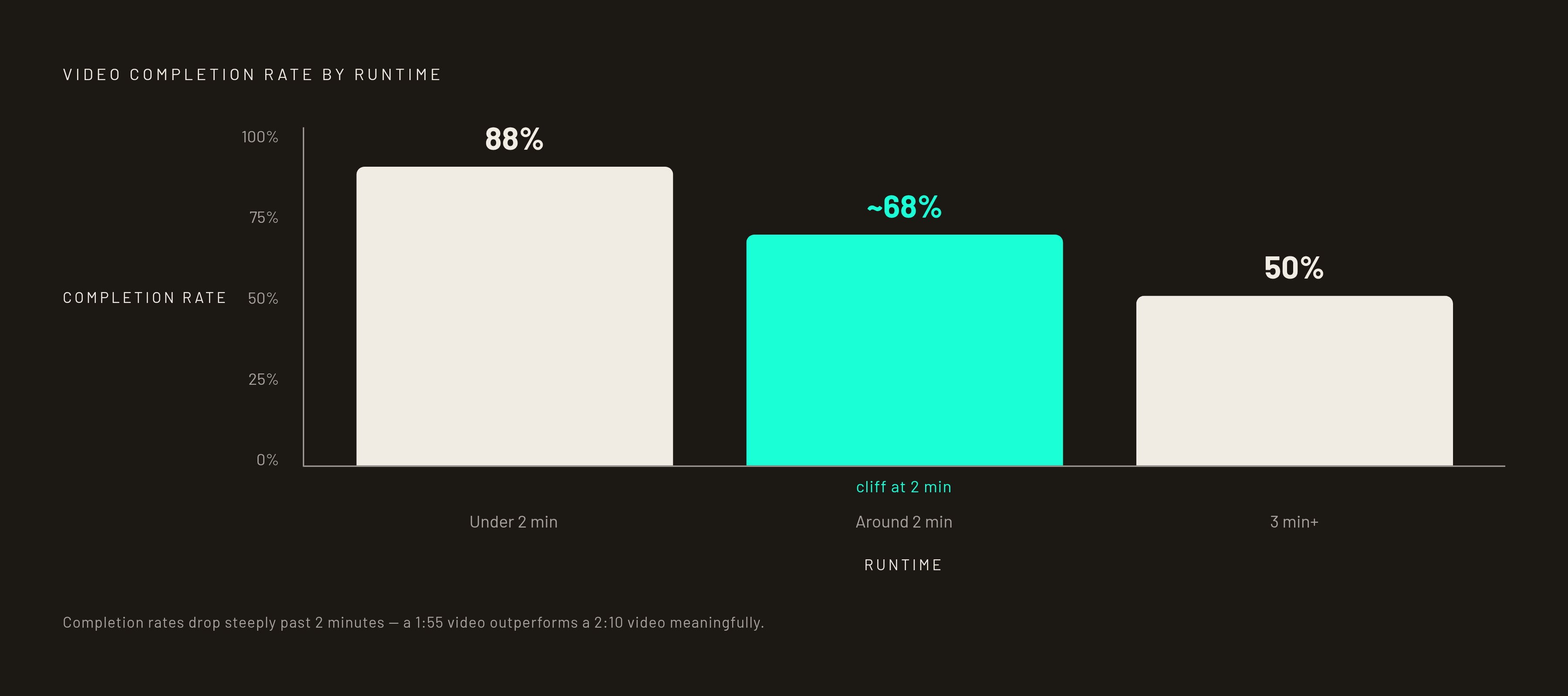
Videos under two minutes carry an 88% completion rate. Stretch past three minutes and completion drops to roughly 50%. The fall-off isn't gradual; the steepest drop occurs specifically at the two-minute mark. A video running one minute and fifty-five seconds retains meaningfully more audience than one running two minutes and ten seconds. That is not a rounding difference, and no amount of compelling content in minute three recovers the viewers who already left.
For homepage placement, practitioner consensus lands at 60 to 90 seconds. Product walkthroughs sitting deeper in the funnel can run longer, because the viewer has already expressed intent by navigating to a dedicated page. For paid social targeting cold audiences, 60 seconds is the ceiling.
But the real argument here isn't about timing conventions. Length is a proxy for strategic clarity. A video that runs long almost always runs long because the team making it hasn't fully decided what the video is actually for, which problem it's solving, and for whom. I've watched this happen repeatedly: three stakeholders in a room, each one advocating for their feature or use case, and the video grows to accommodate everyone's priorities rather than serve the buyer's. Those decisions don't get resolved in the edit. They have to happen before the script.
Dropbox's founding demo is the frequently cited example of concision done right. Drew Houston recorded a screencast showing file sync across two computers: drag a file on one machine, it appears on the other. Nothing more. That video gets referenced as a product-led growth touchstone precisely because it showed one thing completely rather than everything partially. Completeness and comprehensiveness are not the same thing, and that distinction is where most SaaS demo videos lose their audience — like a dinner host who insists on describing every item in the pantry before serving the meal.
What the first five seconds of a demo video must accomplish
Buyers decide whether to keep watching within the first five seconds. Not the first thirty. Five. Those seconds have to spend themselves on the buyer's problem, not the brand name, not a logo animation, not a tagline about transforming the way teams work.
The structural error most SaaS demo videos make is opening with what the product is called rather than what problem it addresses. That ordering serves the vendor's sense of identity, not the buyer's evaluation. A self-directing evaluator who arrived through a Google search has no obligation to keep watching; they will not extend patience to a video that opens on a company name.
Opening on the buyer's frustration or aspiration signals relevance immediately. It tells the viewer: we know who you are and why you came here. Monday.com does this consistently, leading with what the buyer is trying to achieve before earning the right to show the product. The product appears as evidence, not as the subject.
A strong opening contains three things: a named problem or desired outcome, a suggestion that resolution is coming, and a visual that justifies the viewer's next 30 seconds of attention. The script is not a product specification read aloud. It is an argument, and the opening sentence is the claim the rest of the video has to substantiate. If you can't articulate that claim in one sentence before you start scripting, you are not ready to script.
How demo videos fail when they show features instead of communicating value
The feature-tour trap is the most common failure mode, and it's recognizable the moment it starts: "Here's the dashboard. Here's the reporting tab. Here's the integration panel." That structure is organized around the product's architecture, which is only relevant to someone who has already decided to buy. It gives the viewer information without giving them a reason to care about any of it.
Features describe capability. Value describes what changes in the buyer's world as a result of that capability. Those are genuinely different things. A video that conflates them gets watched without moving anyone, and the team making it often can't figure out why, because the video looks fine and covers everything. That's exactly the problem. Buyers in self-serve evaluation mode are asking one question: does this solve my specific problem? They are not asking how the software is organized internally, or in what sequence the development team chose to build things. Showing a buyer your feature list without connecting it to their outcome is like handing someone a map with no destination marked — technically complete, practically useless.
Zendesk's demo works precisely because it is organized around buyer scenarios. The UI appears as evidence that the scenario resolves the way the narration claims. The interface is not the subject; it's the proof.
Stripe's 2024 product demo walked through more than 50 updates and framed them as a single connected capability story rather than a sequence of product announcements read in order. Global tax, modular checkout, and compliance were presented as one coherent answer to one buyer problem. That is a scripting and strategic decision. A generous production budget will not save a video organized around what the product does rather than what the buyer needs.
The production corollary that follows from this: a video built by people with genuine product knowledge, who understand what makes the product different and why that difference matters to a specific buyer, will resist the feature-tour trap almost naturally. A video built for visual polish by a production team working from a features list will default to it almost every time. I have not seen an exception to that pattern.
Matching the demo video to the buying committee, not just the champion
With an average buying group of 8.2 stakeholders, a single video speaking exclusively to one role is structurally incomplete before it launches. The problem compounds as buyer demographics shift: buyers under 40 involve nearly twice as many stakeholders, averaging 6.8, compared to executives over 40 who average 3.5. Seventy-one percent of B2B buyers are now Millennials or Gen Z, up from 64% in 2022. These are not buyers who will extend patience to a video clearly designed for someone else's concerns.
Here's what that actually means in practice. The video the champion watches is also the asset they forward to the CFO, the IT lead, and legal. That forwarded video gets watched without the champion present to contextualize it, without any surrounding conversation, and with no opportunity for follow-up before someone forms an opinion and closes the tab. It has to stand alone and be immediately intelligible to an audience whose concerns are entirely different from the person who sent it.
HubSpot's role-specific video strategy is one operational model for solving this. Separate videos for sales, marketing, and customer success personas mean each stakeholder receives something calibrated to their specific outcome. The videos share a core narrative; they don't share a script.
For most SaaS teams, a single mid-funnel demo video is the minimum viable asset. Role-specific variants, built from the same core narrative and repurposed rather than rebuilt from scratch, extend reach into the buying committee without requiring a full production restart for each persona. "Shareable" in this context means something precise: short enough to forward without requiring an explanatory preface, specific enough to be relevant to the recipient, and self-sufficient enough that the champion doesn't have to introduce it.
Where a demo video sits in the sales motion and how it hands off to the rep
When the buyer finally contacts a vendor, having already completed 61% of their evaluation, the first sales conversation is not a discovery call. It is near-validation. The rep's job is not to explain the product from the top; it is to address the specific residual concerns a largely-informed buyer still has before committing. That is a meaningfully different conversation, and it requires the buyer to have arrived already informed, not to arrive curious and wait for the rep to catch them up.
The B2B SaaS demo-to-close conversion rate averages 25% across a substantial benchmark of companies. The quality of evaluation that precedes the conversation is a primary determinant of whether it converts. A buyer who books a call after watching a precise, outcome-oriented product video already understands the core value proposition. The conversation can skip explanation entirely and move directly to fit, pricing, and objections.
A poorly constructed video creates the opposite dynamic. A feature-tour video generates curiosity without conviction. The rep spends the first 20 minutes of the call re-establishing what the product does, covering ground the video should have already claimed and verified. That is 20 minutes of opportunity cost on a call that closes at 25% under the best circumstances, and it's a dynamic I've watched kill deals that should have been easy.
The call-to-action ending a demo video is a strategic decision, not a production afterthought. A homepage video earns a "see more" click. A product-page demo earns a "book a call" or a free-trial start. Calibrating the CTA to the buyer's stage rather than the vendor's preferred outcome is what makes the handoff between video and rep feel continuous rather than jarring. One practical note: the CTA should be decided before the script is written, because it defines what the video is actually trying to accomplish and determines how the middle of the video should be structured.
What separates demo videos that move buyers from ones that don't
The thread connecting every example that works, from Slack's workflow-oriented screen recording to Zendesk's scenario-led walkthrough to Dropbox's original two-machine screencast, is that each was built around one specific buyer problem. Not a comprehensive product tour. Not a menu of capabilities. One problem, pursued with enough specificity that the right buyer recognizes themselves in it within the first ten seconds.
Specificity converts in a way that generality never does. A video that speaks precisely to one use case will consistently outperform a video that gestures broadly at every use case, because the right buyer sees themselves reflected in the specific one. Generality feels inclusive in concept; in practice, it converts as though it's speaking to no one in particular, because no individual viewer feels directly addressed. I've seen teams resist this logic because they're afraid of excluding buyers. What they're actually doing is excluding all of them — which, if you think about it, is quite the achievement.
Deep product knowledge, not production budget, is what makes specificity achievable. A team that understands what genuinely differentiates their product and why that differentiation matters to a particular buyer can distill it into 90 seconds. A production team working from a features list cannot do that, regardless of how sophisticated the motion graphics are.
There are five questions a demo video should answer before it goes live. Does the opening name the buyer's problem before it names the product? Is the runtime under two minutes for homepage placement, or under three for a mid-funnel product page? Does the video show outcomes rather than navigate the interface as a guided tour? Is it comprehensible and relevant to a CFO or IT lead who wasn't present when the champion first found it? Does it end with a next step calibrated to the buyer's stage, not the vendor's preference? Those questions are not a checklist. They are the argument this entire piece has been making, and a video that cannot answer all five is not ready.
Eighty percent of the buying journey now happens before a sales conversation occurs. The demo video doing that selling work is not a supplementary marketing asset. It is the mechanism that determines whether a vendor makes the shortlist at all.