Using Demo Videos to Qualify Leads Before Discovery Calls
Demo videos that qualify buyers before calls save reps from wasting time on poor-fit prospects.
Before a discovery call, a demo video shown to a prospect can handle the qualification work reps still do while they improvise in real time. Fit-checking and expectation-setting plus disqualification get pushed upstream into a video a prospect watches solo, all before any rep spends time on the lead. If done well, every discovery call begins with a prospect already familiar with the product and roughly able to judge its fit.
Gartner found that, among B2B buyers, 77% called their last purchase very hard. A rep covering basics on a call is bringing the wrong tool to that complexity, and no charisma fixes a mismatch like that, which should have been caught sooner. Pipeline size isn't pipeline quality, and groups that conflate them get calendars filled with calls that had no real chance, because fit wasn't checked before booking. The divide between how frequently qualification should take place and how frequently a rep can demonstrate it did represents the inefficiency this article goes after.
How B2B buyers shape their views before a discovery call
Gartner puts it at roughly 80%: that's how much of the B2B decision-making process wraps up before a seller ever gets looped in. By the time a call happens, they’ve often already made up their mind about a vendor’s value, and they did it without a rep there.
Buyers arrive already informed. Buyers review an average of 11.4 pieces of content before they're ready to contact a vendor. A demo video has to earn one place in the stack a buyer already built, on their own schedule. It has to win a place among the buyer’s stack, already built on their own schedule. Reps get just 17% of the buyer's purchase journey, and 6 to 10 decision-makers have a say on big purchases. A lot of internal discussion happens with no reps there to steer it.
Buyers generally prefer it that way. A recent study found 87% would rather self-serve somewhere along the journey, but doing it themselves isn't deciding by themselves: 69% still expect a rep to sign off before cash goes out. Reps still matter, they just show up at the end now as a closer. Companies still staffing reps to cover basics on an early call spend wages on work the buyer already did at no cost.
Video's edge over other formats before the call
Top B2B buyers prefer watching clips over reading articles, and they admit it openly. Studies show 59% of senior B2B decision-makers prefer watching a video over reading a blog post, while 66% are more likely to consider a product after watching a relevant video, compared to 40% who prefer text-based content.
The viewing figures confirm it. According to one vendor's data, B2B buyers view product videos for 5.4 minutes before contacting a rep, precisely when qualification matters most. According to that vendor's data, prospects who watch a demo video close several times more often than prospects who pass on it, no small difference.
Copy can tell people things. Video shows the product working as promised, which gets closer to what a rep's time on a discovery call would simulate, without costing 30 minutes. A blog post about a dashboard can't match seeing a person open it and run the numbers.
What a demo video needs to do so it actually screens buyers
A demo video built to get noticed and one built to screen buyers are different things, even if the clips are identical. An awareness video wants everyone to see it. A qualification video wants a different instinct: the best-fit handful staying to the end, and the poor-fit eighty gone almost at once. Most demo videos fail because teams mix up those aims. Companies aim for maximum views, then act surprised when the video doesn't filter anyone out.
To handle qualification work, a video must show 4 things so viewers self-assess on their own, no rep needed.
Who the product targets, plain enough that a viewer spots their own role in it or can tell right away that they aren't the audience. What it solves and for what size of need, so a viewer whose situation falls outside that range knows it’s wrong before booking. How the tool works day to day, laid out clearly so a discovery call doesn't waste minutes covering fundamentals again. An honest signal on budget range or setup effort, built to turn away poor-fit prospects, not just bring in good-fit leads.
Confidence matters here too, and it's not some minor metric. Three in four consumers say a product demo builds trust and confidence in the purchase decision. When a viewer trusts what they watched, they handle the call in a way that cuts re-checking time and moves the choice forward.
Drop-off data should get more focus than finish-rate data, if anything. When 70% of viewers leave early on, that low stat acts as a diagnostic showing where the script drops them or misleads them. A qualification demo built right assumes some viewers will leave soon and sees that as the flow working, not falling short. Those who reach that mark have demonstrated stronger intent, while the rest likely found the fit unclear or unconvincing.
Where qualification work for the demo video fits in buyer journey placement.
Placement shapes the kind of signal a video gives off. Most of the work happens in a few places, and gating carries more weight than many groups give it.
Pricing and product pages draw peak buyer intent, while a freely available demo placed right there captures visitors at their most interested. One B2B SaaS vendor swapped its gated demo request for an ungated product walkthrough on its pricing page. With less friction between curiosity and seeing the product, the demo request rate rose by 81%, hitting 3.8% after starting at 2.1%.
Personalized demo URLs in outreach messages show fit before any call is scheduled, and this matters most for prospects still silent. After a buyer asks for more or speaks with sales, a focused short demo can cover the exact problem they raised and improve the later discovery call.
Most teams handle gating the wrong way. Gating a video yields fills rather than real leads, just details typed by anyone ready to fib for access. An ungated video yields watch behavior instead, a more honest signal, since it shows what someone did, not what they typed to clear a gate. A team optimizing for raw numbers should gate. Teams focused on quality shouldn't gate, but most still do because they always have.
Placement also affects what data teams can use. Signals from a pricing-page video differ from the same video landing in an email, since buyer intent changes, and any team scoring leads must keep that data apart instead of folding it into one number. The video has to be wired into both the CRM and the automation stack, so a prospect sitting through 75% of a pricing-page demo triggers follow-up that someone bailing at 20% wouldn't see. If that wiring is missing, the placement generates data no one uses.
How watch behavior becomes a lead qualification signal
Watching 80% of the demo video before closing the tab signals more real intent than typing a wrong email into a gate to get at it. That only matters if the team has built a way to separate them.
In sales teams, that mechanism is the Video-Qualified Lead (VQL), a prospect rated on behavioral signals pulled straight from the video. Viewing time, rewatches, CTA taps.
Watch depth matters most. Watching the whole video, or hitting a set threshold (usually 80%), signals strong intent. Leaving soon signals weak intent or a bad match, and when that drop-off lands on the same timestamp for many viewers, it flags a script issue rather than a fluke.
Today's qualification frameworks mix behavioral signals (up to 50 points), firmographic fit (up to 30), and intent signals (up to 20) into one ranking out of 100. In behavioral scoring, video can add as much as 10 points, while a product page visit gets 15 and a pricing page visit gets 25. Video is just one piece in this setup, yet it's still the one most groups fail to record. Most groups are scoring leads with incomplete data and treating it as final.
How the discovery call differs after a prospect has watched the demo
The gap shows up in the call's opening line. An initial discovery call opens on the basics: what does this business do, who is it for, what is the price roughly. A post-demo call opens differently, closer to "saw the video, here's what stood out, here's what we still need answered." The rep has moved from teaching to selling, and that's a shorter conversation by design, not by accident.
Compression reclaims time that would otherwise be spent walking through basics live. Over seven days of meetings, that becomes real time a rep can use for extra conversations or to dig further into the ones already scheduled.
Mismatches show up before any call gets booked. A prospect watches the demo, realizes the product doesn't fit, and usually self-selects out ahead of booking a call, or brings it up right away if one gets scheduled. Without that screen, the wrong buyer can progress through multiple meetings before the mismatch is noticed, wasting sales hours.
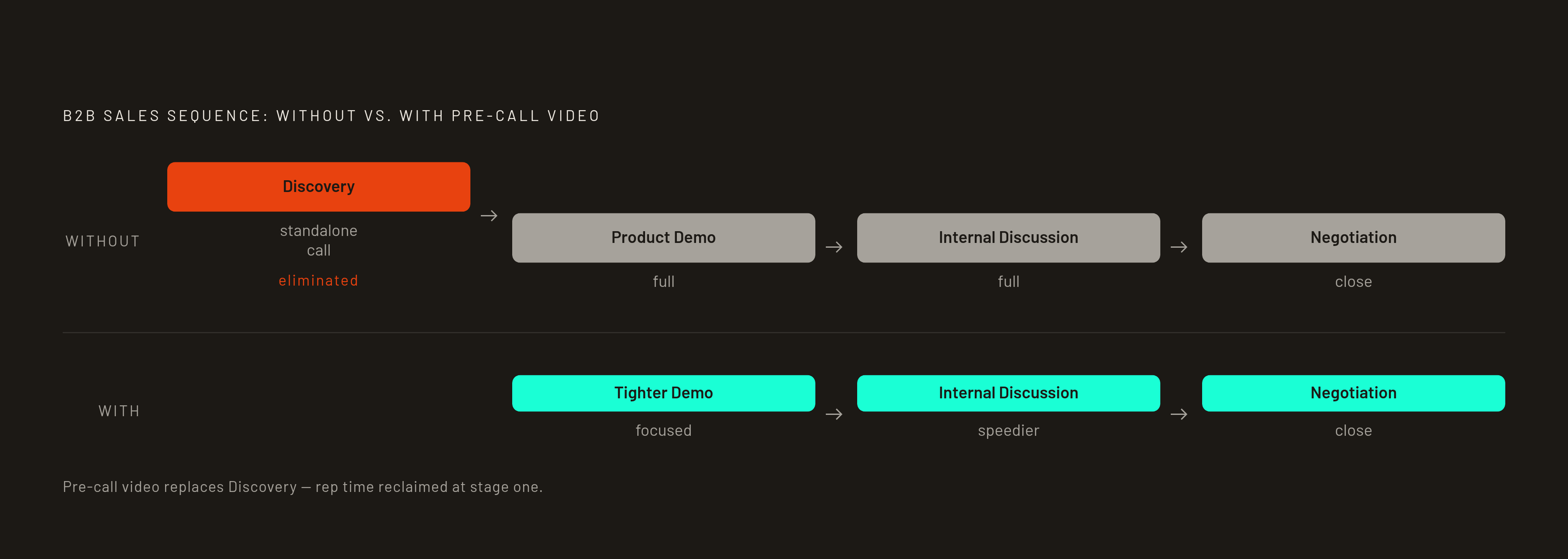
The timeline works the same way. When there's no video before the call, sales typically move through discovery, product demo, internal discussion, and negotiation. When a prospect has watched a demo before the call, the process compresses to one tighter demo, speedier internal discussion, and negotiation. This aligns with broader findings that pre-call video can compress the sales process.
Personalization and interactivity as a multiplier on the qualification signal
A generic demo qualifies based on theme. It gives a viewer a rough idea of the product and makes them figure out if it applies to them. Built for a given job, market, or even company, a personalized demo qualifies with a sharper fit, since the viewer is not translating a broad sell into their own situation. It was built for them from the start.
Personalized demos often yield higher conversion rates than generic ones, as they better align with specific buyer needs. It’s almost another kind of gain, not a marginal increase worth a shrug.
Guided walkthroughs make that signal stronger. How a viewer navigates based on the pain point they care about, deciding what to explore and what to pass over, works as a qualification signal. A prospect who bypasses the integrations area altogether and lingers on pricing for three minutes has shown a team what matters most to them, without ever making a call.
The same holds true for outreach. Generic email sequences often see low engagement, as buyers increasingly favor more relevant outreach. Personalized video outreach can improve engagement compared to standard email campaigns.
Building the system: connecting demo video to discovery call routing
This approach fails as a series of disconnected strategies bolted on at random. It runs as one setup, built from five pieces that all need to be present and connected. If one piece gets skipped, the others degrade, and the issue only surfaces after pipeline quality has slipped.
The video needs to show a match, be structured to make drop-off diagnosable, and live where intent is already high. It's just the starting point.
The tracking setup lets the player collect viewing events, how far someone got, CTA actions, parts played again, and send it to the CRM under a real person. Without it, all that behavioral detail vanishes the moment the video stops.
The scoring threshold converts behavioral data into routing: hitting 80% watch depth and firmographic alignment with the ICP can signal readiness for a rep for discovery booking. If that bar isn’t met, the lead goes to another path, nurture, or stays put.
After a prospect passes that threshold, the booking mechanism kicks in, ideally a scheduling page gathering pre-call details about the video they watched plus what still needs answers so the rep doesn't go in clueless.
The rep briefing closes it. The CRM entry a rep opens before the call needs to spell out which parts the prospect watched, the moment they left off, and everything they clicked. This is precisely why the system exists. A rep who opens a call with "so, what do you guys do" has nothing to work with, while a rep who opens with the answer to a question the prospect was already halfway through asking has everything.