Gating vs. Ungating Video Content in a SaaS Demand Generation Program
The right call depends on where video sits in your funnel and what outcome matters most.
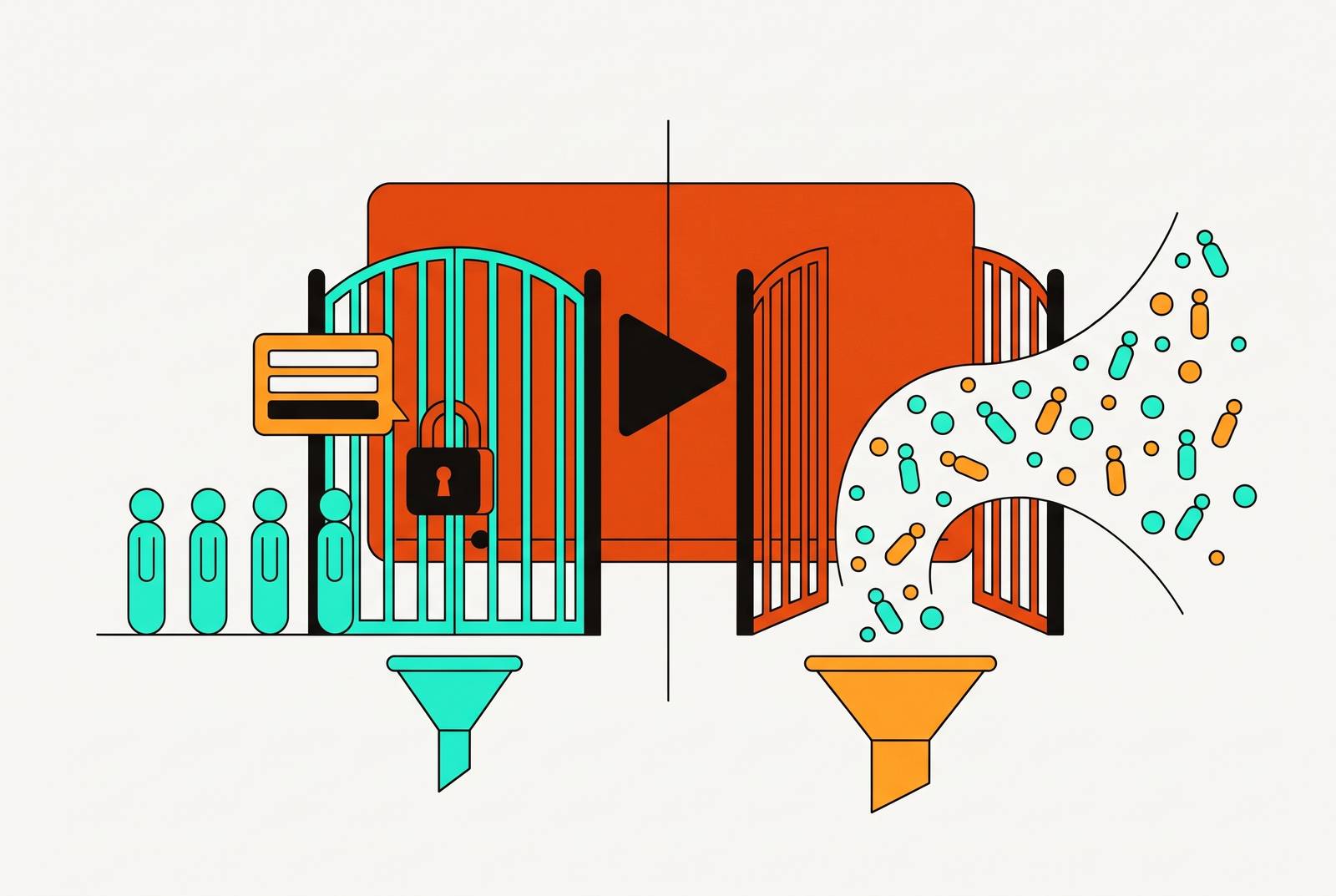
Gating SaaS video should be an asset-level decision. The right choice depends on where the video sits in the funnel, what it helps the buyer do, and whether the business needs reach or lead capture.
Why the gating-vs-ungating debate keeps producing the wrong answer for SaaS video
SaaS demand generation teams keep arguing about gating as a policy. One camp wants a form on everything because contact records make attribution easier. The other wants every form removed because fake emails, low-intent leads, and frustrated sales teams have made lead counts hard to trust. Both reactions have a basis. Neither tells a team what to do with a particular video.
A brand explainer introduces a company, while an implementation walkthrough helps someone evaluate a product. Those jobs call for different choices about access, even when both videos are part of the same campaign. A countable form fill is not proof of better pipeline, but bad form fills are not proof that every gate should disappear.
What gating and ungating each actually trade away, and why video changes the math
Gating trades reach, search visibility, and AI citability for a contact record. That record gives marketing something it can track and pass into a lead process. The cost comes before the conversion, when people decline the exchange and leave without consuming the content. Ungating makes the opposite trade. More people can watch and develop trust, but the business loses that immediate opportunity to identify them.
Without a contact record, the video’s contribution can disappear from attribution models that miss assisted conversions. A buyer may watch ungated content and later reach sales through another path. The later conversion gets counted, but the role the earlier content played goes unseen. That creates a budget problem for marketing. Content can contribute to closed deals without producing the evidence a revenue leader expects to see.
Video makes this trade sharper because it combines high engagement with high production cost. A wrong access decision can waste more investment than the same decision on a blog post. Video also adds a choice that static assets do not offer in the same way. A gate can appear before playback or after the viewer has experienced substantial value. The decision therefore involves both the outcome being optimized and how much evidence of value the viewer gets before being asked to register.
Why the form fill is an unreliable proxy for buyer intent in 2026
A form fill can show that someone is curious without showing buying intent. Someone who registers to get content has agreed to share details in exchange for it, but may not have started looking to buy. Non-buyers bloat the MQL denominator, SDRs spend time on recruiters and agency interns, and lead-scoring models learn from noisy data.
Foundry’s Customer Engagement Study 2023 found that IT decision-makers in North America were willing to share contact information for content they valued. The distinction is the value of the particular asset. A form attached to useful, scarce information asks for a different exchange from one attached to a generic overview.
NetLine’s 2025 consumption report also complicates the case for blanket ungating. It logged millions of first-party content registrations with substantial year-over-year growth, with ebooks driving the majority of demand. Those registrations show that registration itself still works. Is this video valuable enough that a form fill would select for genuine interest?
How to match the gating decision to video type and funnel stage
At the top of the funnel, brand and awareness videos should remain ungated. Brand explainers, company stories, and short-form awareness content answer the buyer’s first questions about who the company is and why it deserves attention. A form blocks that introduction before a relationship exists. Short-form videos for LinkedIn, YouTube, and other distribution platforms help more people find the company and point viewers toward deeper content.
A 60-second SaaS product explainer belongs in that open-access group when its job is to make the product’s difference clear. It creates interest. Thought leadership clips and short educational videos should also remain ungated because they establish credibility through a useful answer. That familiarity has a downstream purpose. Viewers who already trust a company’s content have a stronger reason to register when they later encounter a valuable gated asset.
Testimonial and case study highlights should stay open for a related reason. Their job is to reduce skepticism, and a form adds friction at exactly that point. SEO-targeted video also needs to be open so it can help with search discovery, backlinks, and AI citations. The access decision follows the intended route to the buyer. Content meant to be found and shared cannot do that job well when its substance sits behind a form.
In the middle of the funnel, webinars, masterclasses, and in-depth training become stronger candidates for selective gating. These formats offer concentrated expertise in a structured form to people already exploring a subject more seriously. Length alone does not earn the gate. The exchange becomes reasonable when the content offers the depth and usefulness someone might otherwise expect from a course. A structured training series can justify registration where a broad introductory video cannot.
Proprietary research and benchmark videos can justify a gate because the information is scarce. Original survey results, industry benchmarks, and proprietary analysis make the exchange legible to the buyer. Further down the funnel, detailed product walkthroughs, comparison demos, and implementation videos can also be gated selectively. Their viewers are testing whether the product solves a real problem. In that context, registration can help identify an active evaluator before the person reaches sales.
Gate placement within a video changes outcomes as much as the gate-or-no-gate decision
For videos that earn a gate, placement should match the signal the team needs. A pre-roll gate asks for registration before playback begins, maximizing form fills per view while minimizing total viewers. The viewer is responding to promised value alone. That makes pre-roll useful when capture volume is the priority, but the form offers less evidence that the content itself held the viewer’s interest.
A mid-roll gate lets the viewer watch a substantial part of the video before asking for details. It produces fewer form fills but selects for people who found enough value to continue. Wistia’s Turnstile enables in-video lead capture, giving teams a way to make that choice within playback. Its placement controls make the access strategy executable rather than leaving every gated video behind the same landing-page form.
Progressive gating takes this approach across a series. Early videos remain open to build familiarity and trust, while later, higher-value installments require registration. Turnstile-style controls can support that progression without blocking the first encounter. The practical rule is straightforward. Pre-roll brings in more form fills, mid-roll picks out viewers who have shown interest, and progressive gating builds a relationship before capture.
How hosting platform choice reinforces the gating strategy
Platform choice should follow the access decision. YouTube is suited to ungated top-of-funnel video because it supports search discovery, organic reach, and AI citability, with no cost per view. A gate works against that purpose. Using a discovery platform as the foundation of a lead-capture strategy creates a mismatch between the platform’s strengths and the asset’s job.
Gated mid-funnel and late-funnel videos need different infrastructure. A dedicated hosting platform with native lead capture, viewer-level analytics, and CRM integration supports gate placement and contact tracking that YouTube cannot provide. YouTube gives teams view counts and watch time for awareness work, while dedicated hosting gives them contact records they can track for gated content. Each measurement track reflects a different job.
Measuring ungated video's pipeline contribution without a form fill
Marketing faces pressure to attribute results to video when defending production spend to CFOs and revenue leaders. Standard models built around contact records can give credit to a gated conversion but miss the ungated video the buyer watched three weeks earlier. The form becomes visible evidence. The video becomes an unproven expense. That imbalance rewards capture even when earlier content helped shape the buyer’s evaluation. Removing a gate therefore needs a measurement plan.
Self-reported attribution provides one way to recover that missing context. Teams can ask demo requesters and inbound leads how they first heard about the company and what content they consumed before reaching out. Tracking those responses systematically gives ungated video a place in the record. Account-level analytics offer another route. Where a hosting platform provides company-level viewer identification without a form, teams can see which target accounts consume the content and support account-based follow-up.
Assisted conversion tracking connects the content to the broader buying path. Analytics should credit content touchpoints rather than treating the last form fill as the whole explanation for a closed deal. A viewer who finishes an ungated product walkthrough and then visits the pricing page shows buying behavior that a basic content form may not. Tracking those actions at the account level helps teams tell who is just watching and who is weighing a purchase.
Teams can also ungate the asset, instrument the page, and provide a conversational layer that lets buyers self-qualify when ready. The contact record then comes from voluntary buyer self-identification. This gives revenue leaders evidence beyond a lead count. It also changes how the two approaches fit together. Ungated video builds familiarity that helps downstream gated video convert better, so reach and capture support each other.
Applying the framework to each video asset
The repeatable process begins with four questions, starting with where the video sits in the funnel. Awareness, introductory education, and brand content default to ungated because their jobs depend on reach and trust. Mid-funnel content earns consideration for a gate when its value is clear and difficult to find elsewhere. Late-funnel evaluation content can ask buyers to register so teams can tell who is already comparing solutions. Funnel position narrows the decision without making it automatic.
The second question concerns the video’s specific job. Discovery, credibility-building, and SEO call for open access, while lead capture and pipeline qualification can support a gate if the value justifies it. Social proof belongs on the open side. This question prevents a category label from making the decision on its own. A product video meant to introduce the company does different work from a detailed demo meant to qualify an evaluator.
Third, assess whether the video offers value buyers can only get there. Original research, proprietary benchmarks, and time-bound live events can earn registration, while generic summaries of public information do not. Product specificity provides the same test for SaaS demos. A detailed video showing genuine differentiation has gating potential. A polished overview of category-generic features does not. Taking away the form will not make weak content better, either.
Fourth, assess whether the business needs reach or capture more right now. Early-stage companies and new product lines generally need reach and trust more than contact records. Companies with strong awareness and a working demand engine can selectively gate valuable assets when buyers are ready to identify themselves. That goal then guides gate placement, hosting, and measurement.
The governing principle is to match access to purpose. Running the same questions makes future decisions faster and easier to defend, whether the next asset is a 60-second explainer or a 45-minute masterclass.