Video in Account-Based Marketing Campaigns for SaaS
Matching video to each account's buying stage, then tracking results.
Video in account-based marketing campaigns for SaaS works when it serves the account’s next buying decision. Awareness, committee education, and deal acceleration each need their own stories and proof. The practical foundation is matching video to the account’s stage, then connecting viewing behavior to account-level results.
What ABM actually demands from video — and why stage matters
Most SaaS teams deploy video as a single asset. A well-produced explainer becomes the answer to every campaign need, even when the account has moved beyond the questions it answers. An account that does not recognize the vendor needs something different from a committee trying to settle a specific product concern.
ABM makes that mismatch especially costly because it targets named accounts. It also requires coverage across a buying committee and measures progress at the account level. A video can attract attention without helping anyone inside a target account make a decision.
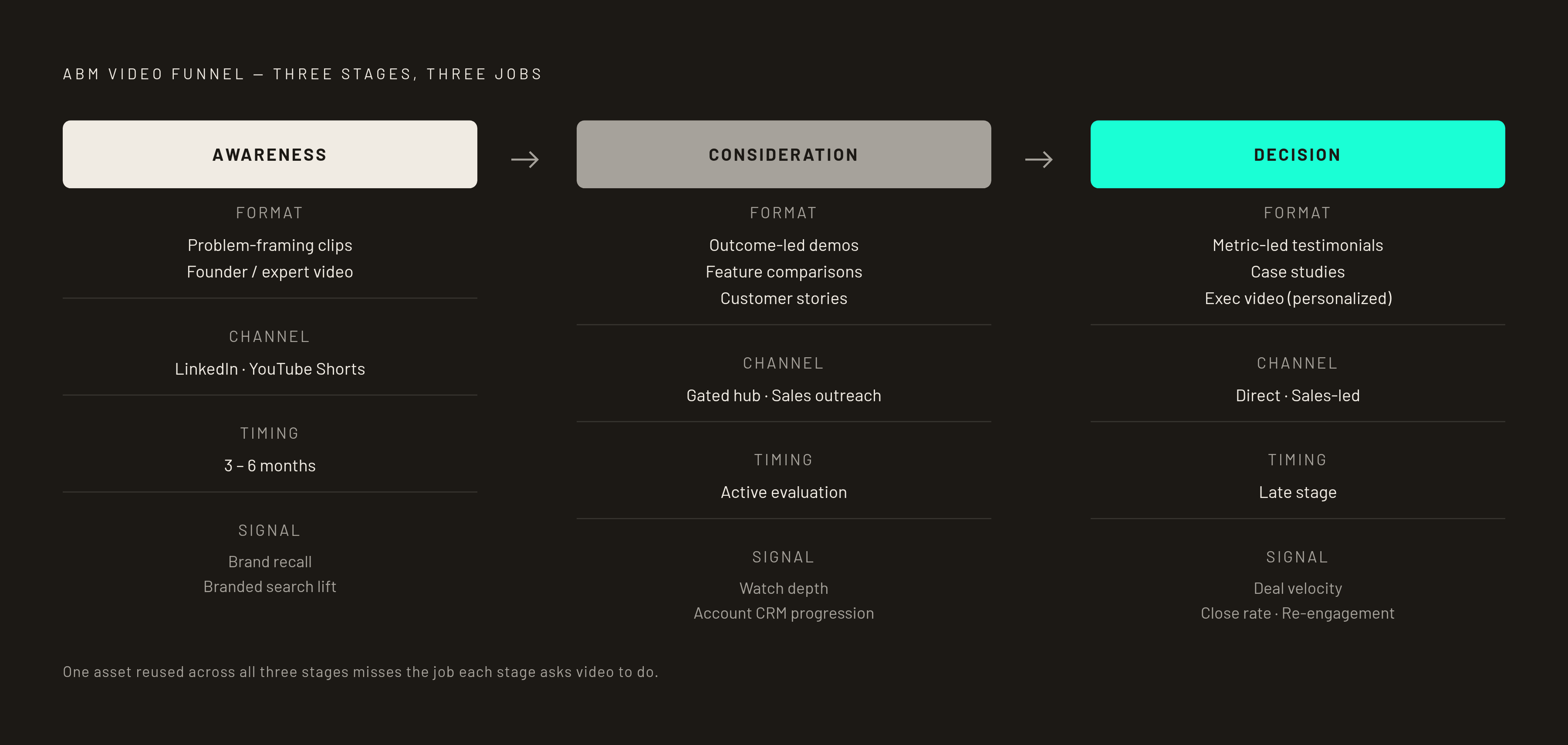
Bayleaf Digital’s 2026 guide maps awareness, consideration, decision, and retention to different video formats rather than treating one explainer as a complete strategy. The format should be chosen after identifying the account’s informational need. That choice starts with two diagnostic questions. Where is this account in its journey? Who inside the buying committee is watching?
Top-of-funnel video for named accounts: creating category familiarity before outreach begins
Before direct outreach, video’s job is to make the brand recognizable and credible to people inside target accounts. It does not need to explain the whole product. Starting with a problem those people recognize helps the brand become associated with an issue they already care about. Success depends on familiarity within the named account list.
Superdirector’s 2026 B2B analysis treats short-form video as a channel for brand recall. The Information’s January 2026 reporting shows how B2B brands compete with consumer brands for the same minutes in the feed. An immediate click is not the main prize. The goal is to be a known name when a deal starts, which changes both the content and the expectations attached to it.
Bayleaf’s guide says educational and problem-framing videos lead to more organic discovery than product demos because AI search engines and social feeds favor content about a problem people know they have. The guide also describes YouTube Shorts and LinkedIn clips as teasers that lead viewers toward deeper cornerstone content. The guide reports that subject-matter experts and founders filmed without heavy production outperform overproduced ads on LinkedIn because they show the human side of the brand.
For ABM teams, the lesson is to build awareness video around the account’s problem and distribute it where those people spend time, both on and beyond the vendor’s site. The payoff takes longer than a campaign click. Awareness can earn its return at the 3-to-6-month mark, when outreach reaches an account that already recognizes the brand. Judging that video by immediate responses would mistake the timing of its contribution for a lack of contribution.
Mid-funnel video for buying committees: educating multiple stakeholders on a complex product
Once an account enters active consideration, recognition is no longer enough. People with different roles, concerns, and levels of technical knowledge need to understand why the product fits their situation. The buying committee is not one audience. A video that makes sense to a technical evaluator may leave an economic buyer unsure what the product will achieve.
Bayleaf’s guide recommends product demos built around a use-case or outcome that show what success looks like before showing the login screen. That order gives non-technical buyers a reason to follow the workflow rather than asking them to infer its value from a sequence of features. The outcome supplies the frame for the detail. As evaluation moves forward, feature comparisons can answer technical questions and customer stories can give the economic buyer proof, both formats the guide recommends for the decision stage.
References to the account’s industry, stack, or stated priority reduce the work each stakeholder must do to connect the product to their own situation. The video also needs to stand on its own because buyers share product education with colleagues who missed the original call. A sales rep will not always be there to explain why a particular feature was shown.
This is where generic explainers fall short. A 90-second brand video cannot explain why a workflow automation tool handles a specific compliance edge case that an enterprise buyer in financial services cares about. That buyer needs the product’s distinctive behavior made clear. The mid-funnel requirement is enough depth to explain the fit without losing the committee members who need the outcome more than the technical detail.
How video tracking at the consideration stage turns watch data into account intelligence
Committee education produces a second return when viewing behavior connects to the account record. It shows sales who is engaging with the product story and how far that engagement goes. Each watch event can signal account-level intent rather than remain a statistic about the content alone.
Vidyard can track viewing behavior by email address and sync watch data to contact properties in HubSpot or Salesforce. That lets a team see which committee members watched a demo, how much they watched, and whether they returned to specific segments. Those details help sales know more about the account before outreach. They help answer whether an account is progressing and which people inside it are engaging, although watching a video is not itself a purchase decision.
The practical workflow connects a targeted campaign’s watch events to account scores in the CRM. Accounts that cross a watch threshold can then trigger a sales sequence, turning content distribution into an active pipeline signal. Without the contact and account relationship, a watch event says something about content consumption but much less about the named account’s progress.
This also explains why mid-funnel measurement differs from awareness measurement. Early video builds familiarity before direct contact, while consideration-stage video can reveal engagement with a specific product story. The latter gives sales a more immediate basis for follow-up.
Late-stage video for deal acceleration: what works when the committee is already evaluating
An engaged committee does not need the introduction again. At the late stage, video has to resolve the objection, concern, or proof gap holding up the decision. Depending on what is holding up the decision, the format may be a customer testimonial with credible metrics, a case study showing comparable outcomes, or a personalized follow-up addressing the account’s stated concern.
Bayleaf’s guide says specific metrics in decision-stage testimonials build trust faster than scripted endorsements. The economic buyer needs to know what happened after a comparable organization made the choice. Praise alone leaves the proof gap open.
A short, human-recorded message from an account executive serves a different purpose. By acknowledging the deal context, it signals that the vendor is treating the account as a named relationship. That specificity can also help revive a stalled conversation. A personalized walkthrough gives a quiet champion new material to circulate internally, rather than another request to repeat the same discussion.
Late-stage video often needs to be recorded fresh because a committee may need an answer tied to its use case, evaluation timeline, or competitive consideration. Reusing the general demo does not resolve that need. The relevant test is whether the video addresses the reason the account has stopped moving.
Personalized video at scale: what the tooling shift actually enables across ABM tiers
Making video for each stage raises concerns about how much it costs and how long it takes. If meaningful personalization is feasible only for a handful of Tier 1 accounts, the rest of the program falls back on generic content. AI-native production tools have narrowed that gap. Lower per-video cost and shorter production time have made personalized video operationally viable at Tier 2 and Tier 3 scale.
Vidyard suits teams that need CRM-connected viewing data to function as an intent signal, particularly during consideration. Sendspark offers targeted personalization for multilingual outreach at a lower entry cost. Sendspark’s 2026 agentic workflows can research a prospect, detect intent, and trigger a personalized video automatically, removing a manual step from the outreach sequence. That is a different need from tracking committee engagement, even when both support the same ABM program.
Bayleaf’s guide names Google Veo, Canva, and Synthesia as tools for work including generating clips, turning long-form content into shorts, creating localized voiceovers, and versioning creative for audience segments. These tools help teams use content across groups of accounts without having to make each version from scratch. Human review remains part of the work. The guide recommends that a person review every AI-assisted video before it goes out because making more videos does not ensure that they get the brand or the technical facts right.
For teams choosing a production approach, the lesson is to let the ABM tier and buying stage determine the tool. Making versions quickly can help with Tier 2 and Tier 3 outreach, while custom production can have a role for a Tier 1 late-stage account that may need a product story with more depth than self-serve AI tools can reliably provide. One tool for every account and every stage risks overspending on Tier 3 or underserving Tier 1.
Measuring video's contribution to ABM outcomes — and what not to track
The measurement test follows the purpose of each stage. Across the program, the outcome is account progression and pipeline created from target accounts. A large audience can still be the wrong audience. Thousands of views from outside the named account list do not make an asset successful in ABM, while a modest-view video watched in full by four committee members at a Tier 1 account can be highly valuable.
At awareness, teams can measure brand recall within named accounts, the lift in branded search from target-account domains, and downstream attribution when those accounts enter the pipeline. That assessment needs to allow for the 3-to-6-month lag. Consideration-stage measurement tracks buying-committee coverage, watch depth, and how the account moves from one stage to the next after engagement. It asks how many committee members watched, whether they completed the content or dropped off, and whether the account moved forward.
Late-stage measurement turns to deal velocity, close rate, and stalled-deal re-engagement. The useful comparisons include whether the cycle shortened after personalized video was deployed and how close rates differ between accounts that received it and those that did not. Views describe consumption, while the ABM program needs to understand what happened to the deal.
Bayleaf’s guide also identifies video appearing in Perplexity and ChatGPT responses as a contribution to buyers’ shortlisting process. The guide points to clean transcripts, timestamped chapters, and intent-matched titles as ways to make videos present in AI-assisted research. But that wider presence does not remove the need to connect engagement to named accounts.
A SaaS team needs CRM-connected tracking that ties a named contact’s watch event to an account record to attribute revenue to video. Without that link, even well-matched content will struggle to justify its investment to a CFO. Stage-specific strategy and account-level measurement have to work together so the team can prove the contribution and improve the program over time.