Video Email Open and Reply Rate Benchmarks for B2B SaaS
Open rates are broken; reply rates show video's real 3x to 5x lift.

Video email lifts reply rates well above the flat baseline B2B SaaS teams get from text-only cold outreach, and the gap is documented, not anecdotal⟦c2⟧. But the size of that lift depends entirely on which metric you're looking at, and in 2026, one of the most commonly cited metrics is close to useless⟦c2⟧.
The wrong metric for measuring video email performance in 2026
Start with the number everyone still checks first: open rate. It's the wrong one, and the reason is mechanical, not philosophical⟦c9⟧. Apple Mail Privacy Protection now accounts for 49.29% of all tracked email opens, which means nearly half of what your dashboard calls an "open" happened because Apple's proxy servers preloaded a tracking pixel, not because a human looked at the email⟦c3⟧.
The result is a split between what platforms report and what actually happened. ESP dashboards routinely show open rates of 35% to 55%, but genuine human engagement is 15% to 25%⟦c4⟧. This isn't a rounding error or a one-off quirk in a single dataset.
One of the often-cited stats in this space is that putting the word "video" in a subject line lifts open rates by 19%, though this claim lives in the same inflated data environment where lift percentages measured against MPP-contaminated baselines are unreliable⟦c7⟧. That figure was measured against the same inflated baseline described above, so treat it as a soft signal at best, not a number to build a forecast on⟦c7⟧. Open rate still has a job to do: watch it for sudden drops of 10 points or more, because that's a deliverability problem, a spam flag, or a broken sending domain, not a quality score for the campaign⟦c8⟧. If opens are out as a performance measure, the next question is what a trustworthy baseline actually looks like⟦c9⟧. Litmus's 2025 State of Email report quantifies the inflation at 17–23 percentage points on average ⟦c5⟧. This is not a niche problem: Stripo's May 2026 report documents a 40-point spread in published "average B2B open rate" figures (15.1% to 55.71%) entirely explained by whether MPP was filtered ⟦c6⟧.
The text-only B2B SaaS cold email baseline in 2026
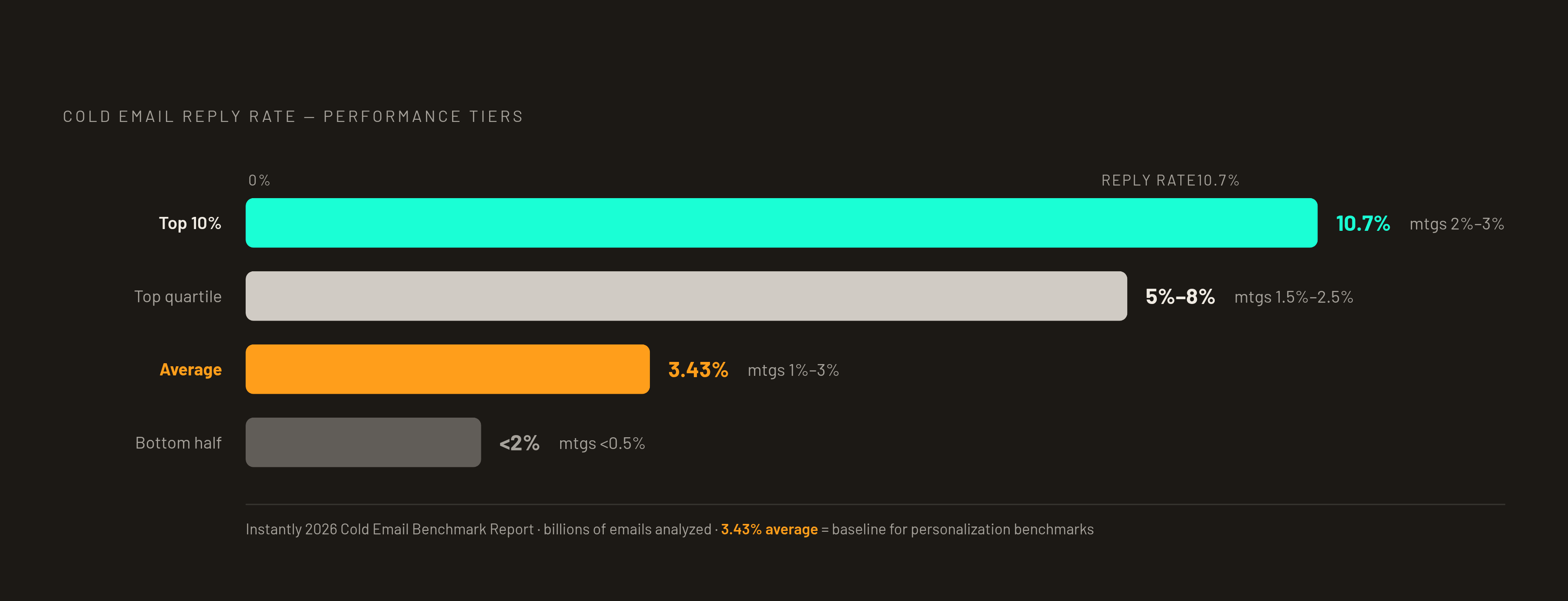
Reply rate is where the real story lives, and Instantly's 2026 Cold Email Benchmark Report, built from analysis of billions of cold emails, breaks it into four clean tiers⟦c10⟧. At the bottom, half of all senders get less than a 2% reply rate and book fewer than 0.5% of sends into meetings⟦c11⟧. The average campaign is a 3.43% reply rate, with a 30% to 40% open rate (MPP-inflated, so read that number with the caveat above) and a 1% to 3% meeting booking rate⟦c12⟧. Good performance, the top quartile, runs 5% to 8% replies with 1.5% to 2.5% booked⟦c13⟧. The top 10% of senders hit 10.7% replies and 2% to 3% meetings booked⟦c14⟧.
SaaS specifically is toward the bottom of this range, and the reason is simple inbox math. A typical B2B SaaS buyer gets 15 to 40 cold emails a week, compared to just 3 to 5 for a buyer in industrial SaaS⟦c15⟧. That saturation isn't even across SaaS sub-verticals ⟦c1⟧. MarTech SaaS averages a 1.9% reply rate, the lowest of any segment, because marketing buyers are the most saturated audience⟦c16⟧. Industrial and vertical SaaS is at the other end, averaging 6.5%, since niche buyer profiles simply face fewer competing vendors⟦c16⟧. DevTools SaaS is in the middle with a 3.8% median and 6%-plus in the top quartile⟦c16⟧.
Title matters as much as vertical. Sell to the CRO and you're competing against triple the inbox noise before your email even opens ⟦c17⟧.
Nurture and lifecycle email, sent to people who already opted in, follows a different set of rules. Those campaigns run 28% to 42% open rates, 3% to 7% click-through, and 1.8% to 4.5% reply rates, and none of that should get mixed up with cold outreach numbers⟦c18⟧. Welcome sequences are the standout performer inside that category, opening at 52% to 68% on the first email before falling to 18% to 30% by the third⟦c19⟧. That's the floor. Everything from here is about how video moves a campaign above it, and how much of that movement is realistic versus vendor-inflated⟦c9⟧.
Video email's effect on reply rates, and which figures to trust
The clearest head-to-head comparison comes from a Levitate analysis of Vidyard data: standard text email ran a 2.5% click-through rate and 1.5% reply rate, while video email in the same comparison hit 17% CTR and 6% reply rate⟦c20⟧. That's one of the few datasets that isolates video as the single variable, which is what makes it worth citing over vaguer vendor claims.
Salesloft's dataset is the largest one on record here: just over 134 million cadence emails analyzed, with roughly 4.5 million containing an embedded video⟦c21⟧. That's platform data pulled from actual sending activity, not a survey or a vendor's cherry-picked case study, which earns it more weight even under scrutiny.
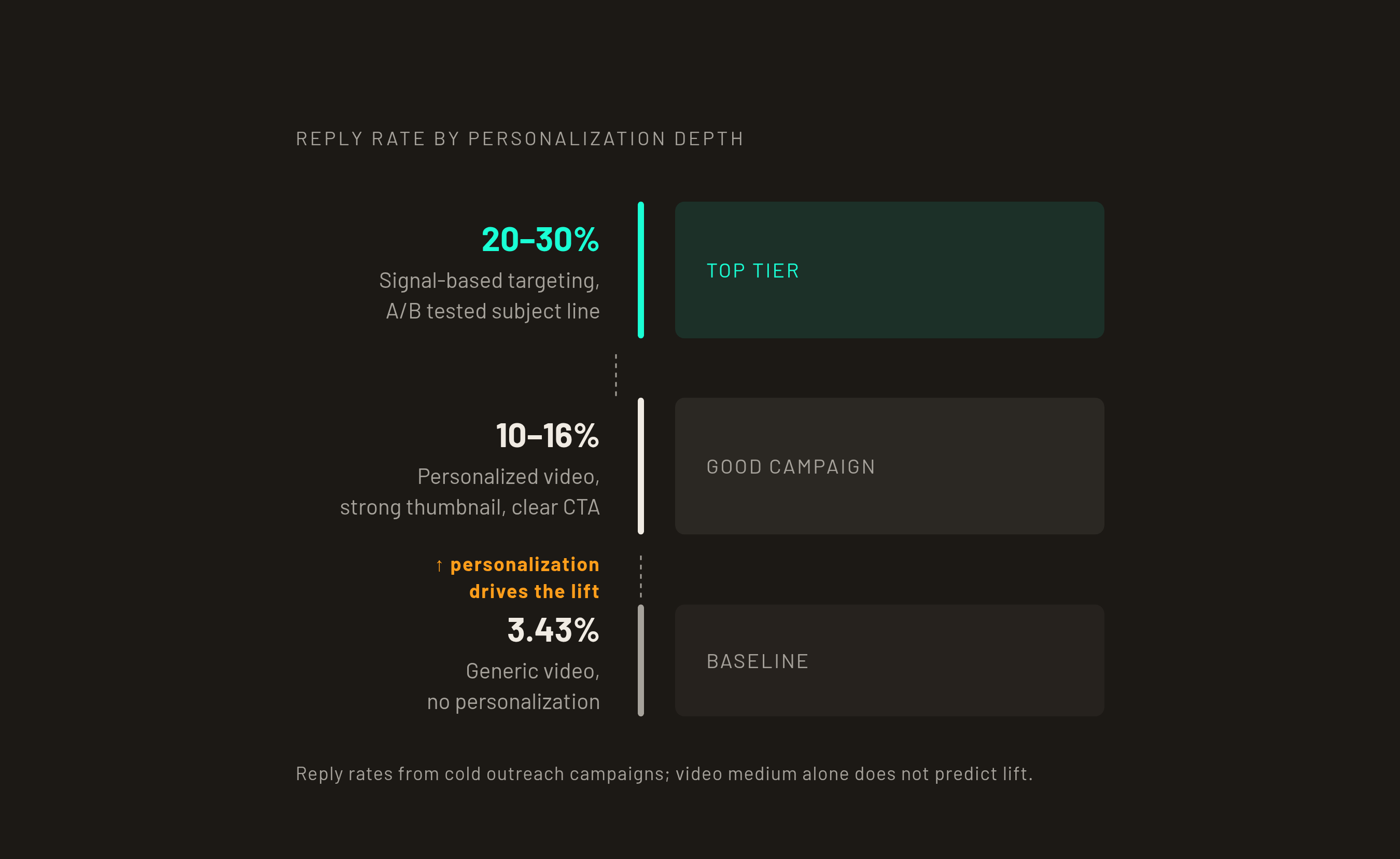
Sales teams that use personalized video in outreach see reply rates between 10% and 16%, and the deeply personalized ones can climb as high as 30%, according to a 2026 analysis from Autobound⟦c22⟧. Set against the 3.43% text-only average, that's a 3x to 5x improvement⟦c22⟧. Separate analyses from Sendspark and Weezly in 2025 and 2026 put average video reply rates at 25% to 30% against just 1% to 5% for text-only⟦c23⟧, though those numbers sit at the top end of the range, not somewhere a typical campaign should expect to land.
Click-through tells a similar story. Video produces 200% to 300% higher CTR than static email, a figure that appears across multiple sources analyzing Vidyard's data⟦c24⟧. Zebracat's numbers add a frequency angle: marketers who send video weekly hit 11.2% CTR, compared to 6.4% for those sending only monthly⟦c24⟧. And tech-sector emails using video show an 18.3% click-to-open rate, outperforming retail and healthcare in the same comparison, which matters for SaaS because its buyers are, functionally, tech-adjacent⟦c25⟧.
The 300% CTR lift and the 25% to 30% reply rates are ceiling numbers, pulled from optimized, heavily personalized campaigns⟦c26⟧. The honest floor most teams are actually working from is Instantly's 3.43% SaaS average⟦c26⟧. The distance between that floor and the ceiling is enormous, and closing it has almost nothing to do with the video technology itself.
Personalization's role in whether video email hits the top of the range or the bottom
Personalized video emails generate roughly 3x more replies than generic video emails, according to Zebracat⟦c27⟧. Recording a video does not automatically buy you the top-tier numbers cited above. Generic video, dropped into a cold sequence with no context about the recipient, performs a lot closer to text-only than marketers like to admit.
There's a useful secondary signal buried in the data too. Average time spent on video-enhanced emails runs roughly twice as long as on text-only emails⟦c28⟧. Video seems to buy attention almost automatically, an attention floor, but personalization is what converts that attention into an actual reply⟦c28⟧.
AI-personalized video specifically boosts reply rates by 26% over generic video, per Sendspark, and drives roughly 16x higher click-to-open rate along with a 4.5x increase in unique click-throughs compared to non-personalized content⟦c29⟧. Instantly's own benchmark data shows campaigns using multiple custom fields, not just a first name, but details tied to the company or the role, boost replies by 142% over generic blasts⟦c30⟧. And yet only 5% of senders personalize every email they send⟦c30⟧, which says something about how much upside is sitting unclaimed in most outbound programs.
Vidyard's benchmark report, built from analysis of more than a million videos, lands on 10% to 20% reply rates for personalized sales video⟦c31⟧. That's the realistic number for "personalized at scale," not the 30% figure that gets quoted in isolation⟦c31⟧. The structural reason this matters for SaaS specifically: a generic explainer video makes the sender interchangeable with every other rep sending the same clip⟦c32⟧. A video that references the prospect's actual tech stack, a recent hire, or a funding round signals that somebody did the work, and that signal is what a reply is actually responding to, not the production quality of the video itself⟦c32⟧.
Case study evidence: what real B2B SaaS video email campaigns actually produced
The 1Huddle case, documented through Vidyard, delivered 45,455 videos with a 68% open rate and a 12% reply rate, well clear of the 3.43% SaaS average⟦c33⟧. Terminus, an ABM SaaS company, is arguably the most relevant case here because it's a SaaS vendor selling to SaaS buyers: VP of Sales Tonni Bennett brought Vidyard into the sales prospecting process, and the resulting case study title references a 3x improvement in sales response rate⟦c34⟧.
Claap's case is one of the sharper before-and-afters on record: one B2B sales team reported reply rate climbing from 4% to 20% within a few weeks of switching to video prospecting⟦c35⟧, a roughly 5x lift starting from a point that was already above the SaaS average. BombBomb's platform-wide data adds a broader signal: more than 80% of people using video report it's generated more replies for them, and BombBomb separately reports video email improving sales reply rate by 56% and lifting customer success efficiency by roughly a third⟦c36⟧.
What ties these cases together is that every one of them involves personalized or context-specific video, not a generic explainer clip dropped into a template. None of the lift comes from video as a medium on its own. Sample sizes, control conditions, and list quality vary widely across these cases, so treat this as directional evidence of what's achievable, not a guarantee⟦c37⟧. A practical read: 10% to 20% reply rates show up repeatedly in real campaigns, 25% to 30% is the reported ceiling for the most personalized sends, and the 68% open rate in the 1Huddle case is an outlier that shouldn't become anyone's planning target⟦c37⟧.
The subject line and thumbnail's effect on video email performance before anyone hits play
Before a single second of video plays, the subject line and thumbnail have already done most of the conversion work. Including the word "video" in a subject line boosts open rates by 19% according to Zebracat⟦c38⟧, though given everything covered above about MPP inflation, that number deserves a skeptical read rather than a literal one.
A more trustworthy figure sits one step further down the funnel: including "video" in the subject line increases click-through rate by 65%, per Sendspark⟦c39⟧. CTR is not affected by MPP the way open rate is, and including "video" in subject lines increases click-through rates by 65%, making this a more trustworthy number to plan around⟦c39⟧. Thumbnails carry their own weight too: emails with video thumbnails see a 34% higher click-through rate than those without one⟦c40⟧, meaning the still image is doing conversion work before the recipient has committed to anything.
Subject line length still follows the same rules as text-only cold email. Sequence position affects reply rates: the first email in a sequence captures 58% of all cold email replies, because the opening hook sets attention before fatigue sets in across the rest of the sequence⟦c42⟧. For video specifically, that means the thumbnail and subject line combination on email one is where most campaigns are actually won or lost⟦c42⟧.
Once someone does hit play, the type of video shapes what happens next. Customer testimonial videos convert at a higher rate than explainer videos across Zebracat's cross-industry data⟦c43⟧. For SaaS cold outreach, that translates into a clear preference: proof-of-outcome content beats a product walkthrough, because a prospect skimming a cold email wants evidence someone else got results, not a tour of the interface⟦c43⟧. Instantly's analysis shows 6–10 words perform best for B2B cold email subject lines, with mobile screens displaying 30–43 characters, and video subject lines that front-load "video" or the prospect's name capture both signals ⟦c41⟧.
Setting realistic performance targets by SaaS vertical and campaign type
Realistic targets have to start from the vertical, since the text-only baseline varies so much across SaaS sub-categories⟦c44⟧. DevTools SaaS is at a 3.8% median with 6%-plus in the top quartile for text alone, and technical buyers tend to reward specificity, so a video referencing an actual tool or stack change is the right format for this audience⟦c46⟧. HR Tech and Fintech are in the middle at a 2% to 4% text baseline, where mid-range video lift is achievable, but buyer wariness in those categories runs high⟦c48⟧.
Layer a second framework on top of vertical: campaign type. A baseline, generic video with no personalization behind it should be expected to perform close to text-only; the 300% CTR figures simply don't apply to that kind of send⟦c49⟧. A good campaign, personalized video with a clear call to action and a strong thumbnail, documented and repeatable, is a 10% to 16% reply rate⟦c50⟧. Top-tier performance, deeply personalized video paired with signal-based targeting and an A/B tested subject line, tops out at 20% to 30% reply rate, and that's a documented ceiling, not the expectation⟦c51⟧.
Lifecycle and nurture video email runs on a separate scale entirely: 1.8% to 4.5% reply rate for text-only nurture sequences, with video's lift applying on top, but the starting point isn't the same as cold outreach and shouldn't be compared to it directly⟦c52⟧. Cost matters as much as reply rate in the final accounting. Cold email overall already delivers a dramatically lower cost-per-meeting than cold calling, and video's reply rate lift compounds that advantage for SaaS teams already running email as a channel⟦c53⟧.
Reply rate, positive reply rate (separated out from "not interested" and out-of-office auto-responses), meetings booked, and pipeline created are the four numbers that actually connect to revenue ⟦c10⟧. Open rate stays directional at best. And the single variable that separates a campaign stuck at 3.43% from one clearing 10% isn't production polish, it's specificity: a video that says exactly what makes the product different to this particular prospect, not a well-lit generic overview, is what moves the number⟦c54⟧. For MarTech SaaS, the text baseline is 1.9%, and even with video lift, inbox saturation from 15–40 weekly cold emails limits the ceiling, so one should plan for the lower end of video ranges ⟦c45⟧. For Industrial/Vertical SaaS, the text baseline is 6.5%, and niche buyer profiles receiving 3–5 cold emails per week mean even modest personalization produces outsized returns ⟦c47⟧.