Video Testimonials vs. Written Case Studies in B2B Sales Cycles
Video testimonials and written case studies serve different moments in B2B deals.

Forrester found B2B buying involves, on average, 13 internal stakeholders plus 9 external influencers, stretching mid-market cycles to 121 days and large-company cycles to 218. With that many people joining at different moments and needing different things, one content asset won't do. Written case studies and video testimonials are not rivals competing for the same role in marketing. They serve two distinct purposes, yet plenty of SaaS companies still underuse one of them.
75% of B2B buyers now do their own research before ever picking up the phone with a sales rep, and 71% of B2B buyers are Millennials or Gen Z who default to self-serve, peer-validated discovery; together these facts sharpen the picture. Proof content, customer cases in any format, now takes on what sales once covered. This shows up sooner now and gets in front of more people. Deciding on video versus written depends on your prospect's position and who joins them. It depends on how far along your prospect is and who else has a say in the deal.
Who uses written case studies and video testimonials these days, and how
Both formats are now expected, not merely nice-to-have. 58% of marketers called video the top B2B content type, with case studies just behind at 53%. Komet Media reports 91% of B2B marketing used Video in 2026, rising from 89% previously, and many companies have created at least five testimonial videos per year.
Case studies grew just as quickly in written form. In 2022, the Content Marketing Institute found that 67% of marketers ran case studies and customer testimonials, a number that hit 78% in 2023. Something shifted in the way marketing views proof during that stretch, and no fad correcting explains it.
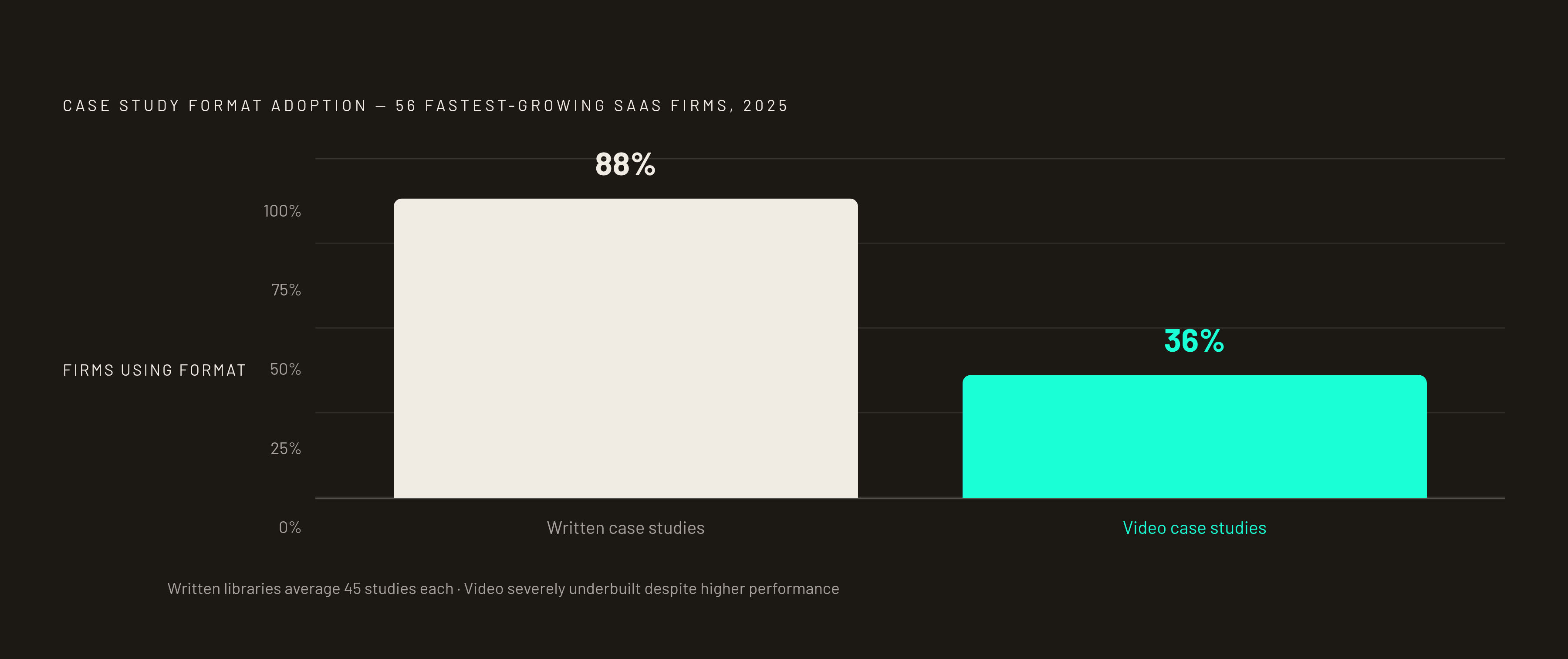
With SaaS specifically, things turn more granular. A look at 56 of the fastest-growing SaaS firms in 2025 turned up 88% using case studies, with 45 on average in each library. A video case study shows up in only 36% of them, but when video is there, teams often highlight its strong performance. The gap from 88% to 36% tells the whole thing in two figures. Most companies have built large libraries of written proof. Video stays underbuilt even though it performs so strongly.
What makes video testimonials a format no other can copy
A person on video does something written text can't. On screen, someone’s tone changes as they describe a problem that once kept them awake, with hesitations in how they move: it does not carry over into writing. People recall 95% of a video message, versus just 10% of that same message read, a gap that keeps one version in mind and lets the other get skimmed and dropped by noon. The gap between 95% retention for video-delivered messages and just 10% for their written form is hardly marginal. A message delivered through video stays with viewers, but that same message read on paper gets skimmed and dropped by afternoon.
According to Influencer Marketing Hub, customers recall a testimonial video 2.1 times better than text feedback. And most B2B customers read online reviews and watch testimonials before deciding whether to buy, but the emotional validation piece, the "this person is like me and it worked for them" reaction, belongs to video specifically.
The conversion stats show this, and B2B gets hit harder than many people think. Testimonial Star reports video testimonials raise B2B conversions an average of 39%, while B2C sees 31%. Video testimonials tied to one clear use case and one hard ROI number lift that average to 44%. Vague talk won't shift the needle. Specificity does; the format built for it is video, with a person speaking.
What written case studies do that video cannot replace
In every sale, a champion must face a group full of people who missed the earlier meetings and build the case for picking this vendor over the rest. They can't just send finance a video and expect it to be read. They want something they can send along, pull a line from in a group message, drop into a deck, and mark up. A PDF fits that job. A video can't. Written case studies work as leave-behind material because they get built for citing, not just watching.
That's key since B2B decision-makers say a large share of them need hard proof before signing on, and proof only works if it stays referenceable. A written case study can hold a metric ("reduced onboarding time from six weeks to nine days") in a form that survives being copied into an internal deck. A video shows that same figure for a minute and a half, then loses it without a transcript.
Written formats let readers see themselves in detail video cannot match. B2B decision-makers say customer-led accounts feel more relevant, and a written case study, well-built, can use several paragraphs for the customer's specific technical bind before naming the vendor. Video, pressed for time, often compresses that context into a single line.
Search is the next factor. Because they're indexable, Written case studies turn up under long-tail keywords a prospect might be typing into Google at 11pm while learning on their own. Video doesn't do much for SEO unless someone writes it out (AdamX). A buyer hunting for vendors before reaching out to anyone usually lands on a written case study. The video follows.
Where each format fits into the buyer's path
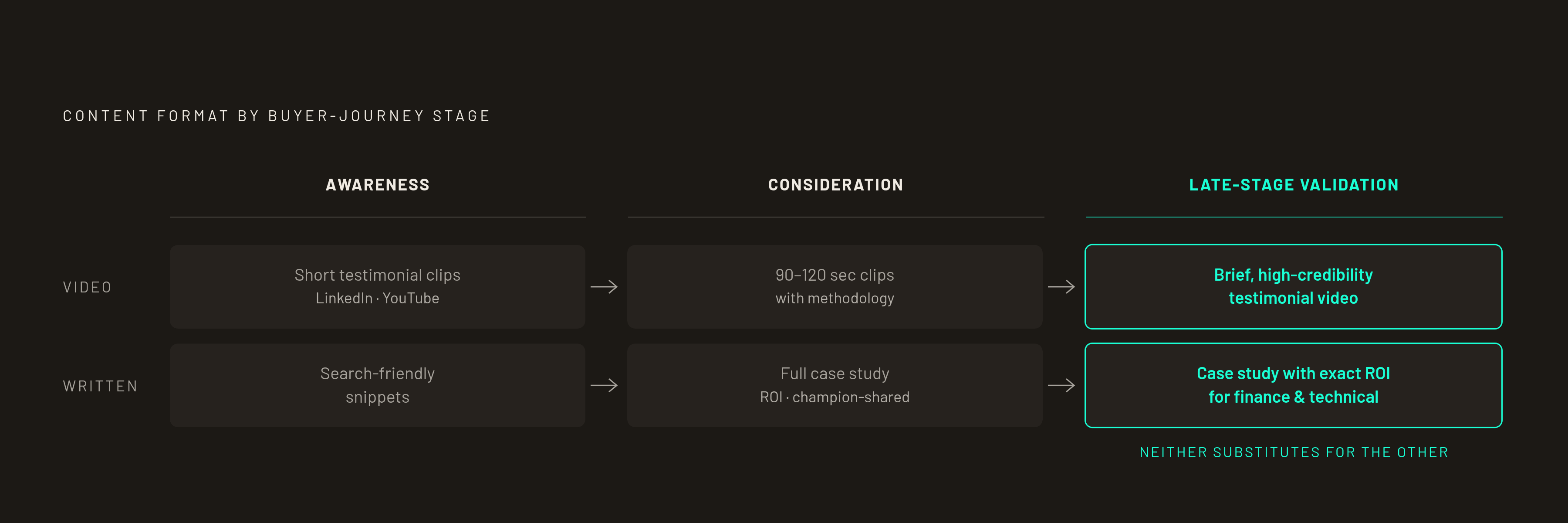
At the start, the buyer is alone, often coming across content through Google or LinkedIn before talking to a vendor. Search-friendly articles show up here as well: brief write-ups that name the problem and lead with an unexpected win to catch people glancing through. Short testimonial videos can serve awareness goals on LinkedIn and YouTube: person, proof, speed, for awareness, not persuasion. At this point, no format closes a deal. Both are simply hoping to make the shortlist.
Consideration is when more stakeholders join the conversation and the buyer looks at choices side by side. Clips running 90 to 120 second fit this stage: sufficient time to show an actual scenario, brief enough that viewers stay to the end. Here, same-field fit counts: testimonial videos with buyers in that field can improve lead quality for B2B contexts. Full written case studies featuring methodology, detail, and measurable results get shared around internally. The champion puts their case together here, drawing straight from the written format.
Late-stage validation is when the group gets assembled, meeting live or in a common file, and the champion must justify the pick they already settled on privately. Written case studies with exact ROI numbers, clear results, and words from a peer of the reviewer help the finance and technical people who didn't see a LinkedIn video. Video still matters: testimonials showing a recognizable business or familiar expert lift conversion meaningfully (per Testimonial Star), since the reference customer's credibility counts here. Gen Report, as shared by Komet Media, reported clips with buyer praise perform 44% better than those without it, making a brief, focused testimonial a valid final-step aid when placed well. The two formats work side by side here: video provides the emotional conviction, while the written piece offers the scaffolding the group uses to sign off.
Who sits on the buying committee and which format works best first
The people involved in buying don't just have different preferences; they take in proof in entirely different ways.
Most buyers start with the testimonial video. They’re looking for a peer in the same job winning with it, and that hands them both the emotional green light and language for advocating internally. When Finance teams and procurement reviewers get involved, they need something for a spreadsheet or memo. They won't sit through a video and extract a number on their own; an explicit ROI in a written case study does that job for them. Technical evaluators look for the setup specifics and methodology that a lengthy written case study is designed to hold. The C-suite still pays attention too: 75% of senior leaders see job-focused clips each week, so a brief, trusted testimonial from a known match at a familiar business can land where a PDF cannot.
Big sales involve 13 internal stakeholders these days, so one format for a single persona won't cut it. Match the proof to who needs it and where they are in the funnel. The same customer call can give the champion one 90-second video and the finance reviewer one full written case study, built from one customer discussion.
Testimonial plays on desktop can drive a significant share of conversions. That gap shows a clear pattern: on computers, in group review settings, people make the calls and use text and video content side by side, not as alternatives.
Production tradeoffs that limit the choice
Money, not taste, is the constraint behind all of this.
Video production often takes several weeks to complete. A written case study can be completed in a few weeks, depending on approvals. Top-tier video production costs between $5,000 and $25,000+, with 44% of marketers hiring third-party firms paying over $15,000 for one testimonial video (Famewall). Written case studies run at a fraction of that price.
Customer buy-in is a separate challenge. Filming and review cycles for video work eat up a customer's day. For a written case study, the call is 30 to 60 minutes, with willingness increases once the request is kept brief, because getting any customer to say yes can be the harder problem than making the content later. It’s a major detail. Making a customer say yes is usually the harder problem, not putting the content together later.
And that schedule gripe comes up often, with 78% in marketing noting a video testimonial needs at least four weeks before completion per Famewall, a problem for any group on quarterly content. Written case studies are ready sooner, even when the customer story behind them is just as good.
How a SaaS proof library takes shape when both formats run side by side
On its own, a format quickly runs into limits. A video library without written case studies keeps technical and budget reviewers underserved and loses SEO. With a written-only library, emotional conviction goes unbuilt and it misses the C-suite focus that video alone tends to hold reliably.
SaaS numbers show the current reality, with 36% of the 56 highest-growth SaaS businesses using customer videos. A real chunk, but not most, so companies stay under-invested when it comes to video specifically for a case study, leaving short-form testimonials aside.
A proof library that genuinely works through an entire buying process usually has four parts. Video testimonials under 90 seconds, aimed at the prospect's field, for early interest and consideration, shown on the homepage, LinkedIn, and emails. Full written case studies detailing ROI and methodology serve the consideration and final buying phases, gated or free based on the funnel. Single-sheet recaps drawn from the in-depth reports, made for internal advocates to share with decision groups who skip the lengthy file. Longer-form video, running 90 to 120 seconds or built as a mini-doc, targets high-deal-size buyers late in the funnel and gets driven through sequences instead of gathering dust on a site.
The idea behind all of it is simple: SaaS products with lots of moving parts get the most from video that shows what truly sets the product apart, based on the exact use case and ROI figure the reference customer saw, because that precision gets video testimonials a 44% average lift in conversion, not video dressed up just to look good. That specificity produces the conversion gain of 44% average B2B video testimonials see when centered on ROI and use, not broad approval. Written case studies take a different approach to the same goal: facts over flash, details over drama. A proof library that leans on both, aimed at the right stakeholder when the right moment comes, supports selling beyond what one format can cover.
Sources
- How to Leverage B2B Customer Testimonials & Case Studies
- 35 Insightful Video Testimonial Statistics (for 2026)
- Video vs Written Case Studies: Pros, Cons & Best Practices (2025) | AdamX
- The 2025 Data-Driven Analysis for Success through Video Stories
- B2B Video Content Statistics and Benchmarks (2026): What the Data Tells Us Right Now
- fello.agency