VSL Hosting and Delivery Platforms for SaaS Marketing Teams
Platforms designed to convert viewers into customers, not just play back video files.

A video sales letter has one job: get the viewer to take a specific action. That single purpose means the platform hosting it has to be judged on conversion infrastructure, not on playback quality or how much storage it offers. SundaySky's VSL guide describes the format as "a structured video designed to persuade a viewer to take a specific action," and that definition traces back to direct-response sales letters, the kind of persuasive mail copywriters like Gary Halbert and Eugene Schwartz built careers on. A VSL is built to sell, not to inform or entertain.
That sales function shapes the script itself: a hook, a problem, a story or insight, a solution, proof of value, a call to action, and a close built on urgency. Delivering that arc well requires a player that can do things a generic host simply isn't built for: drop a CTA at the exact second it's earned, gate content behind an email capture, hide the progress bar so a viewer can't skip ahead to the offer before the persuasion has done its work. YouTube and standard-tier Vimeo are built for something else entirely: getting content discovered and playing it back cleanly. A dedicated VSL platform cares about what happens after you hit play. Free and discoverable sounds appealing to an early-stage team watching every dollar, but discovery and conversion are different jobs. A platform trying to do both usually does neither well when the goal is a sale, not a view count.
The four criteria that determine whether a VSL platform converts
Four things separate a platform that can actually run a VSL from one that just happens to host video files: how deep the analytics go at the individual viewer level, how much control the player gives the marketer over the viewing experience, how precisely a CTA can be placed, and whether the platform supports personalization.
Analytics depth is the first and most consequential. A total play count tells a marketing team almost nothing useful. What matters is per-viewer data: what percentage of the video each contact watched, where they dropped off, whether they rewound and replayed a section. That data becomes useful once it lands inside a CRM contact record, where a sales rep can open a lead and see what that prospect has and hasn't watched before making the first call.
Player control is the second criterion, and it's easy to underrate because it looks cosmetic from the outside. Suppressing the progress bar keeps a viewer from jumping straight to the offer before the problem-agitation section has done its persuasive work. Autoplay settings, thumbnail A/B testing, and mobile-first layout are functional choices that affect whether the video gets watched. SundaySky's guide points to mobile-first, fast-paced delivery as a defining trait of VSLs built for 2026. A platform that drops a viewer into standard YouTube-style controls hands the experience over to the viewer, taking control away from the marketer running the campaign.
CTA placement precision is the third. A call to action that only shows up at the end of the video misses the window when persuasion is strongest. For example, strong platforms let a CTA appear at a defined timestamp, right after the proof section closes, or they trigger it conditionally once a viewer crosses an engagement threshold. In-video lead capture, like an email gate or a form overlay, works the same way: it turns a moment of attention into an identifiable contact before the viewer has a chance to leave.
Personalization is the fourth, and it marks a real fork in the road. Inserting a prospect's name, company, or specific pain point into a video is a structurally different problem from hosting one video for a mass landing-page audience, and it calls for different platform infrastructure. SundaySky's guide points to a hybrid format, a branded animated core with data-driven scenes swapped per audience segment, as the strongest performer for sales enablement. Format matters here too: animated video tends to work for warm landing-page audiences who already know the brand, while real faces outperform for cold outreach, where a prospect expects something that feels personally sent.
The structural split: one-to-many landing page delivery versus one-to-one personalized outreach
The platform decision that matters most for a SaaS marketing team is which primary use case the team is optimizing for, because the two dominant use cases need structurally different platforms underneath them.
One-to-many delivery means a VSL sitting on a landing page, watched by a large and mostly anonymous audience. The goal there is maximizing conversion rate across that whole audience, measuring lift against a control, and attributing pipeline back to video engagement. The platform has to host reliably at scale, report analytics both in aggregate and per contact, and plug into marketing automation so engagement can trigger workflows automatically. CRM integration in this context exists for attribution: connecting watch data to a contact record so video engagement can be scored and reported against actual pipeline.
One-to-one outreach is a different animal. Here the goal is lifting reply rates and meetings booked on cold or warm outreach, and making a specific prospect feel like the video was made for them. The platform needs to generate or assemble a personalized video fast, deliver it in a format that opens cleanly inside an email client, and track whether it got watched, then report that back to the rep who sent it. CRM integration here serves the rep's workflow directly: recording, sending, and checking open and watch data without ever leaving the CRM.
Most growth-stage SaaS teams eventually need both capabilities. Buying a platform built for one and forcing it to do the other tends to produce weak results, because the evaluation criteria themselves pull in different directions, not just the use cases they're meant to support.
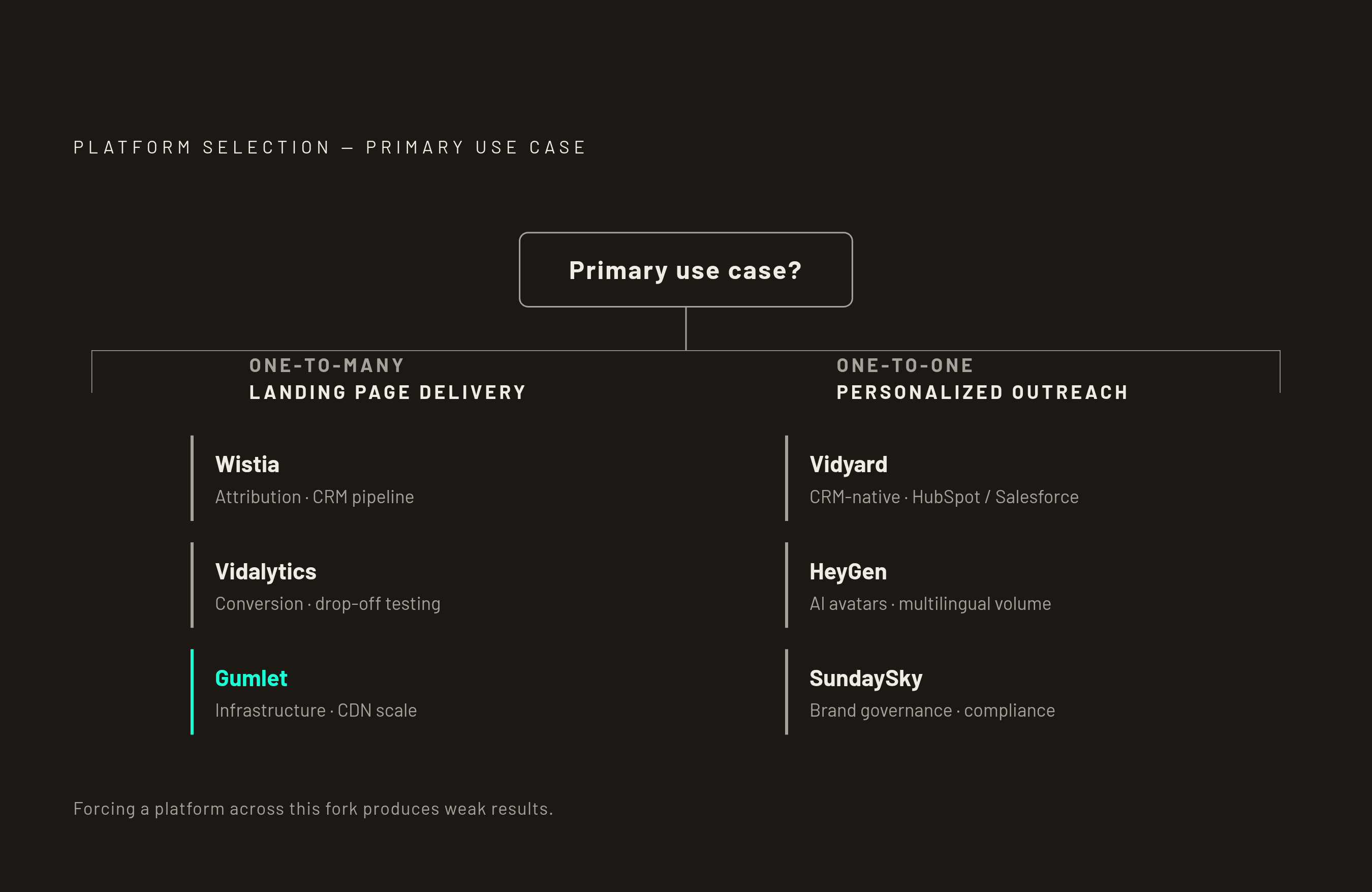
Platforms built for one-to-many VSL delivery: Wistia, Vidalytics, and Gumlet
Three platforms cover distinct positions along the spectrum from conversion intelligence to raw delivery infrastructure for teams running VSLs on landing pages. The right one depends on where the bottleneck actually sits: attribution, optimization, or scale.
Wistia sits at the attribution end. It integrates natively with HubSpot, Marketo, Pardot, and Salesforce, and video engagement data, percentage watched, play events, Turnstile form submissions, flows straight into contact records and can trigger automated workflows from there. So Wistia is the strongest fit for marketing teams that need to show finance and revenue leadership a clean line between video investment and pipeline. The video itself matters as much as the platform measuring it: a company like Letterspade, which builds B2B video for technical audiences and devtools companies, works from the premise that a sales video has to be built around what makes the product genuinely different before any analytics layer can tell a useful story about conversion.
Vidalytics sits closer to the optimization end. It's built around conversion analytics that track the behaviors that predict a purchase decision, rather than general playback metrics or simple view counts. So it's the strongest fit for teams running high-volume VSL tests, iterating on specific script sections based on where viewers drop off or which parts they rewatch.
Gumlet sits at the infrastructure end. It's a cloud video hosting and streaming platform that combines hosting, adaptive streaming, storage, multi-CDN delivery, and a white-label player, treating video as a piece of product infrastructure. So it's the strongest fit for SaaS teams embedding video inside the product itself or on high-traffic pages where delivery performance outweighs conversion intelligence.
Platforms built for one-to-one personalized outreach: Vidyard, HeyGen, and SundaySky
For sales teams using video inside outreach sequences, the platforms worth evaluating are the ones that embed directly into rep workflows, produce personalized content fast, and close the feedback loop down to the individual prospect.
Vidyard is built for CRM-native tracking. HubSpot and Salesforce users can record, send, and track video without ever leaving their CRM, and engagement data, who watched what and when, syncs back automatically to drive personalized follow-ups and trigger sequences. The tradeoff is cost: tighter CRM integration tends to come with a higher per-seat price, which raises friction repeatedly for growth-stage SaaS teams. Vidyard earns its place when the sales team's core need is personalized outreach wired directly into the CRM.
HeyGen uses AI-generated avatars to produce video without a studio shoot, which makes multilingual VSLs achievable at a pace human recording can't match. It's the strongest fit for teams that need to reach multiple language markets or need high volumes of personalized video at a cost-per-unit that a camera crew simply can't hit. Animated or avatar-based video tends to work for warm audiences who already expect a branded experience, but real-face video still outperforms for cold outreach, where a prospect is looking for proof that a real person sent this.
SundaySky takes a different approach, built for brand governance at scale. It lets marketing or enablement teams build approved VSL templates that reps can then personalize safely, so the video stays on-brand no matter how many reps are sending it. That matters most in financial services, insurance, and other regulated industries, where compliance rules limit what a rep can say or show on their own.
Holding the VSL itself constant across both platform classes
No hosting platform fixes a VSL that fails at its one job. The script structure, the format chosen, and how specific the offer is set a ceiling that the best analytics and the sharpest CTA placement can approach but never push past.
The persuasive arc stays fixed regardless of platform: hook, problem, story or insight, solution, proof of value, call to action, and an urgency-driven close. SundaySky's guide treats that sequence as the foundation that has to be in place before format or platform decisions even enter the conversation. Format should follow the message and the audience, not whatever tool happens to be available. A talking-head video suits founder messages or rep-led storytelling, anywhere human presence builds trust. Animated or motion graphics suit complex products, data-heavy narratives, or regulated industries where clarity has to come first. AI-generated video suits high-volume, multilingual, or frequently refreshed content where speed and consistency keep pace that a personal touch can't. A hybrid format, an animated core with swapped-in personalized scenes, suits sales enablement where brand control and individual relevance both need to survive in the same asset.
One finding stands out above the rest: video testimonials placed near the call to action produce a pronounced lift in conversions. You make that call in scripting and production, before you touch a platform setting. The same logic explains why generic explainer videos underperform even on the best platforms available: what makes a VSL convert is the specificity of the problem it names, the mechanism it explains, and the proof it offers, not how polished the production looks. Building that input correctly is exactly the work a production team like Letterspade focuses on for technical audiences, where naming the actual mechanism behind a product is what the video has to get right before any hosting platform can measure whether it worked.
Matching platform to use case: a decision path for a SaaS marketing team
The decision comes down to three questions, asked in order, and the answers point to which platform from this piece is the right starting point. There's no single best choice across the board, only the right fit for a specific team at a specific stage.
The first question: is the primary use case landing page conversion or sales outreach? Landing page conversion points toward evaluating Wistia, Vidalytics, and Gumlet, weighed by how much conversion intelligence the team needs against how much raw delivery scale it needs. Sales outreach points toward Vidyard, HeyGen, and SundaySky, weighed by CRM integration depth, how much personalization volume is required, and any compliance constraints. Teams that genuinely need both should start with whichever use case is generating more pipeline pressure right now, then add the second platform once the first is properly instrumented.
The second question: how mature is the team's measurement setup? A team that can't yet connect video engagement back to CRM contact records won't get value out of platforms priced for that capability. Starting with infrastructure, Gumlet or Vidalytics, and layering in CRM integration once the data model is ready makes more sense than paying for integration depth nobody can use yet. Teams already running lead scoring and attribution inside HubSpot or Salesforce should weight native integration depth over per-feature cost when comparing options.
Before the platform decision matters at all, the VSL itself may need rebuilding, and if the current video skips steps in the persuasive arc, no hook, a weak problem section, no urgency in the close, switching platforms won't move conversion numbers. Platform analytics usually reveal this fast: low completion rates with drop-off concentrated in the first third of the video point to a failing hook and problem section, not a hosting problem. A new platform can't repair a script that never finishes the job it set out to do.