Voiceover vs. On-Screen Text in SaaS Explainer Videos
Placement and audience context, not preference, determine whether voiceover or text wins.

I've spent enough hours in review calls watching marketing teams argue about this to know the answer isn't taste. It comes down to three things: where the video actually plays, who's watching and under what conditions, and how much product complexity you're cramming into 60 or 90 seconds. Get it wrong and you land in one of two ditches: a beautifully written voiceover nobody hears, or a wall of text trying to carry a workflow story it was never built to hold. Wyzowl's numbers put 73% of video marketers making explainers now, which sounds like validation until you realize what it actually means: everyone's making one, so a forgettable execution just vanishes into the feed.
Where the video lives determines what the viewer's ears are doing
Ask this before you write a single line of script: where does the video live? Most teams skip this step, and it should come first, every time.
Here's what's actually happening out there. Verizon and Publicis Media found 83% of desktop viewers watch with sound off, and mobile is worse, around 92%. Facebook, Instagram, LinkedIn: all default to muted autoplay. The viewer has to reach out and turn the sound on, and most won't bother. Add in that 69% of people watch video somewhere turning on audio would be awkward, a train car, an open office, a waiting room, and you start to see the shape of the problem.
Now picture someone who clicked a link in a sales email, or landed on your product page right after requesting a demo. That's a different animal entirely, someone who is usually somewhere sound-appropriate and actually leaning in, not thumbing past you. Same format, opposite listening condition. Drop a voiceover-heavy video built for a landing page straight into a LinkedIn feed, unchanged, and it's broken for most of the people who'll ever see it. Channel comes first, and tone, pacing, and script length all follow after.
What cognitive science actually says about combining audio and visuals
I used to think "just add both, voiceover and text" was a safe hedge, but it isn't, and there's real research explaining why.
Richard Mayer's work on multimedia learning builds on Allan Paivio's dual coding theory: the brain runs verbal and visual information through two separate channels. Hit both at once without overloading either, and recall goes up. That's the whole case for pairing narration with animation, two channels, one message, neither one drowning.
But flip one variable and the whole thing reverses. Mayer's redundancy principle says if you put your voiceover's exact words on screen while the narrator says them, you haven't reinforced anything. You've jammed two verbal streams into a channel built for one, and the brain just chokes. Viewers start reading ahead, miss what the narrator's saying, and comprehension drops instead of climbing.
There are two flavors of this worth knowing apart: content redundancy, repeating the same information twice, and channel redundancy, loading two verbal inputs into working memory at once. SaaS teams default to assuming more information delivered more ways means more clarity sticks, but it's backwards. The real question is whether voiceover and text are doing two separate jobs, or just saying the same thing twice.
When voiceover earns its place in a SaaS explainer
Voiceover does one thing text structurally cannot: it controls pace.
Walk someone through a multi-step workflow, a subtle integration detail, or a differentiation point that needs a sentence or two to land right, and narration can set the rhythm for that in a way text just can't touch. Text gets read at the viewer's speed, whatever that is, while voiceover sets the speed for them. When the idea has layers, that control matters more than people give it credit for.
There's a trust angle too, and it's easy to underrate. 72% of viewers say a human voiceover feels more trustworthy than the alternatives, and brands using human narration see 22% higher recall than AI-voiced versions. In B2B SaaS, where the buyer is sizing you up as a long-term partner and not just a feature list, that credibility signal is doing real work in the background. Voiceover can also build toward something, slowing down right before the reveal of a key number, in a way that's hard to imagine from a bullet point.
This all works best in high-intent spots: a landing page, a sales follow-up email, an in-app onboarding flow. The viewer already clicked, and they're probably somewhere they can listen. Voiceover also serves auditory learners outright, and it's the most scalable piece of the video to localize; AI narration tools now cover over 100 languages, which turns voiceover from a line item into a real lever for international expansion.
All of it rests on one condition, though: the viewer has to actually be able to hear it, which, as I just covered, isn't the default anywhere near most channels.
When on-screen text does the job voiceover cannot
Change the deployment context and text stops being the fallback, and it becomes the whole message instead.
Run your video on LinkedIn, Instagram, or as a paid social ad, and on-screen text is what's actually doing the communicating. LinkedIn's own data shows captioned videos pull 86% more views than uncaptioned ones. That's the platform telling you, in its own numbers, how its feed behaves.
Verizon and Publicis Media also found up to 80% of viewers are more likely to finish a video with subtitles on, and completion rate is the one metric that decides whether your product story ever gets told all the way through. It's not just people who can't hear the audio, either: 42% of viewers say they turn on subtitles specifically to concentrate better, and 29% say they understand a video better with captions on even with the sound fully up. Text isn't just an accessibility patch. It's a comprehension tool on its own.
For a short, punchy value prop, one sentence, maybe two, text often lands it faster than a voice ever could. There's a production upside buried in here too: captioned, text-driven formats get re-edited without re-recording a single word of narration, which matters when the messaging is still shifting. And every word on screen is crawlable, indexable content, quietly compounding your video's discoverability long after launch.
The redundancy exception that changes the calculation for international audiences
Here's where the clean rule from earlier gets messy.
Mayer's redundancy principle holds for native speakers processing their own language, since simultaneous voiceover and matching captions overload that verbal channel. Flip to non-native speakers, though, and the research reverses: synchronized captions actually lower cognitive load for them, because the written word anchors a spoken one that isn't fully automatic yet. What overloads a native English speaker helps someone parsing English as a second language keep pace.
If you're selling SaaS into international markets, developers in Berlin, finance teams in São Paulo, enterprise buyers scattered across a dozen regions, this stops being a footnote fast. It's a legitimate reason to run voiceover and captions together for those audiences specifically, in places you'd skip it domestically. The redundancy principle isn't a fixed law. It's conditional on who's actually watching.
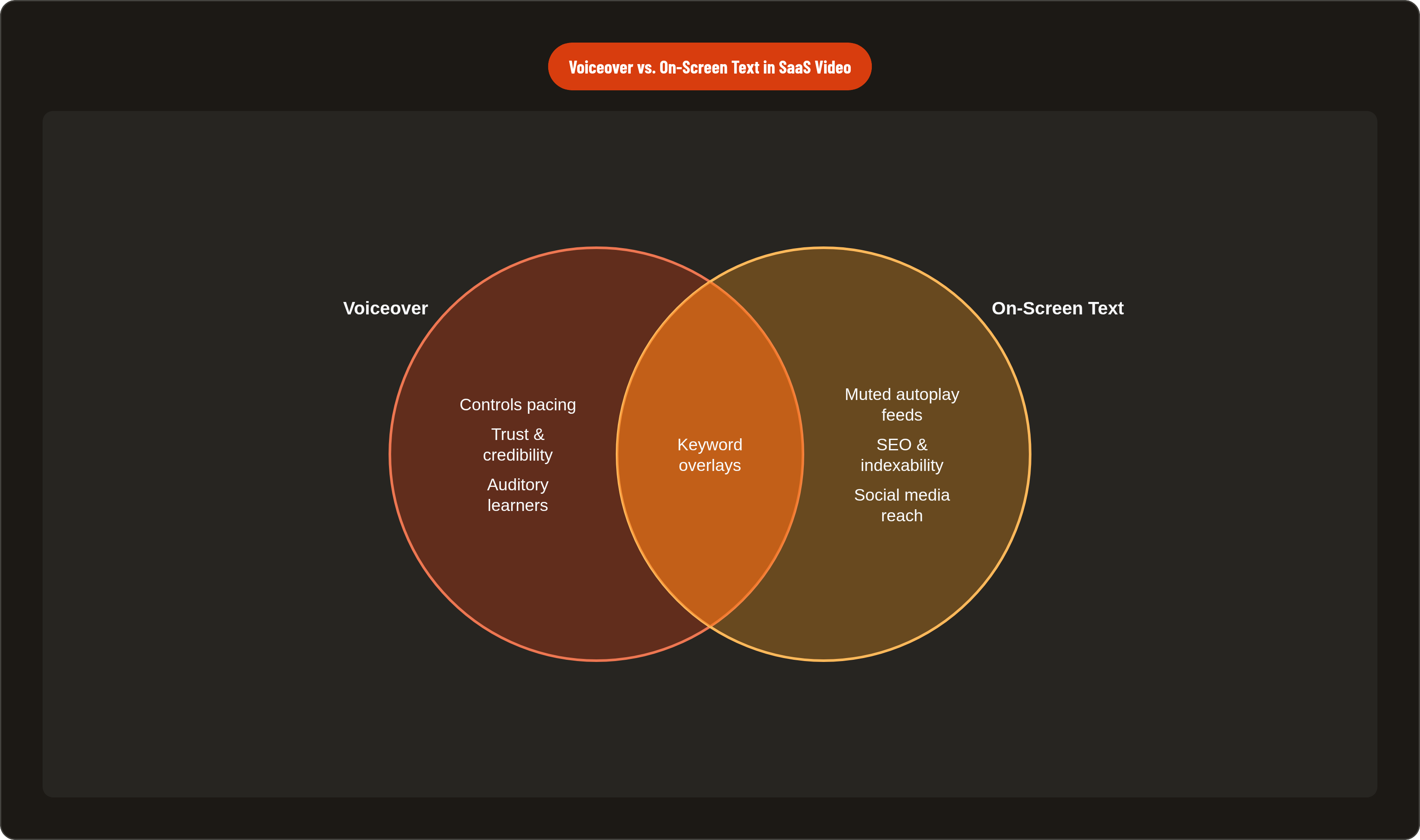
There's a middle path that works almost regardless of language: keyword overlays. Flash a product name, a specific metric, a call to action, alongside the narration, and you're not duplicating the verbal channel the way full-sentence captions do. You're anchoring a moment without overloading anyone. Done right, narration carries the story and selective text just marks the beats that have to land no matter who's watching or where.
How to match the approach to your SaaS video's actual job
Three questions, answered honestly, before production starts.
Where does the video live? A landing page, a paid social feed, a sales email, an in-app tour, a trade show monitor: each one implies a completely different default listening condition. Who's watching, and under what conditions? A high-intent visitor who clicked through isn't the same person as someone thumbing past you on a train. How complex is the actual story? A single value proposition needs something very different from a multi-feature workflow or a technical integration walkthrough.
Answer those and the format mostly picks itself. Landing pages and sales sequences want voiceover-forward video, captions layered on for accessibility and SEO, keyword overlays at the moments that matter most. Paid or organic social wants text as the primary channel, audio as a bonus nobody's required to use. International audiences justify voiceover plus synchronized captions, together, the redundancy exception doing its work. Simple top-of-funnel positioning does better text-driven and quick, minimal narration. Complex demos need narration to carry the nuance, text reserved for anchoring key terms and the call to action.
Picking one format and slapping it onto every channel regardless of fit is where most of this goes wrong. A voiceover-only video dropped into a social feed is dead on arrival for the 92% of mobile viewers scrolling muted. The opposite mistake is just as common: stacking full voiceover on top of full on-screen text as a hedge, hoping more coverage means less risk. It doesn't, and the cognitive science says that produces overload, not clarity. None of this costs a scrappy SaaS team a dollar to get right. It just takes answering three questions honestly before the camera rolls, or before the animator opens the file.
What makes either approach actually work in practice
Picking the right format gets you halfway. Execution is the other half, and it's the harder one.
A voiceover script has to earn its keep on word choice, pacing, tone, none of which a talented narrator can fix if the writing underneath is generic. Generic script in, generic video out, no matter how good the recording booth is. On-screen text carries its own non-negotiables: legibility, pacing, brevity. Flash text faster than a viewer can read it, or cram the frame, and you've defeated the format regardless of how sharp the underlying idea was.
Underneath both approaches sits the same principle: knowing exactly what makes your product different beats production polish, every single time. One precise sentence about your actual differentiation will beat a gorgeous, expensive video that never says anything specific about why anyone should care.
Roughly half of silent viewers depend on captions just to follow along at all, which makes captions the floor, not the ceiling, for any video with ambitions past one narrow, controlled context. Keep the story to its essential difference, delivered in the format that fits the channel it's actually running on, instead of dressing up a feature tour as a 60-second explainer. When it works, narration carries the arc, selective text anchors what has to register, and captions make sure nobody gets shut out on a mute train car somewhere. Each layer does its own job, and none of them repeat each other, which is the whole trick.