Localizing SaaS Explainer Videos for International B2B Markets
Skipping translation for localization cuts churn and support costs across markets.

Most B2B SaaS companies build one explainer video library, in English, and ship it to every market without changing a frame. The damage appears past the marketing funnel: customers who cannot follow an onboarding video take longer to reach their first success in the product, file more support tickets asking what a button does, and cancel at higher rates than customers who got the same guidance in their own language.
The buyer who signs the contract is frequently not the person who watches the videos. Regulated industries raise the stakes further: a financial institution expanding into Germany has to put its product explainers, training videos, and onboarding tutorials in German, and those videos have to follow German financial compliance standards, not just German grammar.
This gap costs money at several points in the funnel at once, not just one. Treating the fix as a translation task undercounts what is actually broken. A company that frames this as "we need subtitles in a few languages" will underinvest in the parts of the problem that actually drive churn and missed activation, and the decisions made downstream, which videos get attention, how deep the adaptation goes, will be wrong from the start.
Why "localization" and "translation" are not the same decision
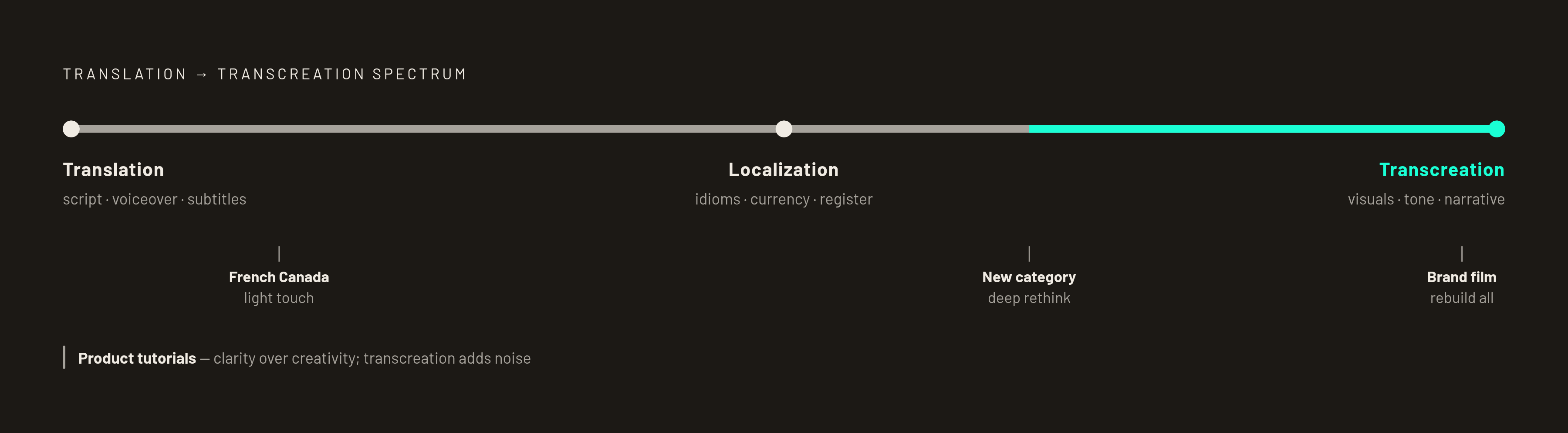
Translation and localization solve different problems, and conflating them is how companies end up with videos that are technically understandable but still feel like they were made for somebody else. Translation converts the words: script, voiceover, subtitles, moved from one language into another. Localization adapts the content so it fits the market it is landing in: idioms, on-screen currency formats, the order steps appear in to match local regulations, even the pace at which information gets delivered.
Formality is one of the clearest examples of why this distinction matters in B2B. A version that gets the formality register right feels built for that market. A version that just translates words while keeping the source market's tone feels imported, even when every sentence is grammatically sound.
Transcreation sits at the far end of this spectrum: it rebuilds the visual elements, tone, and narrative structure for a market from the ground up. That level of rework makes sense for a brand film meant to carry emotional weight, but it is overkill for a product tutorial that just needs to be clear. The practical task is figuring out where a given video sits on this spectrum before any work begins. A video aimed at French-speaking Canada might need only light touches. A video introducing a product category that barely exists yet in a new market needs much deeper rethinking. Knowing which situation applies is how a team scopes the project honestly instead of guessing at a budget.
Which videos to localize first
Every localization pass costs money and time, so the real question a team faces is never whether to localize. It is which videos, in which languages, pay back the investment fastest. The data to answer that question already sits inside the business.
Start with video type. Onboarding videos come first, because new users meet them in their earliest days with the product, when confusion turns into cancellation fastest. Internal and one-off videos rarely justify the effort.
Language prioritization works the same way, built from data the team already has: active accounts and revenue by country, support tickets by language, trial sign-ups by country, sales pipeline by market. Start with one or two languages, measure what happens, then add the next.
HubSpot's approach to Brazil shows this logic in practice. The company didn't settle for subtitles. It committed to native-language voiceover, a signal that the market justified full localization over a light pass. That kind of commitment only makes sense once the data says the market is worth it.
None of this prioritization matters if the production pipeline can't actually execute it fast enough to keep up with a growing list of markets and a product that keeps changing.
Three structural reasons localization projects stall before they scale
Most localization efforts don't fail because of a bad budget call or a cultural misstep. They fail because the production model was never built to support localization in the first place, and the resulting debt compounds with every product update.
Localization debt scales with product velocity. A team that localized its library into four languages is now running four separate update cycles in parallel, and that debt grows with every sprint the product team ships.
Cost scales linearly with markets. Translation, voiceover recording, audio syncing, subtitle review, and quality assurance all have to run per language, and none of those steps get cheaper just because a team is already doing it in three other languages.
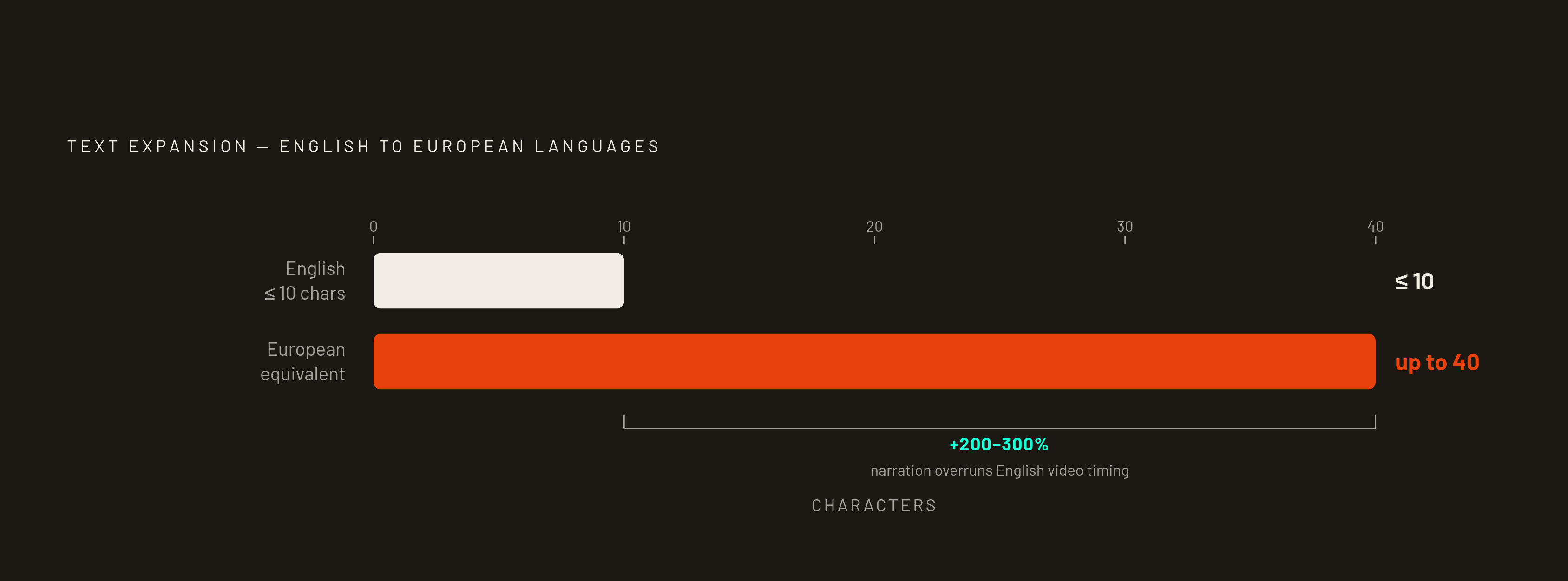
Traditional video localization also creates a timeline mismatch. Traditional video localization takes days to weeks per language to turn around. Most SaaS companies ship product updates on two-week or monthly release cycles. The gap between those two speeds means customers in non-English markets are often watching onboarding and tutorial videos for an interface that no longer matches what's in front of them. The W3C, summarizing IBM's localization guidelines, notes that short English strings of up to 10 characters can expand by 200 to 300% in European languages, becoming three to four times their original length. A video built to tight English timing forces translated narration into a box it doesn't fit, either rushed past comprehension or drifting out of sync with whatever is happening on screen.
All three problems trace back to the same root cause: localization got added after production was already considered finished, instead of being designed into the workflow from the first script draft.
Production design choices that make a video localizable before the camera rolls
A video built with localization in mind from the start costs less to adapt into new languages, stays current when the product changes, and doesn't need to be rebuilt from scratch every time a new market opens. These are engineering decisions, made in preproduction, not fixes applied after a video is already live.
Script first, record second. A clean, direct script, free of idioms, culturally specific humor, and ambiguous compound sentences, becomes the source of truth the whole localization workflow runs on.
Keep the audio layer separate from the visual layer. Burned-in captions, static text overlays, and UI callouts baked directly into the video frame require a full re-edit for every language. Dynamic subtitle tracks and on-screen annotations that can be swapped out without touching the underlying recording let localization updates happen off the main timeline.
Decide deliberately how to handle the interface. If the product does have a localized interface, capture separate screen recordings for each language rather than dubbing narration over English screenshots.
Format choice matters too. CEO-to-camera brand films shot in tight close-up are the hardest case: translated scripts rarely match the original syllable count, and mismatched mouth movement is most visible exactly when a face fills the frame.
AI Dubbing and the Economics of Reaching Multiple Markets
AI dubbing has changed the cost and speed math enough that "we can't afford to localize" stops being a credible objection for most SaaS teams. It has not removed the need for judgment about where and how to use it.
AI dubbing tools use machine learning to transcribe, translate, clone voices, and sync audio to video automatically, cutting production time from weeks down to hours. Per-minute costs run substantially below traditional studio dubbing. Human review still belongs in the process for cultural accuracy, but the baseline cost of getting a first version into a new language has dropped sharply.
Format still determines how well this works. The standard animated or screen-capture SaaS explainer is well-suited to AI dubbing, for the same reason it suits traditional dubbing: talking-head, voiceover, and B-roll-heavy formats don't lock the viewer's attention onto a speaker's mouth. Fast, dense dialogue and extreme single-speaker close-ups create the most friction, since translated lines rarely match syllable count and mismatched lip movement is hardest to hide in close-up.
The quality ceiling matters more in B2B than in most other dubbing use cases. Accuracy drops for technical or domain-specific content, and SaaS explainer videos are built almost entirely out of domain-specific content: product terminology, workflow-specific language, feature names. Idiomatic expressions and complex terminology are consistent weak points, and an error there can mislead a user about what a feature actually does, not just read awkwardly.
The resolution most teams land on is a hybrid model. AI handles first-pass transcription, translation, voice synthesis, and lip sync. Human reviewers with native fluency in the target language, and enough familiarity with the source language to catch what got lost, handle the cultural and emotional polish the AI pass misses. The bottleneck in this model is finding reviewers who meet both criteria, particularly for less common language pairs. That hybrid point, AI for speed and cost, human review for accuracy, is exactly where the three production methods below start to differ from each other.
Three methods for localizing a video
The best localization method for a given video is the one whose trade-offs match the video's role in the funnel, how deep the target market commitment runs, and how often the underlying product changes.
Translated captions are the cheapest method: the original English narration keeps playing, with captions in the target language running underneath. This works for overview videos, where a viewer is watching more than following along step by step. It works less well for tutorials, where a viewer trying to follow a how-to needs their eyes on the interface, not pulled down to captions at the exact moment they need to click something.
Dubbing the finished video lays a translated audio track over the same existing footage. AI dubbing tools have made this method fast and cheap enough that it's become the default starting point for many teams, Salesforce's approach to German illustrates why that default sometimes needs a second step: rather than cramming German narration into English timing, Salesforce let the German script set its own pace and adjusted the video's length to match. That's a production decision, not a translation one.
Re-voicing from a script with full retiming is the highest-quality option. A script gets written directly in the target language, read by a voice actor or AI voice, and the video gets retimed so each scene lasts exactly as long as its narration needs, so "click Approve" still lands on the actual click. It takes the most effort to produce and the most effort to update, but AI-assisted workflows have brought its cost much closer to simple dubbing for teams that already have a clean, scripted source video to work from.
Choosing between the three comes down to three questions. How often does the product change: high-velocity product areas favor dubbing because it's faster to update, while stable core workflows can justify the heavier re-voicing investment.
How Canva, HubSpot, and Salesforce Applied These Methods at Scale
The companies that made video localization work didn't treat it as a single project to complete. They built it into a repeatable practice tied to specific decisions about markets and product.
HubSpot's Brazil decision shows what commitment depth looks like in practice. Choosing native-language voiceover over subtitles signaled that Brazil wasn't a market getting the minimum viable localization treatment. It was a market the company had decided to compete seriously in.
Salesforce's handling of German shows the timing mismatch solved correctly. Instead of forcing German narration to fit English-length timing, the video's length adjusted to the language. That's the retiming principle from the methods above, applied as a production choice rather than treated as a translation inconvenience to work around.
Canva shows what localization looks like once it is treated not as a project but as infrastructure. The company scaled from a single language to more than 100 languages, built dedicated localization teams covering brand voice, content, and quality assurance, and international markets became a core driver of its growth. At that scale, localization is a team structure and an ongoing process with its own staffing and its own workflow.
Measuring whether localization is working as a revenue lever
A company that treats localization as a translation project measures its output: videos delivered, languages covered. A company that treats it as a revenue decision measures outcomes: activation rates, support ticket volume, conversion, and retention, broken out by market.
The metrics worth tracking are the ones that revealed the problem in the first place. Support ticket volume and category, broken down by market, since localization that's working should reduce tickets tied to the topics the video already covers. Time-to-activation by market, which tends to be the clearest signal of whether onboarding content is actually doing its job.
The prioritization framework from earlier in this argument becomes the measurement baseline here. The same data, active accounts, support ticket volume, trial sign-ups, pipeline, that determined which videos and markets got localized first is the baseline a team compares against after the work is done. Setting KPIs like view-through rate, engagement, lead conversion, and support ticket volume before localizing, not after, keeps expectations for revenue impact and adoption honest in each market.
The hardest objection to this whole framework is that B2B sales cycles run long, so attribution gets murky. Support ticket volume and activation speed answer that objection directly: both are short-cycle, both are observable within weeks, not quarters, and both move in the same direction as the harder-to-trace revenue outcomes further down the funnel. The companies winning international B2B markets with localized video treated each localization decision as a bet on a specific market, measured what that bet returned, and reinvested based on what the data actually showed.