Rebranding a B2B SaaS Company at Series A
Settle positioning first, or a new logo just dresses up an old story.

A Series A rebrand should help a B2B SaaS company sell its next stage of growth. That means deciding who the company serves, what makes it different, and why buyers should believe it before design begins. The work succeeds when that decision reaches the sales deck, website, and product.
Why a Series A exposes brand debt that seed-stage companies accumulate silently
The founder opens the website and sees the last version of the company. The board deck describes the next one. One sells a tool, while the other makes the case for a platform. That gap is the real trigger for a rebrand. The funding exposes a mismatch that has been building while the team focused on shipping and finding customers.
That mismatch is brand debt, and it accumulates quietly. Early teams make choices for speed, product momentum, and founder taste. By Series A, they are asking for larger contracts, longer commitments, and trust from buyers who did not arrive through a warm introduction. The message that won over early adopters may not tell an enterprise buyer why it should commit.
The fundraise deck, sales decks, partnerships one-pager, and recruiting deck may use different logos, tones, and even claims about what the business does. Each inconsistency puts a small tax on credibility. Enterprise buyers spend only a small fraction of their purchase journey meeting suppliers, so those materials often speak without anyone from the company there to explain the differences.
What goes wrong when the rebrand starts with the logo
A visual cleanup can make those decks match without making their argument stronger. That is the visual-first trap. The company treats identity as the foundation when it should express a positioning decision. If the story still describes a smaller product or speaks to a buyer the company has moved beyond, better design only makes that same story look more expensive.
The familiar pattern starts with a raise and a new VP of Marketing. A new logo, colors, and website follow. Four months and significant spend later, pipeline is flat because the message still gives no specific buyer a reason to care. The assets changed, but the sales argument did not.
A name change can follow a better logic. Demochimp’s founders saw that its playful name felt too small when they talked to enterprise buyers. The move to Consensus reflected an expanded enterprise vision and a mission of driving buying consensus.
Still, some founders are right to resist a rebrand. If the company is still changing what it sells and to whom, the work may need replacing within 12–18 months. That wastes attention as well as money. If NPS is low and monthly churn is high, the budget belongs in UX.
How to tell whether you need a full rebrand, a partial rebrand, or just a refresh
The first decision is scope. To diagnose the gap, put the website, deck, product, and review-site profile beside those of three direct competitors. Ask what a buyer would recognize as different. If the message is right but the look has aged, a refresh may be enough. There is no reason to rebuild the company’s story just because its design needs work.
A partial rebrand fits when the message or visual identity needs replacing, together with the website, but the name still works. A raise, move upmarket, or new buyer can trigger that change. Focus Lab described PolyAI’s earlier identity as one that “belied its enterprise capabilities.” PolyAI’s 2023 rebrand changed its identity, website, and copy to close that gap while keeping its name.
A full rebrand starts with changed positioning and extends through identity, messaging, website, product surfaces, and sometimes the name. A merger, new category, or name that no longer fits the business can justify that scope. ZEIT became Vercel alongside its Series A in 2020. Lexicon Branding developed the new name.
The hard stop is an unsettled business model. Before product-market fit or during a pivot, there may be nothing stable enough to brand. Wait until what the company sells and who it serves are clear. Enterprise buyers and investors judge how mature a company is by its positioning and how well it delivers, and an attractive logo alone cannot show that.
The correct order of operations — positioning and messaging before any designer sees a brief
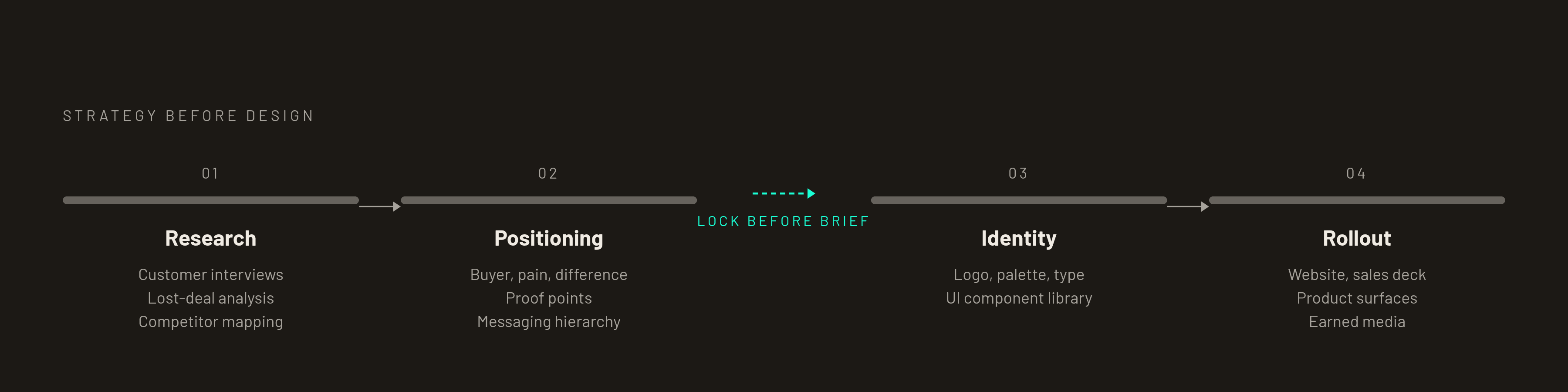
Once the scope is clear, start with three decisions. Define who the product is for narrowly enough to exclude most companies. State what it does differently in terms of a buyer’s outcome. Then show why that buyer should believe the claim, using customers, data, or a track record. These decisions give the designer something concrete to express.
“Acme is a modern CRM platform that helps teams sell better” does none of that. It names a category without making a choice. A useful statement identifies the exact buyer, the pain, the difference, and the proof.
To make those choices, interview a meaningful sample of customers and lost deals. Map what competitors claim to do best and whom they claim to serve, looking for unclaimed space. Then validate the draft with sales. If the proposed position conflicts with what actually closes deals, the position needs work.
Airship shows why this work can unlock a larger story. Its reputation rested on push notifications, while its product had expanded into mobile customer experience across push, SMS, email, in-app messaging, and mobile wallet. Buyers still filed it as a push notification vendor. That limited deal size and excluded it from cross-channel CX conversations, so its rebrand with Block Club rebuilt the narrative around the full capability set.
Salesloft faced a different expression of the same problem. Focus Lab described its category as a “sea of SaaS blue,” where default palettes and geometric designs made tools blend together. The agency repositioned Salesloft around “adding sincerity to sales” and built a visual system using tonal greens. The visual choice followed the strategic one.
The rough sequence is research, positioning, messaging, then identity and rollout. It is not a fixed project calendar. Compressing the work often means skipping strategy, while a drawn-out process can signal too many stakeholders and no clear decision-maker. Keep sign-off to one or two people so the position does not get diluted into something everyone accepts and no buyer recognizes.
Where the visual identity and in-product experience have to move together
The rollout cannot stop at the marketing site. A polished homepage followed by a dated product creates a visible seam during the demo, just when enterprise buyers are forming their view. That gap undercuts the credibility the rebrand was meant to establish. Separate brand and product projects, run by separate vendors, can leave the website promising an experience the interface does not deliver.
A B2B SaaS identity needs a UI component library alongside a logo, palette, and type system for marketing. The budget has to cover that work as well as the website and launch assets. Otherwise, the company renovates the front door and leaves the inside unchanged.
How a well-sequenced rebrand shifts sales motion and what a poorly sequenced one does instead
A buyer who recognizes the brand can arrive at the first call with baseline trust, supporting shorter cycles and higher close rates. Clear positioning also helps explain why the product belongs on the shortlist. A rebrand that changes only the look gives sales better-looking assets but may leave that conversation unchanged.
A sharper message attracts buyers who fit and filters out those who do not before the first conversation. So fewer leads can be a sign that the rebrand is working, even if the drop looks like a failure. What matters is whether the people arriving are more likely to become customers.
Strong brands also generate inbound demand from buyers seeking the product out. Those leads close at a higher rate and cost less to acquire than outbound leads. A positioning-first rebrand aims to change who shows up and what they already understand.
Customers with strong brand affinity are more forgiving of product issues and less likely to leave, which can show up in net revenue retention over time. That is not permission to neglect UX. Brand clarity also supports the investor story by signaling that the company understands its market and can sell to the next tier of customers.
Two structural shifts in 2026 that change what a rebrand has to cover
In 2026, more buyers are doing their research inside AI engines before they visit a website. Their view may already be formed by the time they arrive. AI Engine Optimization, or AEO, therefore adds another surface to the rebrand. A new homepage claim cannot, by itself, replace years of signals from analyst coverage, review sites, PR, and third-party content.
Review-site profiles, analyst coverage, and earned media need to tell the story of the new positioning too. Otherwise, the website tells one story while the wider information base preserves another. This is the old deck-sprawl problem across a much broader set of surfaces.
Generative tools can create names or logos resembling existing brands, raising the risk of consumer confusion and trademark infringement claims. Faster production does not remove that risk. The USPTO’s total trademark processing time was approximately 10 months in the first half of fiscal 2026, so that timeline belongs in project planning before the launch decision.
Changing a name or domain also changes the timing of the launch. Research on domain migrations shows that search rankings can take a substantial period to recover, so digital infrastructure changes need room in the plan. A rebrand schedule that covers only creative delivery misses those dependencies.
AI-generated content introduces a less visible risk as well. It can make a company’s voice safer, blander, and more interchangeable, especially when AI acts as copywriter, sales rep, and customer support agent. When the brand is loosely defined, those tools have no clear position to put into words. The same failure that produces generic visual identities then spreads through the company’s language.
What to look for when choosing who runs the rebrand
Partner selection should begin with the order of work. Does the firm rebuild the narrative before anyone touches the logo, or is identity the starting point? Both ways of working can meet a real need, but they solve different problems. A company whose positioning has changed needs genuine positioning and messaging work before design.
Focus Lab designs B2B brand identity based on strategy for B2B and PE/VC-backed technology companies from startup to pre-IPO. Its work includes PolyAI and Salesloft. Strategy leads, but identity is the primary deliverable, and full rebrands involve a significant monthly retainer. That makes the scope of the strategic work an important part of the buying decision.
Lippincott takes a research-led approach to enterprise brand transformation, including repositioning and enterprise identity. It suits large enterprises, global brands, and rebrands driven by M&A, and quotes a price for its consulting work. Everything Design has one team that handles brand strategy, identity, and a Webflow build. It serves funded B2B companies from Series A up, including SaaS, fintech, and deeptech, with project pricing scoped by complexity.
When the main problem is narrative clarity, a specialist video partner can serve a narrower role. Translating complex SaaS positioning into a concise product story can test the message while producing launch assets. A sixty-second story that helps close deals is a stronger test than a guidelines document alone. That role complements positioning work.
Whichever partner the company chooses, one person inside it needs the power to sign off on the work. Adding more people who must approve the work takes more time and can make the choices the rebrand should clear up less clear. At kickoff, record demo requests, sales-accepted lead rate, and enterprise win rate so there is a baseline before launch. Those are concrete outcomes against which to judge the work, rather than asking whether everyone likes the new look.