Founder Story Video Format for B2B SaaS Brands
Founder story videos build trust before buyers talk to sales reps.
B2B buyers finish most of their evaluation before a sales rep ever gets on a call. By the time a demo gets booked, the shortlist is already set, and the deciding factor usually isn't a feature comparison. This piece is about the format that fills that gap: a founder story video built on a deliberate arc, with structural choices that make it work as a sales tool.
Why buyers decide before talking to sales
A buyer evaluating B2B software spends weeks in independent research before a vendor conversation starts. Peer forums, review sites, vendor content, and word of mouth do the work that a sales rep used to do in a first call. By the time a rep picks up the phone, the buyer has already formed a conviction about who's credible and who isn't.
That changes what the shortlist stage actually tests. When two vendors offer similar capabilities at similar prices, the separation usually comes down to trust in the people building the product, not a spec sheet. A corporate product page can describe features all day, but it can't answer the question every buyer is quietly asking before committing time to a sales process: can these people be trusted when something breaks? That question needs a human answer, and it needs to arrive before the first call, not during it.
How a founder's voice closes the trust gap
B2B decision-makers extend trust to people faster than they extend it to logos, and that gap is widening. AI-generated brand content now fills every feed and every inbox. A human voice stands out against a flood of automated, lookalike content. A founder talking about a real problem reads as a signal because so much of what surrounds it doesn't.
The data backs this up directly. Personal LinkedIn accounts generate seven times more impressions than company pages for equivalent content, so a person's name carries a message further than a brand's does. AI content tools have also pushed the cost of a "good enough" explainer video down to somewhere between $0 and $50 a month, so production polish alone no longer tells a buyer anything about quality or trustworthiness. Anyone can produce a clean video now. Founder-led content is rated the highest trust-to-effort content type available for this reason: a sophisticated B2B buyer can tell a real point of view from a corporate content calendar almost instantly, and that gap is what the format trades on.
A founder story is still, technically, a vendor making a claim about itself, even when it's shot in an office. That's true, and the answer lies in distribution, not content. Once that video moves through the founder's personal channel and gets picked up by peers or communities, it stops reading as "brand content" and starts reading as "person I follow." The frame shift happens through where the video travels, not just how it's made.
Founder story video's fit by category
Founder story video performs best in technical categories: dev tools, infrastructure, AI tooling, B2B marketing software. Buyers in these categories expect technical depth from whoever is selling to them, and a founder who can speak to that depth directly satisfies an expectation that a marketing team's copy usually can't.
The format carries a structural weakness, though. It depends on one person's time and willingness to show up on camera regularly, and most founders have limited hours to give to marketing. The approach that builds the most trust is also the hardest to sustain at scale. By Series B, most companies need to broaden the roster: a VP of Engineering, a Head of Product, a Head of GTM, each developing their own voice on their own topic ladder. That widens the company's content surface without making it feel brand-led again. The deeper risk sits further out. If audience trust gets built entirely around one person's face, a founder's exit or step-back creates a transition problem that no amount of production quality can patch over. Companies that build this into their content strategy should be planning for that handoff from the start, not after it becomes urgent.
What most founder videos get wrong: biography versus conviction
Most founder story videos fail for a structural reason that has nothing to do with lighting or sound. They're built as biography or brand polish instead of a path from problem recognition to product conviction. A video that walks through "here is my background, here is the company, here is what we do" is an about page with a face attached. It confirms that a company exists. It doesn't give a buyer any reason to trust the people running it.
Modern B2B buyers are trying to understand how a founder thinks, how they make decisions under pressure, and whether they actually understand the buyer's day-to-day job. Features, funding announcements, and vision statements don't answer any of that, and buyers tune out the moment a video leans on them. Over-producing the video makes the problem worse, not better: high production value reads as marketing budget, not founder authenticity, and once a buyer notices the production, they start evaluating the performance instead of the substance. A simple interview that makes a clear business point will consistently beat a cinematic piece that never explains what changed operationally for the customer.
There's a floor on the other side too. Poor audio immediately reduces credibility, and sloppiness reads as disrespect for the viewer's time. The video has to be built around a deliberate sequence that earns trust before it asks for conviction.
The structural arc that turns a founder's story into a sales trust mechanism
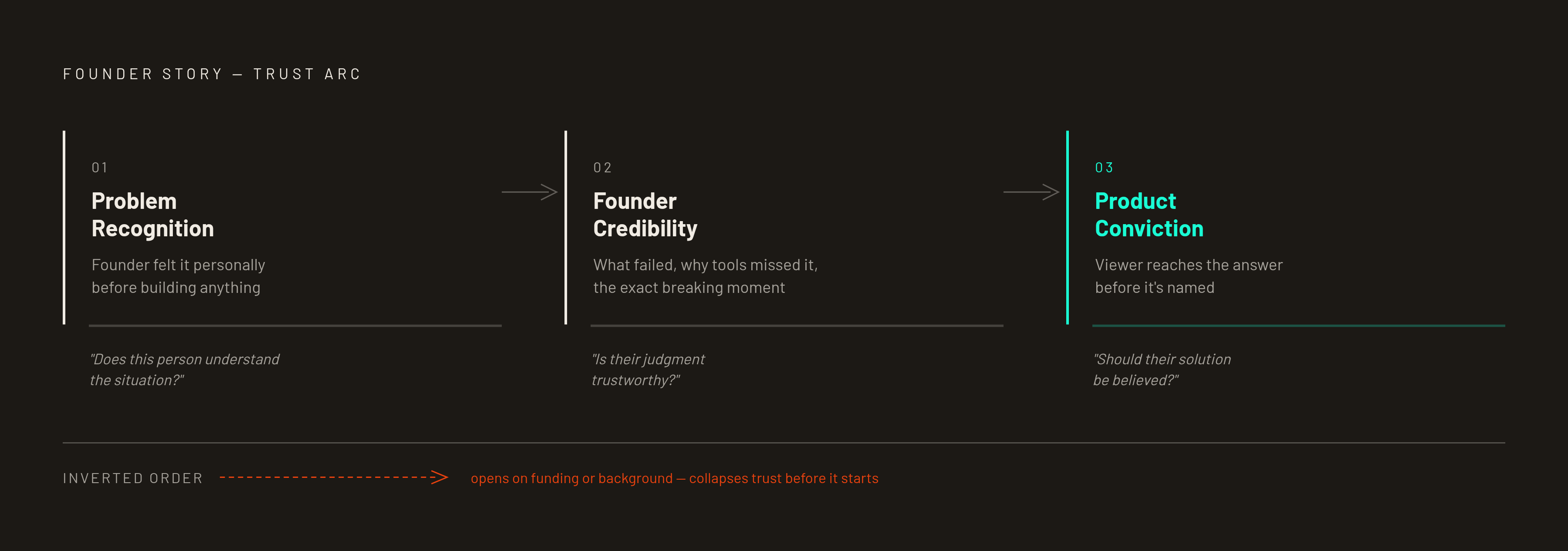
A founder story video works as a sales trust mechanism only when it follows a specific order: problem recognition first, founder credibility second, product conviction third. That sequence isn't a stylistic preference. It mirrors how a buyer's own thinking actually unfolds when they're deciding whether to trust a vendor. The buyer is silently asking three questions in order: does this person understand the situation, is their judgment trustworthy, and should their solution be believed. A video that opens with background or a funding announcement answers none of those questions and inverts the order the buyer needs.
Problem recognition has to come first because buyers trust founders who felt the problem personally before they ever built something to sell. That's why opening on company history or a pitch deck framing destroys the trust sequence before it starts. Founder credibility gets established through specificity, not credentials: what exactly failed, why the tools on the market didn't fix it, the precise moment the founder thought "this shouldn't be this hard." Specific detail is what makes a story believable. A vague account of frustration doesn't do the work.
Product conviction comes last, and it has to be earned. If the problem story is specific and honest, the product arrives as the logical answer to it, and the viewer reaches that conclusion on their own. A video that sells makes the product the logical answer; a video that only explains why something exists does not. The arc also does quiet work as an objection handler. A founder who addresses a common hesitation inside a real story is more persuasive than one who argues against it directly, because a story feels safe to listen to in a way an argument doesn't.
Four formats that apply the arc to different sales situations
The same arc produces four distinct video types, each suited to a different point in the sales cycle and a different trust barrier that needs to come down.
The Problem Recognition Story works for top-of-funnel buyers who don't yet know the founder or the company. It opens on the broken workflow, not the solution. Hassam's video is a working example of the format: it begins with a recurring issue in the market that personally frustrated him, shows why the existing tools on the market didn't solve it, and only arrives at the product once the problem has been fully established. What belongs in this video is the process that kept causing frustration, the reason existing tools failed, and the specific moment the founder realized the problem shouldn't be this hard to solve. Background, funding, and awards don't belong here. They pull focus away from the problem and onto the founder's resume.
The Mistake Story works for mid-funnel buyers who need to trust a founder's judgment under pressure. It openly discusses a decision that didn't go as planned. TK Kader's video is an example: it shares a go-to-market move that failed and the lessons that came out of it. At this stage, honesty beats polished positioning, because transparency builds trust faster than a perfect narrative does. A founder willing to be wrong in public reads as more trustworthy than one presenting an unbroken success story.
The "Why This Is Not for You" Story targets buyers actively comparing multiple vendors. It names, explicitly, which customers shouldn't buy the product. Rob Walling's video, "Don't Start a SaaS in 2026 Until You Watch This," is a live example of the format in action. It sounds like a risky move, telling part of the audience to walk away, but it builds trust fast because it proves the founder knows exactly where the product's limits sit. A buyer who self-selects out was never going to close. A buyer who self-selects in arrives pre-qualified.
The Objection Story serves late-stage buyers sitting on one specific hesitation. Instead of a feature list or an FAQ page, the founder addresses that single objection through a real narrative. Stories land because they feel safe to absorb, while arguments put a buyer on the defensive.
The POV on Market Shift Story builds category authority and top-of-funnel trust at scale. It shares the founder's read on how the landscape has changed and what that shift means for buyers. Dave Gerhardt's video on building a large B2B audience fits this type: it shares patterns observed from working closely with marketers rather than offering vague predictions about where the market is headed. It works because it positions the founder as a reliable interpreter of the category, not simply another vendor competing inside it.
Production choices that serve the format rather than undermine it
The right production level is whatever keeps a viewer focused on what the founder is actually saying. In practice that usually means less than a marketing team expects and more than a founder assumes is necessary. Audio quality is the real credibility floor, not visuals. Bad audio signals carelessness and costs trust immediately, while lighting and camera quality matter far less than most production teams assume.
Informal settings, an office, a break room, a home setup, reinforce the personal-channel framing that makes founder content structurally different from brand content. Cinematic production works against that framing. Vertical video and selfie-style framing carry a real distribution advantage: on LinkedIn, vertical formats show a 24% lift in click-through rates, so the aesthetic that most closely resembles founder-filmed content now performs better.
Enterprise buyers still expect polished, product-led video somewhere in the sales process. That's true, but it's a secondary concern. A founder story video builds the human trust that makes a buyer willing to sit through the demo.
The most efficient production model takes advantage of the crew already being on site. While filming the primary founder story, capture three to five additional short clips at minimal extra cost: social teasers, email headers, background footage for the website. That one shoot then funds a whole quarter of smaller content, multiplying the return on the time already spent.
Distributing a founder story video so it reaches buyers before sales does
A founder story video built on the right arc still fails if it only lives on the company's YouTube channel or website. It needs to travel through personal channels and third-party contexts to shed the "vendor claim" frame and start reading as something a buyer found.
The primary channel is the founder's personal LinkedIn, not the company page. The same video gets dramatically more reach and converts inbound interest at a far higher rate when it carries a founder's name. A repeatable cadence builds the audience that makes the longer story land when it eventually appears: short, consistent 30 or 60-second clips framed as "this week's thinking," posted regularly in informal settings. Third-party amplification matters just as much. A story told only on owned channels is still a vendor claim by definition. Once peers share it and communities discuss it, the frame shifts.
Sales teams should treat the video as part of the sequence, not a passive asset sitting on the website waiting to be found. It belongs in a proposal follow-up, a first outreach email, or as a trust signal sent ahead of a first meeting. Adam Robinson, CEO of Retention.com and RB2B, bootstrapped two B2B SaaS startups past $30 million in annual recurring revenue using LinkedIn as his primary channel for acquiring users, with founder story content as the core mechanism driving it. The distribution channel was as structural to that result as the content itself.
A newer distribution surface is forming around AI answer engines. A founder who publishes consistently under their own name builds a citable persona that AI assistants can surface when someone asks a category question, something a company page, with no name attached to it, simply cannot do.