Video Timeline for a SaaS Product Launch Campaign
Mapping video to each buyer stage—not launch day—turns a single asset into a conversion engine.
I've spent the last few years watching SaaS teams treat launch video like a single homework assignment: one asset, built in the final sprint, dropped on the homepage, and left alone. That habit costs more than most teams realize. Most B2B buyers do their homework long before they ever talk to a salesperson, and if video isn't already working during that window, it's absent for the part of the sale that matters most.
Here's the thing nobody tells you upfront: production quality is rarely the bottleneck. Sequencing is the real constraint, and it's the one teams overlook most often. I've watched teams pour six figures into one gorgeous explainer, drop it on launch day, and wonder why it didn't move pipeline. A single video can't build anticipation, arm a sales team, and onboard new users all at once. The buyer is a different person at each stage of a launch, so video needs a different job at each stage. Get that mapping right and everything downstream gets easier.
The three-phase structure that gives every video a clear job
Three phases, because the buyer isn't the same person in any of them. Pre-launch, they've never heard of you, and there's nothing yet to compare you against. At launch, they're comparing you against two or three other tabs open in their browser. Post-launch, they're either a new customer trying to get value fast, or a prospect still parked in your pipeline, waiting for a reason to move.
Pre-launch video has one job: curiosity and waitlist signups, nothing more. Launch video has to show clear daylight between you and the alternative, and cut friction to that first action, whether that's a trial, a demo call, a signup. Post-launch splits in two directions at once: keep the new users you just won, and keep working the ones still sitting on the fence.
I've sat in enough launch retros to notice a pattern: teams that map video to a real go-to-market plan hit their numbers more often than teams improvising week to week. The three-phase structure also functions as your production calendar. Miss that, and you'll find yourself trying to storyboard a hero video with two weeks left on the clock, which never ends well.
One thing gets lost here constantly, so let me say it directly: the goal is giving each video a specific person to talk to and a specific job to do, not simply producing more video. Volume without a job is just noise with better lighting, and I've seen plenty of noise dressed up as a content calendar.
Working backward from launch day: the production clock
Most teams underestimate this timeline until they're living inside it, usually around week six, panicking. A fully custom explainer from an agency typically runs several weeks depending on complexity and scope. Larger studios with more elaborate pipelines quote longer still. A freelancer working a tighter brief can turn one around faster, especially if the script's already locked.
Scope creep drives most delays, more than the animation work itself. Someone decides mid-production that the mascot needs a different color, or the CTA needs to change, and suddenly you've lost a week and a half. Lock the script and storyboard before anyone opens After Effects, because that alone saves 20 to 30% of total production time, with the higher end of that range kicking in when the internal review chain is long.
Launch prep overall runs 3 to 6 months. For a small team, plan on 4, not the breezy 3 you'll want to believe. Work backward from launch day: if that's week zero, your hero asset needs a finished creative brief in an agency's inbox well ahead of launch, accounting for the full production window plus internal review. Earlier if the product's complicated, earlier still if you're launching into a crowded category where everyone else already has slick video up.
AI tools have changed the math for everything downstream of that hero asset. They cut production time by half or more on the secondary layer, the social cuts, localized versions, A/B tests on different hooks. What's emerging as the sane approach is a hybrid: studio production for the hero video, where brand and complexity actually matter, AI tools for everything else. You end up shipping more video without diluting the one asset carrying the most weight.
On money, so you've got a real number to plan against: a professional 60 to 90 second custom animated explainer runs $5,000 to $15,000 right now. Wyzowl's 2024 survey landed the average one-minute animated explainer at $8,457, which tracks with what I've seen quoted directly. Early-stage teams working with an individual freelance specialist instead of a full agency often land a solid 60 to 90 second explainer for $3,000 to $6,000. And AI-native production has pulled median cost per finished minute down from around $4,200 to something closer to $2,500, which mostly matters for that high-volume secondary layer.
Pre-launch video: building an audience before the product ships
This window runs roughly 6 to 8 weeks out. Nothing here converts; everything here primes.
The teaser comes first: 15 to 30 seconds, built to get shared and drive waitlist signups. Show the problem, or better, the feeling of the problem, and never show the UI this early. It runs on paid social, organic social, the founder's LinkedIn, the early-interest email list. Resist explaining too much, since its only job is earning the right to be watched later, by the fuller explainer.
Then the homepage demo: 60 to 90 seconds, live on the landing page 4 to 6 weeks before launch, sitting right next to the signup form. Video compresses understanding in a way a wall of copy just can't match, and this is where that advantage actually gets spent. Script it from the buyer's pain outward, not from your feature list inward. Most people say they'd rather learn about a product through video, but that goodwill evaporates the second the video starts talking about itself instead of them.
If you're launching on Product Hunt, you need a third piece. Plan for it 30 days out, and treat the first six hours after your Tuesday-to-Thursday, 12:01 AM Pacific slot as the window that decides your ranking for the day. This one runs shorter than the homepage explainer, hitting the hook and outcome while skipping the full walkthrough.
Across all three: positioning and messaging need to be locked by weeks 4 through 6 of pre-launch, before anyone writes a single script line. Pick 2 or 3 features and stop there. A pre-launch video stuffed with capability loses the thread of why any of it matters right now, and that's exactly where generic explainers go to die. If your video could belong to any SaaS product in your category, it isn't doing its job yet.
Launch-day and launch-week video: converting attention into first action
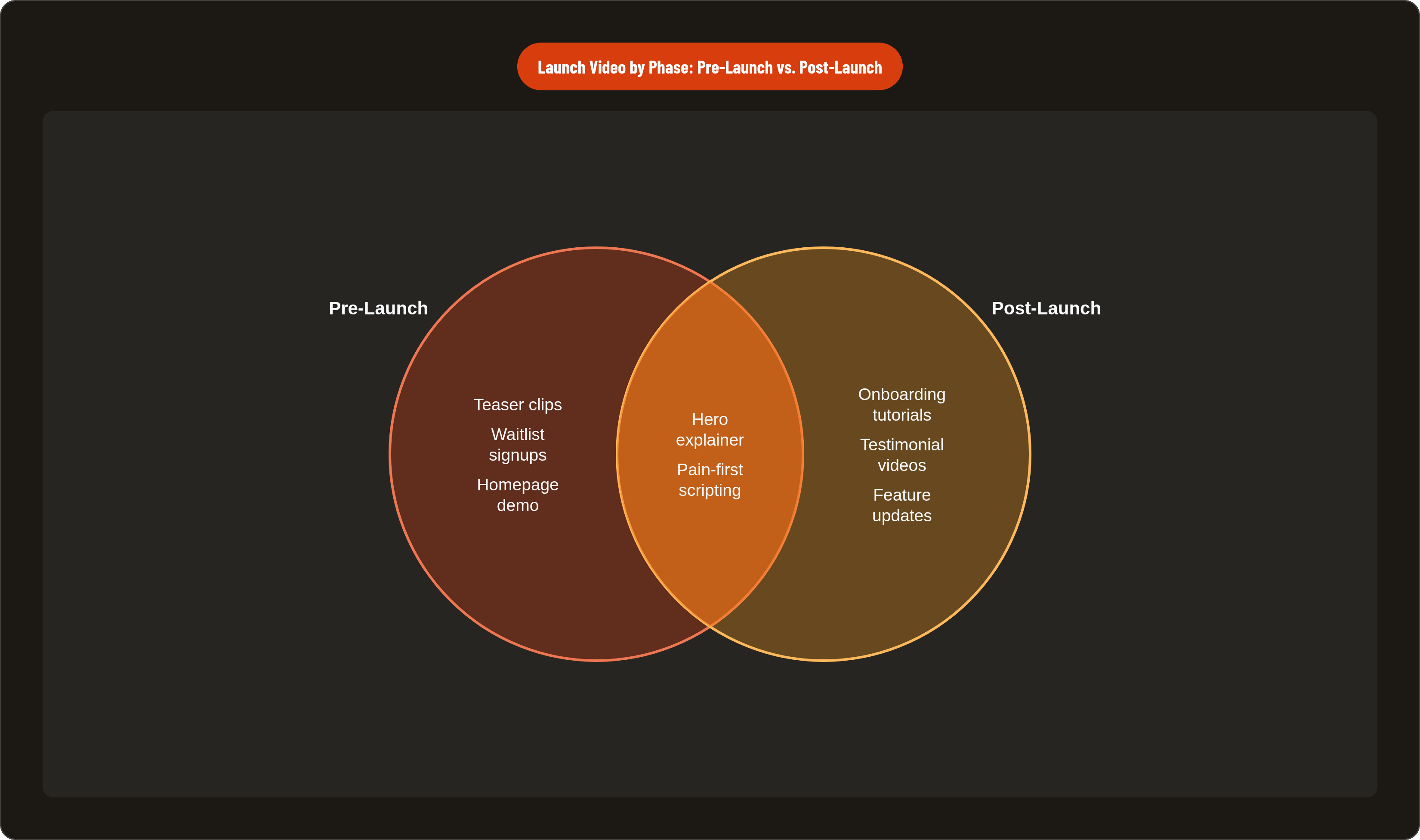
By launch day, the buyer already knows who you are. They want to watch the thing work, not be convinced the problem exists.
The hero explainer runs 90 seconds, lives on the product or pricing page and in outbound sequences, and gets watched more than anything else in the whole suite. I still build these on AIDA, unfashionable as that sounds: Attention in the first 8 seconds, hooking the real pain point directly. Interest, building the "what if this actually worked" case. Desire, the product resolving that pain on screen. Action, closing hard to a trial or a demo. Most B2B decision-makers would rather watch a demo than read a whitepaper, full stop, and this asset exists to meet them exactly where they already are. It works best when a founder or someone who actually built the thing is on camera. Overproduced brand films lose to plainer, knowledgeable people talking straight into the lens, because in B2B, trust closes more deals than cinematography ever will.
The product demo runs longer, 2 to 5 minutes, and shows real workflows inside real UI, the product operating inside something that looks like the buyer's actual Tuesday. This audience is past being convinced the problem is real; they're comparing solutions now. Studios built specifically for technical B2B products orient their demo scripts around that exact moment. Research from Advids found demo video shortened sales cycles from 33 days down to 27, which makes this as much a sales tool as a marketing one. It belongs in outbound sequences, on a "see it in action" page, and sent by account executives both before and after discovery calls.
Then five social hooks, 15 seconds each, pulled from the hero asset. Each one isolates a single pain point or outcome rather than just chopping the full video into smaller pieces. These run against cold paid audiences who haven't seen the explainer at all. Set up retargeting for anyone who watches past 50% of any clip in the sequence, since that's a real signal of intent, not a vanity metric.
Retargeting deserves its own line here, because too many teams skip it. Anyone who watched video and didn't convert on the first pass is the warmest audience sitting in your data right now. Follow them with the demo or a testimonial clip, because skipping that step means leaking most of the value the launch spend generated in the first place.
Post-launch video: keeping new users and converting the ones still watching
Two audiences, two different needs, and treating them the same wastes both.
New customers need to win fast, or they churn quiet and fast too. Adding clear, short tutorial videos to the onboarding flow has been shown to cut onboarding times by up to 40%, with a direct knock-on effect on activation. Task-specific clips embedded in the product or pushed through in-app notifications beat long walkthroughs every time, one video, one job, done. These don't need polish; a plain screen recording with clear narration is the right tool here, as long as it's accurate and matches the order the user actually moves through the product.
Prospects still on the fence need proof, not more explaining. Customer testimonials move trust in a way marketing copy can't fake, and the best window to film them is the first 4 to 6 weeks post-launch, while early adopters are still excited and can talk in specifics instead of platitudes. The format that works: 60 to 90 seconds, opening on a hard number, "we cut onboarding time by 40%," ahead of any soft language about how much someone loves the product.
Feature update videos keep the pipeline warm long after launch week fades from memory. Every release is a reason to re-engage; a short update clip lands faster than a release note, and gives a sales rep a legitimate excuse to reopen a conversation that's gone quiet. A cadence that holds up: refresh the core assets once or twice a year, produce new feature or education content monthly, push short clips weekly. Consistency beats volume, every time, no exceptions I've found.
Put it all together and you get a buyer who saw the teaser pre-launch, watched the demo at launch, and sees a testimonial three weeks later. That sequence, built deliberately by phase instead of by deadline, is the entire point of planning video this way.
Scripting each video so the right message lands at the right moment
The most common failure looks the same across every phase: the video opens on features instead of the buyer's actual problem. It's polished, it's well-lit, and the viewer never once thinks, that's my situation. Start with the pain, then the cost of doing nothing about it, then the product as the fix. That order rarely changes.
What changes is the specifics. The teaser names the pain and hints at relief, no product claims at all, pure emotional priming. The hero explainer names the pain precisely, shows 2 or 3 concrete ways the product resolves it, and closes to one action, not three. The demo skips convincing the viewer the problem is real, since they already know that; the question in their head is whether this fits their situation. The testimonial hands the mic over completely and lets the customer talk in their own words while the brand gets out of the way. The onboarding tutorial drops the marketing voice entirely: what to click, in what order, why it matters to the person's actual workday.
Feature prioritization follows the same rule everywhere: 2 or 3 features with the highest payoff per video, never a full tour of everything the product does. Most people say they'd rather learn through short video than any other format, but that preference disappears fast the second the video starts feeling like a commercial. Frame everything around the buyer's job, not your roadmap, and you stay on the right side of that line.
The trust signals that actually work in B2B: founders or the people who built the thing on camera, real UI instead of abstract motion graphics, named outcomes instead of vague category talk. Deep product knowledge produces something a generic production house can't fake, a script specific enough that the buyer recognizes their own Tuesday in it. That's the whole gap between a video that converts and one that gets closed politely three seconds in.
Choosing who makes the videos: in-house, agency, or a specialist
Not every video here deserves the same budget or the same process. Treat them all the same and the budget allocation stops making sense quickly.
Onboarding tutorials, feature updates, quick social clips: keep these in-house, since authenticity beats polish here almost every time. A plain screen recording with clear narration, shot fast by someone who actually knows the product, outperforms a slick outside production in this lane more often than not.
AI-assisted tools have earned their spot for social variants, localization, and testing different hooks against each other. Adoption is moving fast, too: the share of marketing teams using AI video tools grew from roughly 18% in 2025 to 34% in 2026, and that curve is still climbing, not leveling off.
That leaves the hero explainer and the demo video, the two assets doing the most work in the funnel, and that's exactly where paying an outside specialist or agency earns its fee. Complexity, brand fidelity, a script that needs real product depth behind it, that's worth the invoice. Everything else in the suite is worth building fast, building often, and building without waiting around for a production calendar that was never designed to move at this speed anyway.