Comparing NYC Video Agencies to Remote-First Video Vendors
A guide to deciding between high-cost local crews and remote vendors for video production.

Video is now operational infrastructure for most businesses, and the vendor decision, whether to hire an NYC agency or a remote-first vendor, is one buyers make repeatedly, not once. Getting that decision right requires understanding a handful of concrete trade-offs. This piece maps them.
Wyzowl data shows 91% of businesses use video as a marketing tool, with 76% producing at least one video per month. Wistia's numbers show 87% of marketers say video has directly increased sales. These aren't vanity metrics for a creative department; they're commercial stakes. The vendor you choose shapes your output volume, your budget burn rate, and how well your message lands.
Neither model, local agency or remote vendor, is inherently superior. The right call depends on your project type, team structure, and budget ceiling.
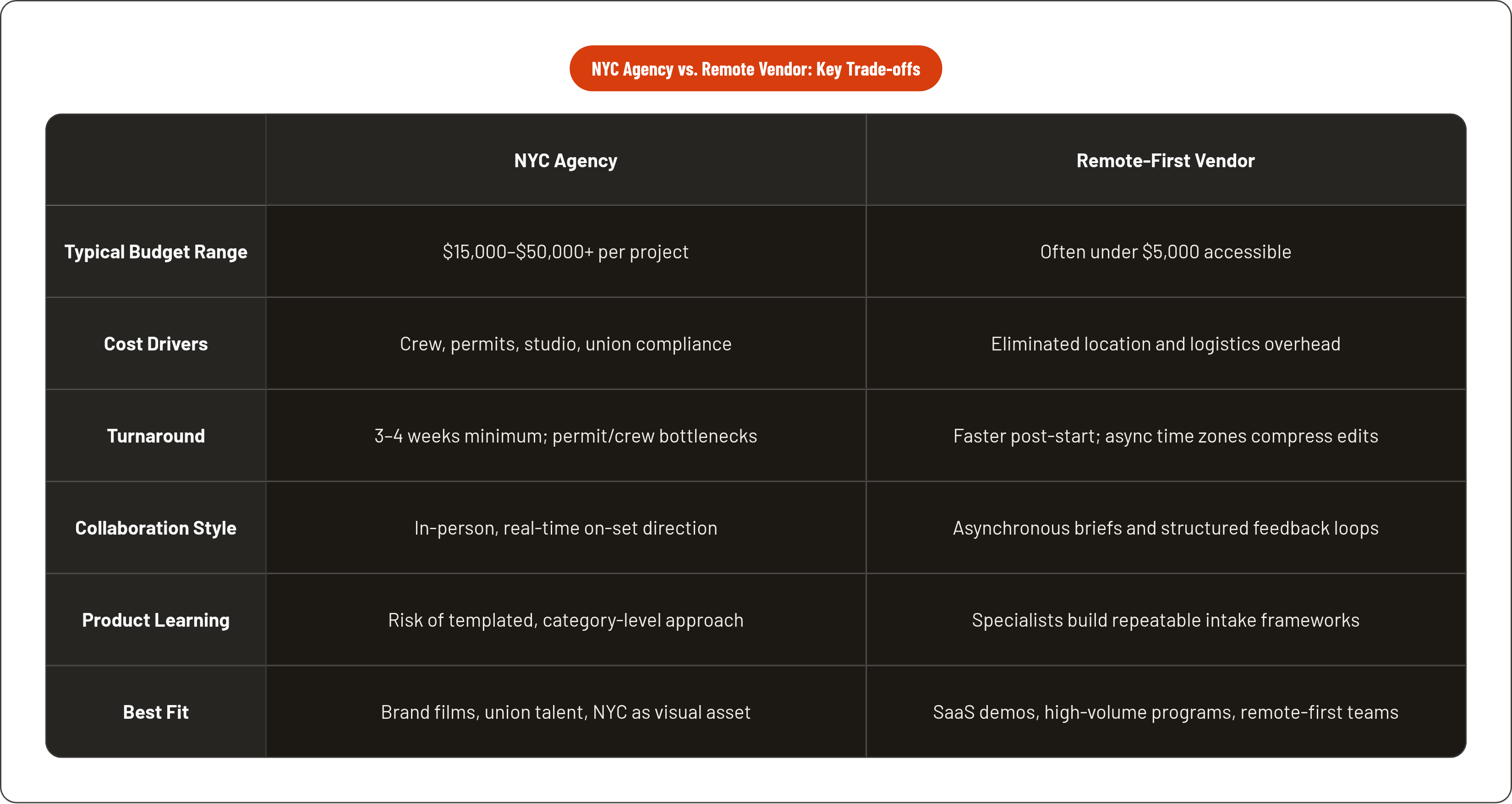
What Each Model Actually Looks Like in Practice
An NYC agency is a full-service operation with physical infrastructure: in-house directors, on-site production crews, studio access, permit relationships, and pipelines into union talent. When you hire one, you're buying into an ecosystem built around the city's media industry.
A remote-first vendor operates differently by design. The team is distributed, collaborating through cloud-based tools. Depending on the scope, they might ship a kit to your office, direct a shoot over video call, or work entirely in post-production from footage you supply. "Remote" describes the operating model, not the team size or the caliber of output.
A third model is worth naming: the hybrid approach. Some NYC agencies now run editing teams in other cities or time zones to accelerate turnaround. johnnypuetz Productions, for example, crews shoots in New York while running its editing operation in Berlin. The physical and digital halves of production run in parallel rather than sequentially.
Remote-first vendors range from solo specialists to structured teams with dedicated project managers, strategists, and editors. For SaaS and B2B buyers, there's a category of specialists worth knowing specifically: vendors built around deep product knowledge, operating asynchronously with founders and marketing teams regardless of geography. Some of these vendors are designed explicitly for SaaS companies, with a brief process engineered to surface what makes a product distinct before scripting begins. The vendor's ability to learn your product often matters more than where they're located.
Where NYC Agency Costs Come From and What Buyers Actually Pay
NYC rates are a direct function of the city's labor market. A Director of Photography bills $800 to $1,500 per day. Sound technicians run $400 to $800 daily. Production assistants cost $150 to $300 per day. Crew fees per member per day typically land between $500 and $1,200, and professional NYC scriptwriters charge $500 to $3,000 depending on complexity and experience.
Equipment is its own line item. RED camera rentals run $800 to $2,500 daily. Lighting packages add $500 to $1,500 per day. Sound stages cost $1,500 to $5,000 or more per day. A basic one-day shoot in New York commonly lands well into the five-figure range before post-production begins.
Permitting surprises most buyers. Street permits run $500 to $2,000 or more. A rooftop shoot can require $1,000 to $5,000 in permit fees alone. General production permits and insurance add $300 to $3,000 depending on complexity. These aren't edge cases; they're standard line items on a mid-range NYC production.
At the project level: a mid-range corporate video averages $15,000 to $30,000. Brand films or multi-day productions run $20,000 to $50,000 and up. Hidden costs that compound include travel time between Manhattan locations, tri-state logistics, union compliance requirements, and competition for studio space during high-demand periods.
What the premium buys is real: access to SAG-AFTRA performers, iconic location backdrops, and production infrastructure that's genuinely hard to replicate outside a major media hub. That's the value proposition, and for the right project, it's a legitimate one.
How Remote-First Vendors Price Differently and Where the Savings Come From
The cost gap between NYC agencies and remote vendors is structural, not incidental. Remote vendors eliminate travel, location fees, studio rental, and large on-site crews. These aren't efficiencies; they're entire cost categories that simply don't exist in the model.
MultiVision Digital has documented remote crews saving buyers substantially compared to equivalent in-person production. Those savings compound on projects requiring multiple shoot days or locations, where travel and logistics costs multiply with each additional day.
Pricing models also diverge. Traditional agencies quote per project after a discovery session. Remote-first vendors have pioneered flat-rate and subscription structures, some offering retainer-style editing plans. For teams producing video consistently month over month, the subscription model provides cost predictability that per-project pricing doesn't.
Wistia's data shows 40% of companies spent under $5,000 on video production in 2025. That budget range is largely inaccessible through a full-service NYC agency but achievable with a remote specialist. AI tooling is accelerating this further: adoption of AI-assisted editing rose sharply from 2024 to 2025, and vendors integrating these tools pass some of the time savings to clients in the form of faster turnaround and lower revision costs.
One caveat: lower cost doesn't mean unlimited scope. Remote vendors have real constraints on what they can produce without physical crews. Buyers should understand those constraints clearly before signing.
Turnaround Time and What Actually Drives It in Each Model
The common assumption is that a local agency is faster because you can walk in, and a remote vendor is slower because of coordination overhead. In practice, this is often reversed.
Filmless, one of NYC's faster agencies and a shop built explicitly around speed, promises promo videos within an average of three to four weeks. Traditional full-service agencies run longer. The bottlenecks are structural: permit approval timelines, crew scheduling across union and non-union talent, studio availability, and the logistics of multi-location shoots across the tri-state area.
Remote vendors compress the timeline differently. Cloud-based file transfer eliminates the physical handoff bottleneck. Post-production can begin the same day footage is captured. Distributed teams working across time zones can compress the edit cycle in ways a single-location shop cannot.
The hybrid model takes this further. When a New York crew is filming while an edit team in another time zone is already working on earlier footage, the overall production clock shrinks substantially. johnnypuetz Productions illustrates this model in practice.
For SaaS buyers with a specific launch date or campaign deadline, the honest question isn't "who's faster by default." It's "what's in the critical path for this specific project." A product demo video with no location requirements has a completely different critical path than a brand film requiring a permit, a sound stage, and union talent.
How Collaboration Style Differs and What It Costs in Time and Energy
In-person collaboration with an NYC agency is useful for stakeholders who think through creative problems by talking in a room. Pre-production alignment happens faster when everyone is physically present, and on-set real-time direction gives clients direct creative control during the shoot itself.
Remote collaboration requires more deliberate communication infrastructure upfront: written briefs, asynchronous feedback loops, and precise creative documentation before production begins. That upfront investment sounds like overhead. In practice, it often reduces total time spent, because teams that write precise briefs get fewer revision cycles, not more.
The process maturity for remote production has caught up with the ambition. Haivision's Broadcast Transformation Report found that a large share of broadcast organizations named enabling remote production as their top organizational priority in 2025. The tooling and workflows are there.
For scrappy SaaS teams without a dedicated video producer, a remote vendor who runs the project process on their behalf, providing brief templates, review tools, and structured feedback stages, can actually reduce the buyer's time burden compared to managing a full NYC crew on-site.
What breaks down in poorly run remote engagements is worth naming plainly: vague creative direction, slow feedback loops, and stakeholders who treat asynchronous review as though it were synchronous. These are process failures, not failures of the model itself.
How Well a Vendor Can Learn Your Product, and Why This Matters Most for SaaS
For most B2B software companies, production quality is not the limiting factor in video performance. The limiting factor is whether the video accurately reflects what makes the product different from its category peers.
Generic explainer videos, polished and well-produced but product-agnostic, don't convert. They don't convert because they could be for any competitor in the space. The video has to carry a specific argument about a specific product. That argument can only come from someone who did the learning work before scripting began.
NYC agencies with large, diverse client rosters often apply templated creative approaches across industries. This is efficient for the agency. For a SaaS product where differentiation is the entire commercial point, it's a genuine risk.
Remote-first specialists who focus on a single vertical build repeatable product-learning processes over time. They've developed intake frameworks for understanding positioning, ideal customer profiles, and objection handling before a script is drafted. The brief process for vendors built around this approach is designed to extract what makes the product distinct, rather than defaulting to category-level messaging that smooths over the specifics.
HubSpot data shows 55% of marketers produce video in-house. Those who outsource are often doing so precisely because they want someone outside the building to distill the message. That outside perspective is only valuable if the vendor does the learning work. To test whether a vendor will: ask how they learn a product before writing a script, who writes the script and whether they have B2B experience, and whether they can show you a video where the differentiator is specific rather than generic.
Project Types That Genuinely Favor an NYC Agency
High-production brand films where New York is part of the visual identity belong here. The city as backdrop is a legitimate creative asset when the brand warrants it, not merely a cost center.
Projects requiring union talent, SAG-AFTRA performers and broadcast-tier crew, favor an NYC agency when the performer tier is non-negotiable and the budget supports the full infrastructure. Multi-stakeholder productions where live on-set decision-making is essential also fit this model: executive interviews filmed in controlled environments, live events, and activations where the client needs to be physically present and making real-time creative calls.
Companies already based in New York with internal teams capable of managing production logistics are better positioned to absorb the coordination costs of local agency work. The friction that hits out-of-market buyers is meaningfully reduced when the client and vendor share the same geography. Campaign shoots with complex location requirements also favor an agency with existing permit relationships; those relationships save real time on approval timelines.
Project Types That Favor a Remote-First Vendor
SaaS explainer and product demo videos are the clearest case. Screen recording, motion graphics, and voiceover work are entirely location-agnostic. Physical crews add cost without adding value to this format.
High-volume content programs, teams producing multiple videos per month, benefit from the flat-rate and subscription models remote vendors have built. An NYC agency's per-project pricing doesn't scale to this cadence without the budget expanding proportionally.
Companies outside New York, or outside the United States, who would otherwise pay travel and coordination overhead on top of an already premium rate structure, get a more direct value exchange with a remote vendor. Early-stage SaaS teams with sub-$15,000 budgets face a structural mismatch with full-service NYC production, where a single shoot day can consume the entire budget before post-production begins.
Remote vendors also fit naturally when buyers already have internal footage, screen captures, or product walkthroughs and need someone to shape that raw material into a finished asset. And for teams where the CMO or founder is the subject-matter expert and the primary bottleneck, remote workflows built around asynchronous review let them contribute on their own schedule rather than a shoot-day schedule dictated by crew availability.
What to Check Before Hiring Either Type of Vendor
Portfolio fit comes first. Does their reel include work for products with similar complexity to yours, or is it weighted toward consumer brands and simple narratives? A B2B software product requires a different kind of creative muscle than a lifestyle brand.
Script ownership and process is the next question. Who writes the script, how many revision rounds are included, and what is the process for learning your product before a word is written? This question separates vendors who have a real intake methodology from those who start writing from general category knowledge.
Revision structure is where budget surprises most often occur. Get clarity on how many rounds are included, in what format, and what additional rounds cost. This applies equally to NYC agencies and remote vendors.
Ask for the actual production schedule with milestones, not just a delivery date. The schedule reveals where the risks are. A delivery date alone tells you nothing about where the project could stall.
Get a full pricing breakdown, including any location, permit, travel, or licensing costs not reflected in the quoted rate. NYC agencies in particular have line items that surface late in the process if the buyer doesn't ask for them early.
References should come from comparable clients. A B2B SaaS buyer should talk to another B2B SaaS buyer who used the vendor, not a nonprofit or a retail brand. The production challenges and content requirements are different enough that the reference only informs the decision if the contexts match.
For remote vendors specifically: ask how they handle communication across time zones, what tools they use for review and approval, and whether they've managed remote-first client teams before.
The question that cuts through most of the evaluation is simpler than all of these: can they explain your product's specific value proposition back to you, in plain language, before the script exists? If the answer is no, the video won't be able to do it either.